In a public Discord message, Liana Kerzner stated:
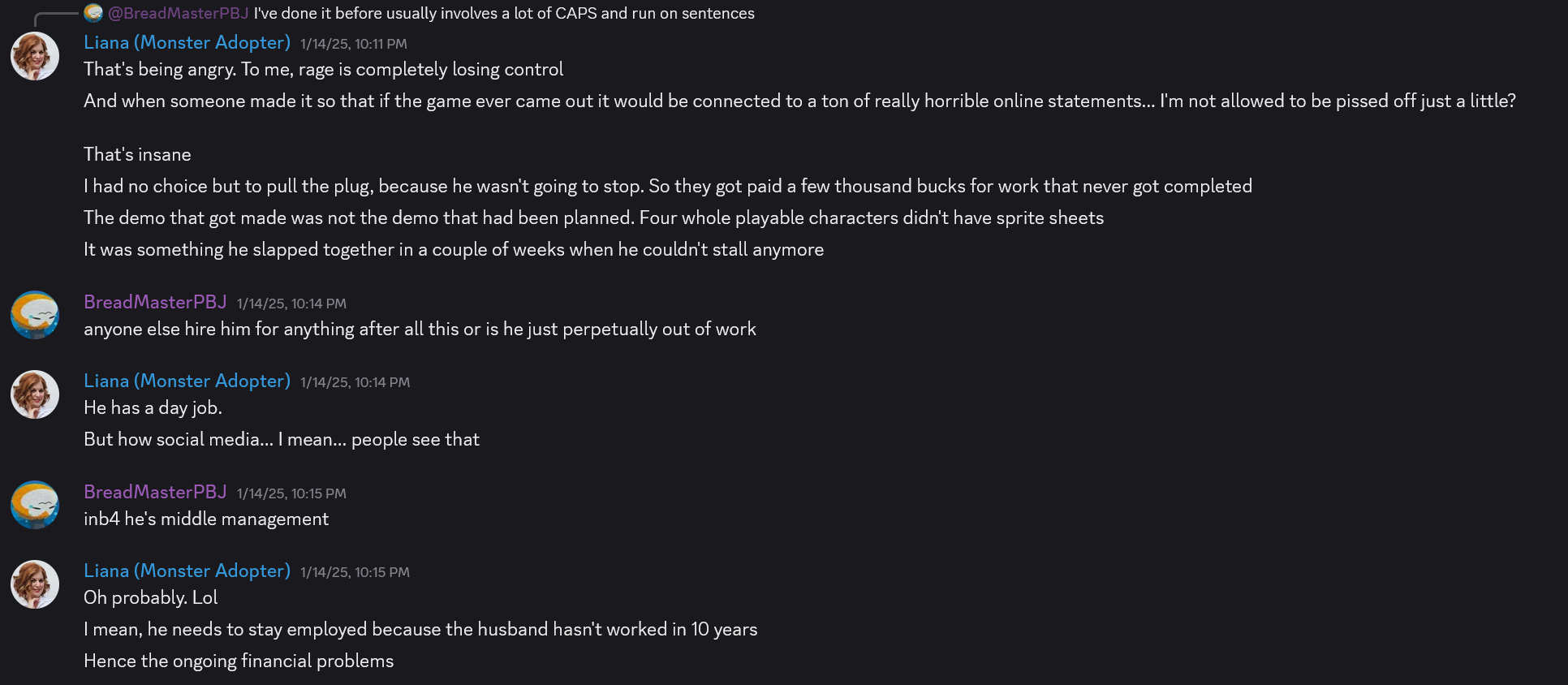
This statement — framed in a context of narrative ambiguity and blame — is incomplete and misleading when measured against the contemporaneous financial records and project documentation. Kerzner’s message appears to equate total project payouts with work that was, in her view, unfulfilled, while overlooking key facts about project responsibilities, deliverables, and documented spending.
According to PayPal transaction records spanning the entirety of the Kickstarter campaign through project cancellation, the amounts I received from Kerzner for Song of Sparklemuffin are:
$1,868.00 — Payment for work on the project
This was reported on my tax filings and is documented in project financials.
My responsibilities included:
These project costs are independently documented:
-$179.00 — One‑year marketing/commerce domain package through GoDaddy (promotional)
-$378.00 — Total spent on paid plugins for visual and combat systems (Image 3)
-$299.88 — Renewal cost of that service in 2024 (not renewed subsequently)
This service was renewed the next year for the regular cost of $299.88.
When renewal for that service came around in 2024, we decided not to
renew as itch.io allowed us to send out updates to backers by
incorporating the Kickstarter backer emails.


These expenditures are spent specifically on services and tools for the development, not funds “burned” without purpose. None of these purchased plugins were used in subsequent personal projects without repurchase.
After our Open Call looking for voice actors for the demo, Liana had
selected several potential voice actors for the vertical slice demo. We
had slotted several candidates for characters during the December 2021
listening session. Among the voices that were selected were actors for
Ruchel, Tomoe, Ayaan, Isibindi, Armand, but Kerzner wasn't satisfied
with the candidates for Maus. She was looking for a vocal quality and
affect that didn't sound like Antonio Banderas' take on Puss n' Boots.
She wasn't fully satisfied with the actors who auditioned for the role.

Towards February, she decided that I would be better suited to voice Maus, despite my reticence. Although I am extremely confident in my singing voice, I don't consider my speaking voice good material for voice-acting. Nevertheless, she thought I'd be the most suitable choice to voice the character. I did several takes on the existing lines from the script and Kerzner decided that I would henceforth be the voice actor for Maus.
$300.00 — Advanced on October 8, 2022 for voice recording sessions intended for the vertical slice demo (Image 4).
Recording sessions did not occur because Kerzner never completed either demo script. Sample recordings were provided; feedback from Kerzner was received, but official sessions never took place as the vertical slice demo script was never finished by her.
On October 8th, 2022, Liana Kerzner advanced $300 to me for the upcoming voice-over recordings for the character. Voice acting would only be present in the vertical slice demo, however, not the combat demo. Recording sessions would take place when the vertical slice demo was nearing completion and would have Kerzner providing live input and direction in a similar fashion to the recording sessions done for Hank's Inferno, a game in which Kerzner was a consultant but which did not reach completion.
Kerzner’s framing — “a few thousand bucks for work that never got completed” — fails to acknowledge:
1.Both demo scripts (combat and vertical slice) were left unfinished by Kerzner, as shown in project documentation (video and file exhibits appended).
2.Deliverables tied to funds paid to me were completed or meaningfully advanced (engine work, sprites, effects, systems).
3.Plugin, domain, and service costs directly supported development infrastructure and were not excessive for an indie game.
The statement becomes especially misleading when the only funds paid to me were not “a few thousand” for no output, but rather were tied to clearly documented work.
Outside of the official project work and the one unrelated commission I mentioned earlier, Kerzner also provided personal financial help on occasions when I was experiencing genuine hardship. As I’ve noted, my company never fully recovered from the effects of the pandemic. Compensation lagged significantly behind industry norms, but I stayed on due to the uniquely supportive and healthy company culture — a rarity in the field. It may have been unwise not to seek better-paying alternatives, but the absence of toxicity made it difficult to leave. I remained loyal, hoping the situation would eventually improve.
Complicating things further, my husband Asher lives with a disability — which Kerzner, a self-styled mental health advocate, later mocked in her Discord channel (as documented in the video I released). These pressures sometimes pushed us into tight corners financially. During those moments, Kerzner stepped in to help, drawing on her own funds and offering support as a friend.
This was typical of our dynamic — we had frequent conversations where we both confided in each other. Kerzner often shared with me her own frustrations about financial difficulties, especially those stemming from her husband’s choices in both business and their personal lives, and his mental health. She frequently cited these factors as causes for delays on her end of the project. All of this reflected a close friendship spanning more than five years.
The total amount Kerzner gave me as personal support is accounted for in my PayPal records and is not relevant to the project backers — except in one key way: when I published a video that exposed only a fraction of Kerzner’s misrepresentations and contradictions, supported by hard evidence, her response was not to refute it but to escalate. She went straight to Twitter.
Instead of responding directly to the specific inconsistencies and inaccuracies I documented — which, at the time, were already significant but limited in scope compared to the evidentiary body presented here — Liana Kerzner chose a very different public response. Rather than addressing those points with evidence or correction, she posted a sequence of tweets in early October that disclosed very personal and intimate information about me, my husband Asher, our marriage, our financial situation, and aspects of my husband’s mental health, many of them distorted, exaggerated, or portrayed in the most negative light possible. All of these have been archived and will be presented later in this article.
The tone and content of those disclosures were, by any measure, harsh and deeply personal. The disclosures included material that was completely unrelated to the specific issues I raised, and were shared publicly on Twitter rather than in response to the documented claims themselves. This shift in focus — from addressing verifiable contradictions in public statements to sharing private information — had the effect of reframing the public conversation away from the documented evidence and toward personal matters that bore little relevance to the project.
When evidence is challenged with factual documentation — screenshots, timelines, and verifiable records — it would have been straightforward for Kerzner to rebut individual points. Instead, the response centered on personal history and private details that were not at issue in the documented claims themselves.
That public disclosure had multiple effects:
1. It drew attention away from the documented contradictions in Kerzner’s public statements by focusing public attention on personal aspects of our lives rather than the project’s factual record.
2. It exposed information about my husband’s disability and mental health, and our private lives — information that was shared without context and without our consent, and which effectively leveraged mental health stigma in a public forum.
3. It framed financial support she had provided in a transactional way, emphasizing the amounts she had given and the circumstances under which she offered help, without acknowledging the broader context of our friendship or the personal nature of those interactions.
This public framing positioned Kerzner as a benefactress keeping score, and implicitly cast our relationship as one that was one‑way and unequal — despite the mutually supportive aspects we shared over more than five years of friendship. Rather than addressing the specific factual concerns I raised, the public disclosures turned the narrative toward what Kerzner described as her own generosity, and away from the documented inaccuracies in her earlier statements about the development process.
It’s also notable that the public disclosures referenced aspects of my personal life — including my husband’s disability and our domestic experiences — neither of which were germane to the claims under discussion. As his spouse, it is within my right to contextualize and describe our lived experience where it intersects with how our conduct has been publicly represented. But it was not necessary to the central issues at hand, and it shifted the public conversation to personal circumstances rather than the factual record of the project.
In several of these posts, Kerzner also addressed or invoked personal values, lifestyle choices, and normative standards in ways that — when juxtaposed with her self‑described identity as “quirky” or unconventional — appeared to draw attention to aspects of our personal lives rather than to the documented evidence. At times the comments were framed in a way that seemed intended to invite criticism of our lifestyle or family context rather than to engage with the facts of the project timeline, communication history, or deliverable status.
One of the more persistent themes in these disclosures was an emphasis on how much she had purportedly helped us financially, as if to imply that assistance we received should have obligated us to refrain from public critique. That implication — that personal support should restrict our ability to correct the public record — stands in tension with principles of open discussion and accountability.
It is also worth noting that Kerzner’s public framing in these disclosures appeared to leverage social stigma — in particular around mental health — in a manner that had the effect of diminishing the credibility of any critique my husband or I might offer. Whether intentional or not, framing an individual’s mental health status in public discourse in relation to credibility can have a chilling effect on that individual’s willingness or ability to speak publicly about matters of professional or public concern.
We do not assert that every personal or private detail shared was disclosed with the intent to harm, but the effect of these disclosures in the public sphere was to redirect attention away from the documented discrepancies in Kerzner’s statements and toward personal narratives that had little to do with the factual matters at issue. This redirection — and the emphasis on personal history, financial support, and private medical context rather than project records — functioned as a kind of narrative shift that obscured the underlying evidence rather than confronting it.
In summary, the public disclosures following my initial corrective video did the following:
1. Shifted the focus away from specific, documented contradictions toward personal, private information.
2. Framed personal support as transactional, implying that assistance should limit or silence critique.
3. Brought personal aspects of our lives into the public sphere in a way that was not necessary to address the underlying factual disputes.
4. Leveraged social narratives around mental health and lifestyle that were peripheral to the core issues.
Later sections of this article will analyze these dynamics in greater depth, including their broader implications for public discourse, narrative control, and reputational impact.
One of the most telling elements of Kerzner’s response in early October was her deliberate emphasis on the financial assistance she had provided to us during times of difficulty. Her tweets repeatedly framed this support in terms that suggested a ledger of obligations — portraying herself as a financial benefactor and implying that our continued well-being was dependent solely on her generosity. The subtext was unmistakable: that our relationship was unequal, and that we had offered little or nothing in return.
This portrayal was deeply dissonant with the nature of our friendship as I understood it. Over more than five years of close connection, we exchanged support — emotional, creative, and practical — in ways that I considered mutual. Yet Kerzner’s public framing reduced those years to a transactional account, and one in which she alone extended value.
Such a framing calls into question the spirit in which that support was offered. When someone emphasizes the help they gave only after a disagreement — and only when that disagreement threatens their public narrative — it inevitably raises the question of whether that support was ever freely given, or whether it came with strings attached.
And crucially: did Kerzner not benefit from our friendship, creativity, or labor? Was the relationship truly one-sided, as her later comments suggest?
In fact, I contributed meaningfully — and without compensation — to several of Kerzner’s creative projects. As a composer and audio engineer, I created the musical pastiche that concluded the final episode of BOSSFIGHT, a production which she presented as the capstone of that series. I also edited voice tracks for the episode to improve overall quality.
Beyond that, I lent my editing skills to parodic content for her YouTube channel, including The Player, a project she promoted publicly. I arranged and produced five of the Chiptune Cabaret songs featured in the promotional campaign for the Song of Sparklemuffin Kickstarter: “Sierra Staircase,” “When You Play Skyrim,” “Up A B,” “Sight of Pixels,” and the campaign finale “Come and Back Our Game.” These were publicly shared to promote the project and directly supported the Kickstarter’s engagement.
These contributions were not made with any expectation of repayment or public recognition. They were offered in the same spirit in which I believed Kerzner’s support to be offered: as part of a mutual friendship and creative collaboration. Yet in retrospect, her comments suggest that such mutuality was not part of how she viewed the relationship. In choosing to recast our history through the lens of a one-sided ledger, Kerzner erased the labor, time, and trust that I had contributed in good faith — work that materially benefited her projects and public presence.
I also contributed unpaid labor—approximately $1,000 worth of character design—to a proposed visual novel project titled XY Girls. The project was authored by a friend of Liana Kerzner’s. The work was done freely, as a favor. The project never moved forward, reportedly due to complications with securing grant funding. Jess, who would later contribute to Song of Sparklemuffin, also offered unpaid level design support to XY Girls.


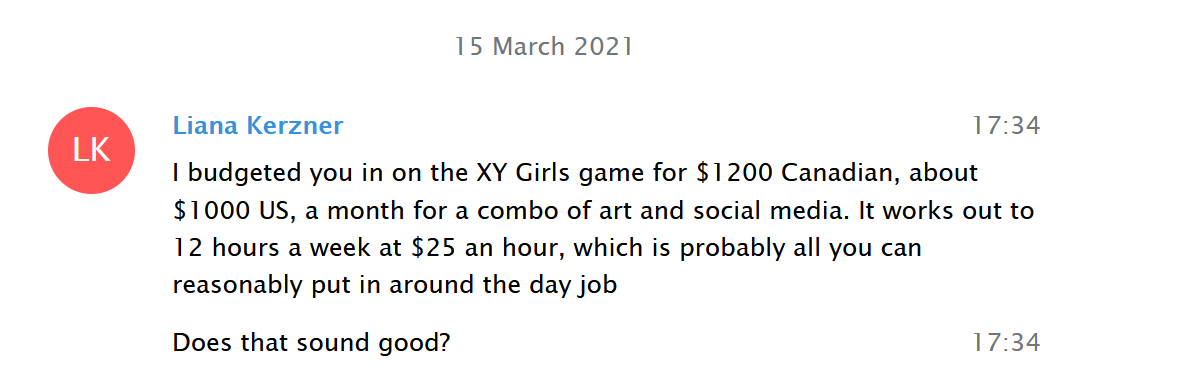
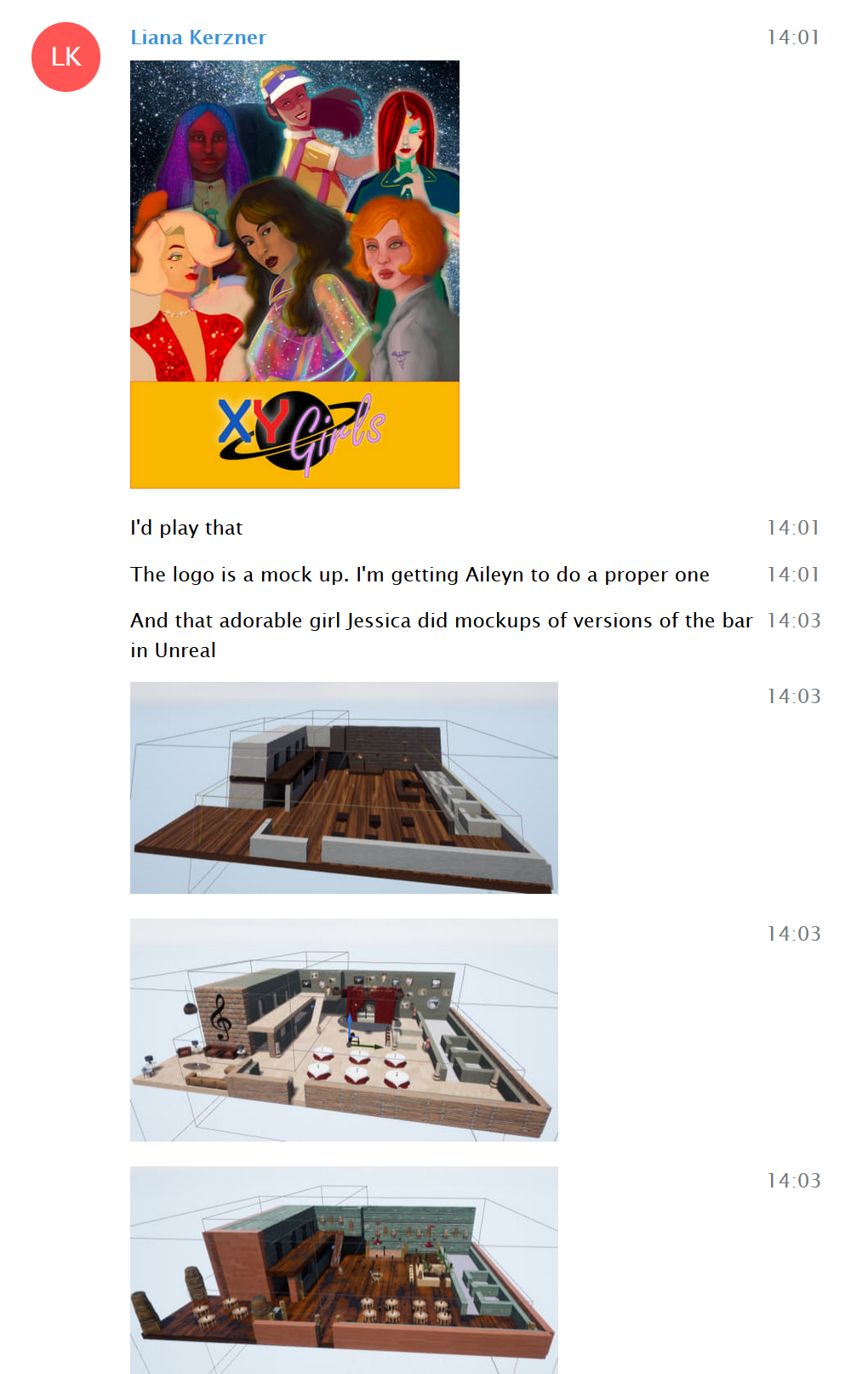
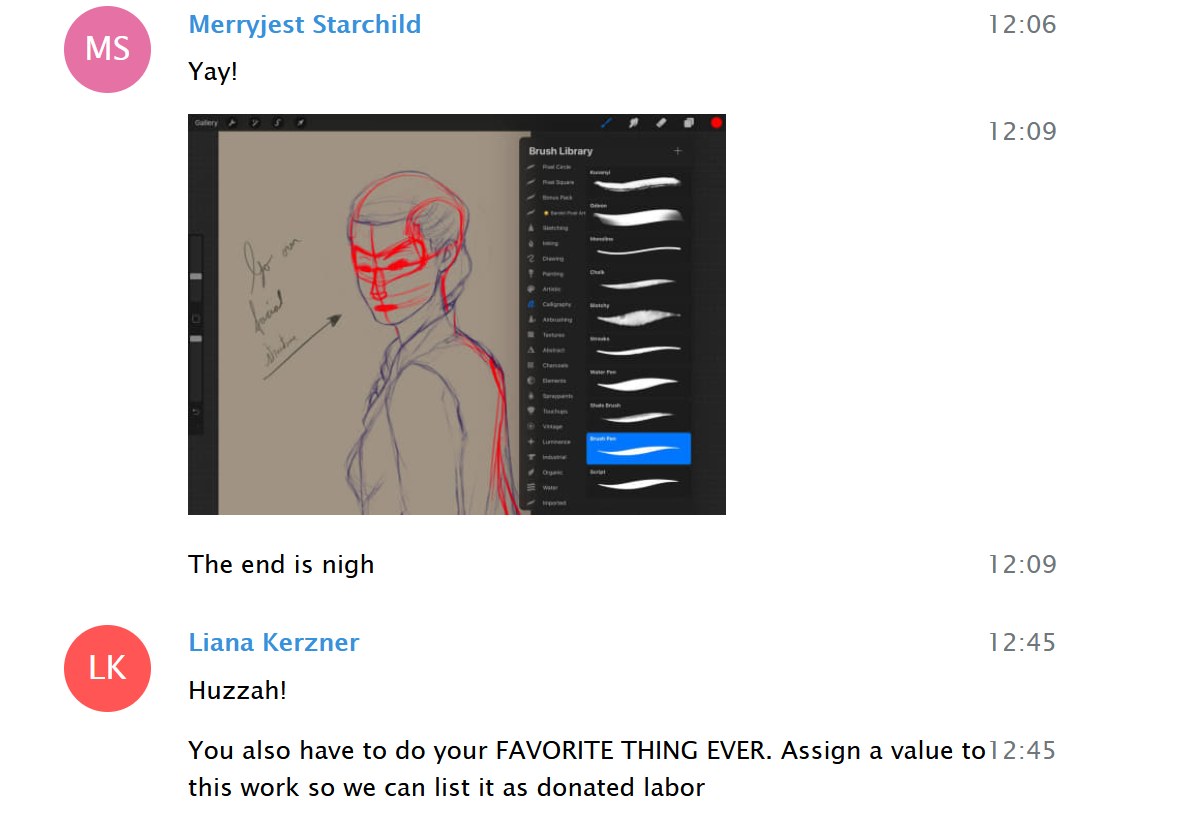

Jess, as you may have gathered from those screenshots, joined Song of Sparklemuffin after having contributed free level design work for XY Girls.
The game never got off the ground because, as I understand it, issues
with the grant applications that would have secured funding for the
endeavor.
Separately, I also created artwork at Kerzner’s request for The Best of Both Worlds, a published story collection by Derwin Mak. My digital painting, signed with my usual "Merryjest" signature, was used as a bookmark in the release copies. Like the XY Girls work, this was done in the spirit of friendship and collaboration, not compensation.


These examples matter in light of recent public implications by Kerzner that our relationship was largely one-sided, with her offering support and us offering little in return. I raise them not to claim credit but to provide balance—particularly as this narrative has been reframed in ways that, in my view, obscure the mutual nature of our past contributions.
Kerzner has implied that we are indebted to her generosity and that any criticism on our part constitutes betrayal. But our objections stem from how we have been portrayed—publicly and repeatedly—in ways that diverge significantly from the documented facts. Raising concern over being misrepresented is not a violation of friendship; it is a request for fairness.
Furthermore my contributions — both creative and relational — were part of a friendship that I believed was rooted in mutual support. But her post hoc recharacterization raises broader questions about the authenticity of that dynamic, and whether the support she gave was ever truly disconnected from expectations of silence, loyalty, or deference. This pattern — of emphasizing generosity only when challenged — will be examined again in later sections. For now, it’s worth remembering: a gift that must be paid for retroactively was never really a gift at all.
In the video Gaming's Integrity Problem, Kerzner shared sentiments that underscore a desire for openness with backers, stating:
"I have found over time the right people, the people who actually spend money on things, prefer it when you communicate, when you let them know what's going on, as opposed to trying to razzle-dazzle, you know."
This is a fair and reasonable standard. But the question arises: Has it been applied consistently?
Elsewhere, she referenced the difficulty of withholding information:
"Intellectual property, secret stuff like that, yeah, for sure, but no one should be gagged from talking about a professional experience because it's just seen as improper or somehow people have to believe that you're coming at them straight. And it just got to the point for me that I was uncomfortable with how little I was saying about things. I had to be cryptic. And, you know, then it came to the point where I had to do some disclosure because of the way things went down. And, of course, a bunch of people got mad at me, but that's the thing about integrity. People will get angry at you for having it."
Around the same period, she also shared and endorsed posts suggesting that “abusers’ secrets” should not be protected. These messages were framed in ways that indirectly implicated us—even if not named

Later, on January 13th, 2025, she posted:
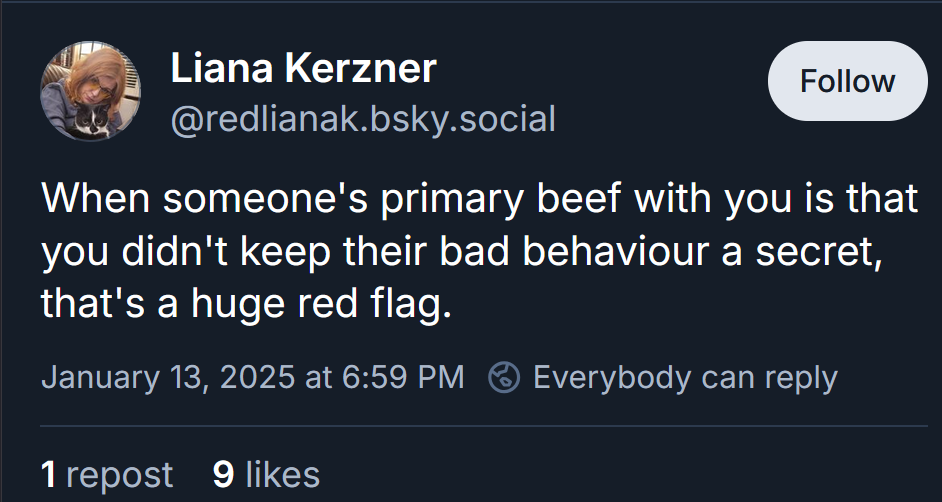
This does not reflect our actual position. Our core concern has not been about private grievances being aired, but about inaccuracies and misleading portrayals—statements that cast us in roles we do not recognize and do not accept.

On January 13, 2025, I publicly responded to Kerzner directly for the first time since the project's cancellation. Shortly afterward, she posted a vague reference that appeared to be about that exchange, describing being "screamed at" by someone upset that she had spoken publicly about the behavior of their spouse. Though I had raised genuine concerns about public mischaracterizations, this summary reframed the interaction as aggression rather than a request for accountability.
In the same post, Kerzner drew analogies between our situation and a headline involving Michelle Obama. The comparison seemed misplaced and difficult to reconcile with the specific facts of our case. More importantly, it introduced yet another layer of interpretive framing—one in which legitimate concerns about how we were represented were reduced to a matter of someone refusing to “hold a spouse accountable.”
That framing becomes especially relevant when we consider a separate issue—one that raises important questions of fiduciary responsibility.
In a private Telegram conversation on February 2, 2022, Kerzner acknowledged that her husband, Steven Joel Kerzner, had taken $3,000 from the Kickstarter funds allocated to the Song of Sparklemuffin project.

Steven was not a team member. He had no official role and no legal right to access those funds. The backers who supported the campaign did so based on the understanding that Liana Kerzner, not her spouse, was responsible for their use.
To my knowledge, this financial incident has never been publicly disclosed to backers. Kerzner later claimed that the funds were replenished, but I cannot confirm this, as I never have access to the relevant financial accounts. What remains uncontested is that, according to her own statement, someone without authority accessed funds held in trust for a creative project—and no transparent explanation or accounting has been offered. Rather, the event has been obscured by casting blame for the project's closure entirely upon my husband.
This presents a sharp contrast with how Kerzner responded to an unrelated incident involving my husband, Asher. The incident in question was a disagreement between Asher and Poppy, which Kerzner has characterized as 'transphobic'. The conflict did not involve slurs, threats, or gender-based insults. Asher’s criticism centered on what he believed were manipulative rhetorical tactics being used during the exchange—a view he articulated directly but without reference to Poppy’s gender identity, which was irrelevant to the point raised, and which Asher and I fully respect, even if we do not respect what we consider to be the individual in question's character.
Despite this, and despite never mentioning it during their 'Ugly Fight' (another contradiction I exposed during the video which caused Kerzner to take to twitter), Kerzner later positioned the transphobia angle as a core justification for ending the project. She publicly suggested that it revealed unacceptable behavior and since then has described Asher in severe terms across several platforms, characterizing him as mentally unstable, dangerous, and even implying that we both display a pattern of cyberstalking. These portrayals, once made public, severely impacted his mental health, and reputation—and, by extension, mine—despite the fact that this single argument was a personal dispute and not part of the game’s development process.
What makes this especially troubling is that Kerzner framed this event as a breach of moral trust requiring disclosure to the project’s backers and broader audience. She argued that silence in such a context was tantamount to enabling harm, and that transparency—even when painful—was necessary for ethical integrity.
By contrast, the financial irregularity involving her own household—wherein, by her own admission, her husband Steven accessed $3,000 from the project’s Kickstarter fund despite having no role on the team—was not disclosed publicly at all. There was no message to backers, no transparency, no call for ethical accountability. Though Kerzner later told me the money was returned, the key issue remains: a fiduciary breach involving third-party funds occurred under her supervision, and those who funded the project were kept unaware.
This discrepancy—between what is considered disclosable misconduct and what is kept confidential—raises a serious question about how harm is assessed and narrated. One incident was about a private disagreement between two individuals. The other involved project finances, public money, and formal obligations to backers. Yet only the former was presented as a moral crisis and elevated to public scandal.
The dynamics of public disclosure become even more complicated when viewed through the lens of Kerzner’s shifting relationships—particularly with individuals she previously defended.
One such relationship was with Poppy (@ladydiabolique), who was facing multiple lawsuits, including serious allegations brought by a former partner. In public, Kerzner strongly supported Poppy: she brought her onto her radio show, made videos defending her against criticism, and even claimed to have read a 250-page document to ensure her defense was factually sound. This alliance formed a public stance—Kerzner positioned herself as a protector of Poppy’s voice.


However, as of November 1st, both Poppy and her partner Zena (@galaxybunny) had blocked Kerzner across social media. Though neither party offered a public explanation, Kerzner’s subsequent activity strongly suggested a retaliatory posture.
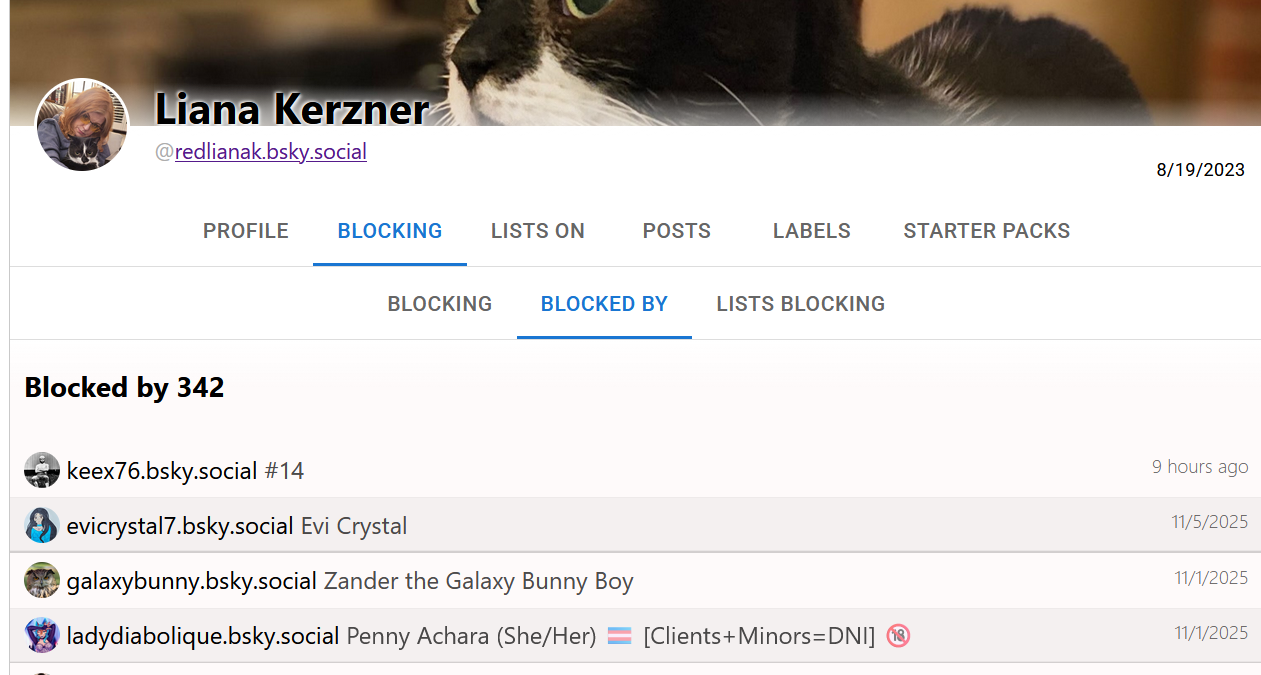
For instance, Kerzner released a video titled “Is Bitterness All Bad?” shortly after the falling-out, hinting that the appellative of 'strange and bitter' had been applied to her by someone with whom she had had a recent break, and Kerzner spoke critically of polyamorous dynamics—an unmistakable allusion given Poppy’s well-known relationship dynamics. While these may appear neutral on the surface, in context they function as covert public commentary targeting a former friend. The timing and specificity of the posts—combined with the sudden cutoff—reinforce this interpretation.

This conduct mirrors how Kerzner has reframed other broken relationships, including ours. Public support is presented as evidence of ethical commitment, while public fallouts are reframed to highlight betrayal or perceived moral failure in others. The common thread is preserving her own image as principled and mistreated, while casting former allies as unstable, toxic, or duplicitous.
In our case, the contrast is sharp. Asher was publicly condemned after a private disagreement, whereas Steven's unauthorized use of backer funds was kept private. Asher’s non-financial, interpersonal dispute with a third party was made central to the cancellation narrative. And where Kerzner once held space for Poppy’s story, she now delivers indirect criticisms. The timing and content suggest a familiar pattern: former allies, once distanced, become new subjects of indirect critique.
This is relevant not because of the breakup itself, but because of what it reveals about how Kerzner manages reputational transitions. Individuals once championed can later be recast in less favorable terms, especially when conflicts arise. Support is often framed as principled and researched, while reversals are framed as moral awakenings or disappointments.
In the context of how she publicly handled our situation, this pattern is hard to ignore. Our experience was similarly reframed through post-hoc justifications, vague insinuations, and a moral lens that painted dissent or criticism as betrayal. In both cases, the arc of the narrative serves to preserve her own positioning as principled and aggrieved—regardless of the private reality that preceded it.
And when our challenging of the narrative became too loud for comfort, Kerzner threatened us legally.
Understanding the broader context of Kerzner’s legal posture requires examining the environment in which these threats were made. Multiple communications we received—sent on her behalf—were marked by legal warnings, aggressive demands, and accusations of defamation. These came at a time when we were raising objections to public mischaracterizations and attempting to set the record straight using verifiable evidence.
It is important to emphasize: at no point did we threaten to sue Liana Kerzner, nor did we seek to silence her, as she alleged in her YouTube episode 'Society prefers Women'. Our efforts have been focused on correcting a false narrative—not stifling her voice. Despite this, her legal representative attempted to pressure us into silence through language that framed criticism as defamatory, regardless of the truth or context.
This may be partly explained by the jurisdictional gap between Canadian and U.S. defamation law. Canada operates under a legal model where statements are presumed false, and the burden falls on the defendant to prove truth. U.S. law, by contrast, places the burden on the plaintiff, who must show that a statement was false, damaging, and, in cases involving public figures, made with actual malice.
Because of this legal asymmetry, the U.S. enacted the SPEECH Act, which bars enforcement of foreign defamation judgments that do not meet U.S. First Amendment standards. U.S. courts have described Canada’s libel law as fundamentally incompatible with American free speech values. In one case, a U.S. court deemed such foreign judgments “repugnant” to constitutional protections.
The Ontario Court of Appeal accepted the legal opinion of a US jurist that stated: “Courts in the District of Columbia and in other American jurisdictions have uniformly held that libel judgments rendered in foreign courts where the law does not comport with the principle set forth in New York Times Co. v. Sullivan and its progeny are repugnant to the public policy of those jurisdictions and must therefore be denied recognition.” - Zvulony & Co blog post re: US/CA Defamation
This matters because threats of Canadian legal action can and have been used to intimidate Americans—even when such judgments may be unenforceable across the border. It places critics in a position where they are expected to prove their innocence in a system not designed to protect critical speech. For individuals without access to legal counsel or deep resources, this can be chilling.
The legal letters we received—sent without prejudice not as part of a dialogue but as one-sided ultimatums—appeared to leverage this asymmetry. They invoked Canadian standards while making demands of Americans. If this strategy is part of a larger pattern, it raises uncomfortable questions about the use of legal tools to manage personal narratives and suppress dissent.
An anonymous critic—who has commented publicly on Kerzner’s past disputes—has alleged that she tends to respond aggressively toward individuals who speak out about perceived asymmetries in her personal or professional conduct. At the time, my husband and I did not give much weight to those claims. Now, after experiencing the pressure firsthand, we view them differently.
It is also notable that most of Kerzner’s critics who have raised similar concerns appear to be based in Canada. That context matters. In a legal system where defendants must prove the truth of contested statements, it is understandable why some may choose to remain anonymous—particularly if they lack the financial means to defend themselves against a prolonged legal challenge brought by a well-resourced and connected party, especially one represented by a prominent media lawyer such as Dr. Mark Bourrie.
If Dr. Bourrie or others wish to characterize my disclosure of information regarding the alleged transfer of project funds by Steven Joel Kerzner as defamatory, I believe the facts are clear and verifiable according to statements made to me by Liana Kerzner in a direct conversation. Canadian banks are legally required to retain account records for several years, and I believe it would be straightforward to verify the existence and timing of any such transaction. Unless Liana Kerzner was knowingly providing me with false information about her husband’s involvement, the action she described to me carries serious ethical—and potentially legal—concerns under the standards of fiduciary duty and donor trust where it pertains to Kickstarter's policies.
This situation differs meaningfully from the private matters Liana Kerzner has chosen to share publicly about others. It involves project finances and the management of backer funds—subjects that fall squarely within the realm of public accountability for anyone running a crowdfunded campaign.
Kerzner has consistently stated, in her own words, that the behavior of close associates or collaborators is relevant to public perception of a project. By that standard, the conduct described here—her husband accessing project funds—would seem not only relevant but essential to disclose. To my knowledge, this has never been communicated to backers by Kerzner.
In my view, this silence stands in sharp contrast to the extensive public narrative Kerzner constructed around my husband’s conduct, which did not involve finances or breach of trust, but rather a personal argument. The inconsistency in disclosure standards is difficult to ignore.
I must also acknowledge a concern: based on Kerzner’s past behavior, I anticipate she may attempt to reframe this situation by making personal claims about me or my marriage. This pattern—portraying critics as abusers or victims of abuse—has appeared in other public disputes and will be examined in Kerzner in Conflict.
It is not outside of the realm of the possible that Kerzner might decide to label her own husband as abusive, in the wake of this revelation. In which case, this criticism by her of Song Eretson comes to mind:

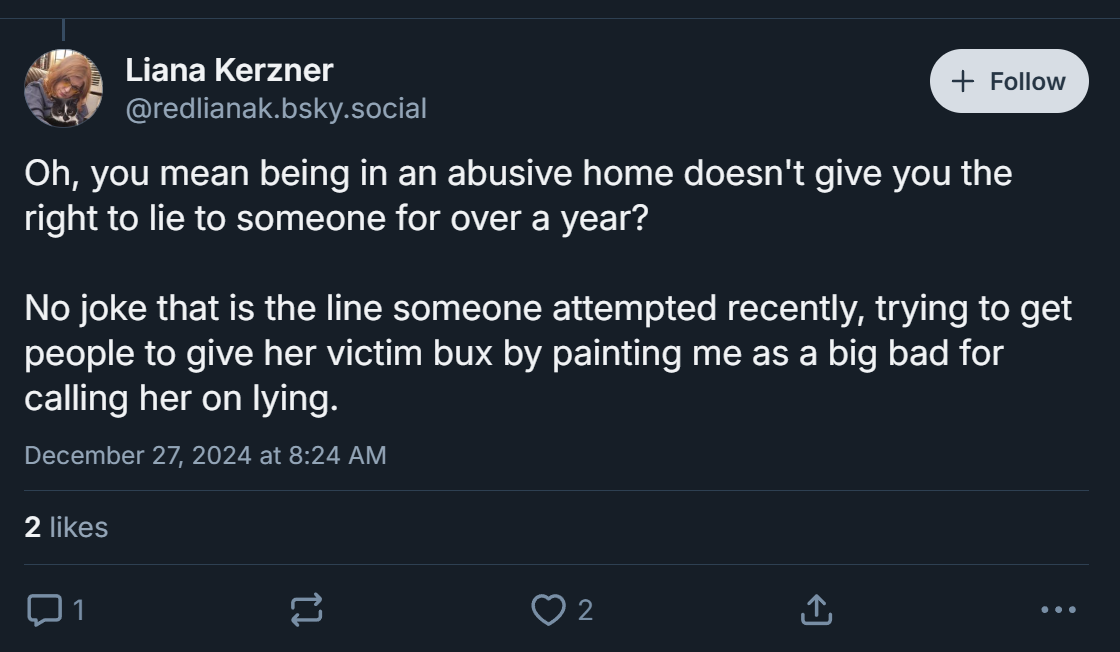
Given the aforementioned pattern, I expect similar tactics may be used against me following the publication of this exposé. I do not say this to preempt criticism, but to clarify that sharing private details about someone’s personal life—especially details shared in confidence during a friendship— and distorting them to serve a discreditation agenda does not constitute ethical response to factual allegations.
In a December 15th, 2025 episode of Manly Monday, Kerzner stated:
"I will go nuclear and I will not say anything that is not true, and I will stand by everything I say because it is all true. It takes a lot for me to drop bombs in public. But when I do it, it is controlled and it's not done out of revenge. It's not done out of spite. It's like, okay, you chose to take this public. You chose to destroy my try to destroy my reputation. Get in line. Plenty have tried. Here's what really happened."
This quote is significant. In the next chapter, I will return to this rhetoric in detail as we examine her retelling of the conflict with Asher. As this chapter has shown, Kerzner has repeatedly characterized her critics using broad emotional frames—while omitting key factual context.
Before closing, I must further mention the issue of statements made in Kerzner’s Discord server. According to screenshots forwarded to me by a source, and as you have been able to see, Kerzner has made numerous public claims about me in several general channels, including ones labeled General and Mental Health. These screenshots include dozens of comments that I believe misrepresent both events and motivations. The source who provided this material did not have access to a private channel on the server labeled Game Dev Chat, which is limited to approved members and moderators. I do not know what has been said in that channel, but I have concerns—based on the tone and content of what was shared in the publicly-available channels of that server—that similar or more severe statements may exist there, and would be even more pertinent and damaging as the channel is dedicated to those who are interested in game development.
For the purposes of this documentation, I selected eleven of the clearest, most representative examples of public mischaracterization from among the many I received. These instances, I believe, demonstrate a pattern of intentional framing that goes beyond misunderstanding or emotional reaction. The cumulative effect is one of reputational harm through consistent and targeted misrepresentation.
Let us now turn to accountability. In the next section, I will lay out what I take responsibility for regarding Song of Sparklemuffin. I will also explore what Liana Kerzner has not acknowledged, despite being in a position of authority over project communications.