Claim 7: I Burned Through A Surprising Amount Of Money On Plugins That Did The Exact Same Thing Over And Over

Liana Kerzner has publicly asserted in Discord that I “burned through a surprising amount of money on plugins that did the exact same thing over and over again,” and further suggested that both I and Song had the ability to “create a crisis” that led her to accommodate our supposed underperformance. In the same context, others in the chat (including Bobby Calloway and Aileyn) implied negative assessments of my professional ethics and character. The screenshots accompanying this claim illustrate statements that, when viewed together, have caused reputational harm.

Before evaluating the claim itself, it is important to summarize what the available evidence actually shows regarding plugin expenditures, how those purchases were discussed, and the functions those plugins provided. 

The core suite used for Song of Sparklemuffin (Visustella Core) includes a suite of free base plugins. Paid plugins were optional extensions intended to provide functionality beyond the free feature set — for example, turn‑order manipulation, battle interface improvements, tactical tweaks, and custom combat behaviors. 

As documented in the list embedded in this article, 30+ plugins were purchased using Song of Sparklemuffin Kickstarter funds. Each plugin entry includes:

The name of the plugin,
Its published cost at the time of purchase,
A brief description of its function,
A link to the plugin’s official documentation.

Name Cost Description / Features
The Grande Series $30 Equip Passive system, allowing actors to equip passive states to enhance battle potential. These were set aside to expand Solomon’s different triggers and the battle pros and cons they’d give him.

Equip Medal system, which were special pieces of equipment that would be awarded for completing quests. In the game, characters did not change armor or weapons, they upgraded them. [crafting.png] The crafting system allowed the players to choose between three types of upgrade for each weapon at each tier, giving them a different variant to that character’s fighting style. The medals were meant to be add-ons that added abilities, effects, etc, like magical trinkets they could wear and exchange between characters so they could experiment with builds.

Battle Grid system, which was the real star of that plugin suite and the main reason behind the purchase. It allowed me to create and modify the grid combat style that you saw in the demo, adding an extra layer of tactics.
Limited Skill Use $5 A very handy plugin that allowed you to set certain skills to only be useable a certain number of times per battle, how many uses are restored at the end of combat, etc. This was used extensively to create Princess Sparklepony’s poop projectiles, making each type of poop a skill that could run out of charges and disappear when it did instead of using the inventory system, having the player go into their inventory and rummage around potions and other things to be able to grab a turd and fling it at an enemy would have been a hassle.
Visual State Effect $8 Used to overlay states such as the freezing effect with Maus’ Epee attack, and other things. Normally the engine has only one status effect animation and effect, but this plugin allows you to basically overlay anything over the character when they’re affected: a block of ice, an animation, etc. A steal.
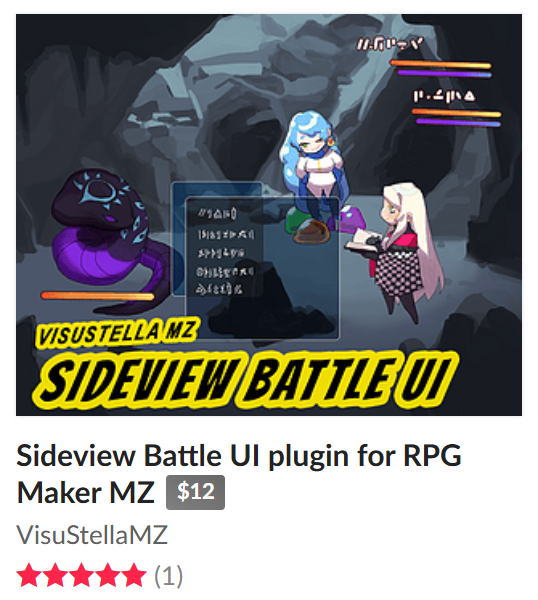
Sideview Battle UI $12 This gave me the very flexible UI that I eventually modified into the storybook character stat indicators for combat, giving me that nice Ultima VI vibe I was looking for and making our combat interface look more unique.
Action Sequence Projectiles  $5 We needed this so the pony could fling poop. And, well, also so that characters could just throw things, too. The Bandit chief, Bruno, would throw daggers at you. And if you caught that reference, I see you.
Bright Effects $10 This suite is excellent because it really punches up the color vibrancy, but also allows you to do glimmer effects and god rays, which I used when lighting the Shimmering City so it would… shimmer. The til shift filter also created some nice, soft blur effects that were used at certain points in the intro.
Battle A.I.  $8 DESPERATELY needed. The engine’s default battle AI is extremely primitive and creating a level of sophistication from scratch would have been a task in and of itself. This plugin now only expands enemy choice during combat, but also introduces the components of A.I. Styles, A.I. Levels, Rating Variance, A.I. Conditions, and Influencing TGR Weight.
Enemy Level $8 Basically the Oblivion system. Sort of. It allowed me to create enemies with varying levels when encountered in combat. The nice thing about this one is that you can set caps for certain enemies to never be above or below certain number of levels from the party. It also allowed me to use different images for the battler based on the level.
Life State Effects $5 The base engine does not, in fact, come with an easy way to implement states like Revive, Doom, etcetera- some of the standards in the JRPG repertoire. In order to get some of the spell effects, this plugin was necessary.
Party System $15 Throughout the game, the player was going to be able to use Glowy Box as a means of camping and reaching a sort of safe haven where they could interact with the party members as Princess Sparklemuffin, and also change your party loadout, since you could only have four members of the party with you at any one time. The default engine only allowed you to change party members from the main menu and no more- there was no functionality to lock party members, set party members as required, switch them mid-battle, restrict when and where the functionality was available, etcetera. This plugin was vital to be able to implement the party system.
Anti-Damage Barriers $8 What it says on the tin. One of princess Sparklemuffin’s key important spells in the early game was to essentially conjure magical shields that would give out after a certain amount of damage was received. The basic engine does not have many options for damage mitigation outside of raw defensive parameters. Ths plugin allowed us to have all sorts of barriers- cancellation barriers, nullification, reduction, absorption, etcetera.
Quest Journal System $15 Quests. Gotta have them. The basic engine does not have a native quest tracking system.
Action Sequence Camera $5 Cosmetic plugin used for battle effects. You can Attach the camera to a specific point on the screen, or target, pan the camera, have the camera go out of bounds, custom zoom levels, axis tilt, etc.
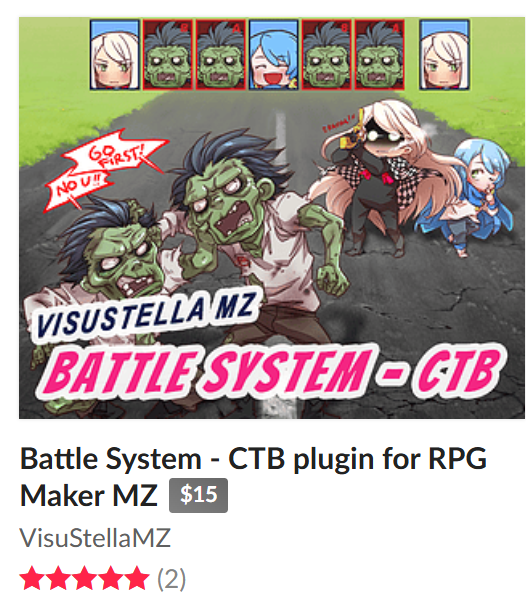
Battle System CTB $15 This is the system we ended up going with insofar as turn manipulation core went after trying another one. This far more complete plugin allows you to manipulate turn order in combat through skills, spells, and actions, for yourself and your foes.
Name Cost Description / Features
Horror Effects $10  This is the plugin that gave us the ability to simulate the CRT effect through PixiJS. It also came with a slew of other really cool effects that had a lot of possibility. Some of the effects were used for the depression/sadness status effects caused by the Oyizis.
Encounter Effects $8 A core component of the stealth system. Events can be given alert functionality to chase the player if the player steps within their vision range, responded to terrain tags, you could create preemptive attack bonuses if attacked from behind, etc.
Auto Skill Triggers $15 This is a pretty complex plugin that allows for a lot of versatility in changing classes. This was the central column of our class progression system, since it solved a lot of issues- such as being able to keep in memory which bust a character is using for conversations when they change classes… which the base engine doesn’t let you do.
Battle Cursor $5 For the CRPG players out there. The system only indicated that it was each character’s turn by having them step up. This option allowed for an optional pointer cursor to point to the character that had just become active. I designed a hand-pointer set of cursors that varied with each character. 
Visual Inventory $8 The basic engine’s inventory is your standard JRPG textual inventory with a tiny icon. This allowed me to create something more customizable, varying the size of icons and even using larger sample sheets for them.
Battle Command - Talk $8 This was going to be a core functionality for characters who would try to talk their way around boss fights, triggering debate mini-games. The player would have experienced this during the Tusk boss battle. Liana never finished writing the script.
Visual Fogs $8 Special effects for atmosphere. Were used in several places during the demo, such as during Ruchel’s cauldron scene. Was also used to trigger the autumn fog in the weather system.
Visual Battle Environment $10 This was one of my favorites. You didn’t see it in the demo in action but you got to see it during one of the spell demonstrations. This allowed you to change the battle background, animate it and subject it to all sorts of effects.
Item Crafting System $15 Used to implement a cooking system to make different sorts of useful edible items.
Picture Common Events + Choices $5 + $15 Functionality to bind common events to pictures. This was the base that I used for the graphical interface behind the Spellsong system, upon which I created a  whole new evented independent spellcasting system.
The Wanderlust Suite $30 An excellent suite with three different plugins:  Movement effects which was used for the characters walking on different terrain, but the Weather and Lighting effects plugin were the main drive. The weather effects expanded the engine’s basic three weather special effects to a total of 8 elements and 10 patterns each. These special effects were trigged for the weather system that I built.

The Lighting effects took the light effects of the previous plugin and added dynamic and directional lighting, which allowed us to have distinct light sources and lights that could point in specific directions, rotate, etcetere. They were used for pretty much everything- from the stealth system to regular lighting in environments.
State Tooltip $8 Ok, who on earth doesn’t just hate it when you have characters with status effects and all you know about the effect is a little icon floating over their heads. "What is it, Lassie? You got Doomed? No, is it Blind? Or ticks?"

This plugin solved the issue- hovering the mouse over one of your enemies or your characters, you’d get a pop-up that would show you what conditions they were afflicted with.
Skill Containers $5 Skills that could contain other skills. With flexible taxonomies. There was an underlaying problem with having a spell system as vast and as varied as Princess Sparklemuffin's Spellsong: The sheer number of spells. The finding of spells by experimenting with the different components could be fun, but were we really going to ask the player to memorize the combinations for more than a hundred spells?

No, of course not.

Enter this beautiful plugin. This is the user-facing side of how the song spells that Princess Sparklemuffin discovered would get organized. Learned songs would get filed under categories such as Songs of Healing, Songs of the Land, etc. That way you didn’t need to input the combination for the song every single time if you already knew it, or you couldn’t remember it. You could just go to your songbook and choose it. Of course, those who liked the LOOM aspect of things could always show off and do the combinations by heart.
Skill Input Combo $15 This was the input controller behind Princess Sparklepony’s dance system. I slapped it on top of the long chain of events that determined each dance choice and variable. It took a while to get it to work the way I wanted it to because the way it processed each button input wasn’t exactly what I needed, but it was half of the way there.
Name Cost Description / Features
Skill Cooldown $5 This was put in place in order to have skills that could be easily abused require cool-downs to balance things out. It was also applied to enemies, in particularly boss-type encounters like the Master at the monastery, to prevent him from spamming his extra-strong attack in case the enemy AI failed to read a directive. I've already mentioned that the base engine came with a very primitive A.I. system— the A.I. expansion helped create a lot more nuanced combat patterns and fuzzy logic, but you still had the odd occurrence where an enemy would use the same large-scale attack twice in a row, it was an inevitability that was baked into the engine itself. So, there was a very real need to actually restrict the use of a skill of that sort so that the engine itself could not consider it a viable alternative when makin weighted decisions.

This plugin solved that issue, and it's also another example of a basic core functionality that should have been part of the engine's base features but which, for some reason, the designers decided not to include.
Debugger $3 This paticular plugin was a GODSEND. The default engine’s debug menu only has switch and variable manipulation options, which really wasn’t enough for any comprehensive level of testing and debugging. This plugin allowed me to launch Common Events on the go, teleporting to any desired map, quick options, initiating battles, modifying quantities for items, weapons, armors, altering self switches, and applying buffs, debuffs, and states.
Visual Parallaxes $8 By default, the engine only allows each map to have one parallax. Such a limit makes it difficult to create different layers of objects to portray distance and the like. This plugin allows you to add an unlimited amount of parallaxes per map alongside many controls. This is how the parallax maps that created the more unique buildings for the Glimmering City were going to be handled.
Action Sequence Impact $5 A collection of filters using the Pixi JS filter that add multiple impact effects to battle by producing special on screen  effects to make certain actions like critical hits, guarding, and dodging more visibly different adding to the flavor of the battle: Color break effects, chromatic aberration, color blur, shockwave effects, bizarro inversion, desaturation, oversaturation, motion trails, time scales, negative inversion, time stops and zoom blurs. 
Victory Aftermath $8 The basic victory screen after every battle is depserately lacking in details. The Victory Aftermath plugin consolidates the rewards granted upon finishing a battle successfully into one screen (or more if there are level ups). This helps reduce the amount of button presses needed to display similar information by default and adds more detailed information upon victory:

Consolidates EXP, Gold, and Items acquired through battle rewards into one battle screen.
EXP gauges for currently active battle party will be displayed on the same screen to indicate progress.

Upon leveling up, individual screens can be shown (optionally) to display parameter changes, new skills acquired, and level up quotes.
Construct Series 3 $20 This plugin set was pretty crucial for the combat demo. It contained:
The Tutorial Panel System: The plugin adds the ability to display tutorial panels seen in many recent JRPG's. The tutorial panel system allows the player to read forward and backward at their own pace while having visuals displayed on the relevant tutorial pages. The player can later reread the tutorials found in a dedicated Tutorial List scene that is accessible through the main menu. This was the plugin that was used to convey the system lessons at Snowpaw Mountain.

 Event Chain Reaction: Making events react to anything but the player requires a lot of extra coding in the basic engine. This plugin changes that by adding in many different ways to cause event changes to take place. This includes streamlined forms of push and pull, catalysts that cause reactions, pressure plates and heavy objects, chargers and conductors, a form of timed decay, and objects that submerge when moved into the water.  This was very much the core mechanic of a lot of the more mechanical puzzles that would come later in the game, but it was also slated to be employed for the sneaking sections— the ability to distract trolls and set traps to catch them.

Unique Tile Effects:   Added new properties to tiles, by marking them with regions or assigning those properties to the terrain tags. These new unique tile effects allow more player and event interactivity with the environment. Such interactivity ranges from tiles that cause the character to slide from one end to the other to other tiles that bounce the character forward.  This would have entered more into effect when the player traveled Northward and encountered the icy terrain around Kings' College.

When the individual costs of these plugins are totaled, the sum comes to $378 USD. This is the complete amount spent, using project funds, on paid Visustella extensions for the game.

From an industry perspective:
-A total of $378 USD for plugin functionality across an entire project is atypically inexpensive for small indie teams leveraging off‑the‑shelf solutions rather than commissioning bespoke programming.
-Custom coding for equivalent systems (e.g., combat mechanics, tactical modifiers, dialogue integration) from scratch would likely cost three times as much or more if performed by a contractor with comparable skills, given industry hourly rates and the absence of an in‑house programmer. 

Given those facts, the term “surprising amount of money” may be true in a very narrow sense — no indie project spends large sums on off‑the‑shelf tools when free alternatives exist — but the implied criticism that this level of spending represents misuse or waste is not supported by the evidence. 

Kerzner’s statement also asserts that the paid plugins “did the exact same thing over and over again.” A review of the items in the linked list shows that the purchased plugins provided distinct technical functions; they were not redundant duplicates. Each plugin fulfilled a purpose that extended core engine behavior in ways important to the demo’s structure or the intended gameplay experience. For example:

-Some plugins modified turn order and initiative systems,
-Others managed battle scene presentation and UI behavior,
-Several added logic for status interaction, movement modifiers, or conditional effects not available in the base engine.

This variety of purpose is documented in the list embedded above. 

For every plugin purchased with Kickstarter funds, I provided Kerzner with a description of what the plugin does, why it would be useful for the game and a link to vendor/official documentation.

In each case, I sought and received Kerzner’s approval before making the purchase. There is an archived message trace confirming this pattern of communication for every plugin bought with project funds.

This directly contradicts any suggestion that plugins were bought without oversight or that I acted unilaterally in ways unknown to Kerzner. 

Kerzner’s remark about plugin spending, when taken together with implied character judgments by others in the same chat (including comments about my “ethics” or “morals”), contributed to a public narrative that:

1. I acted irresponsibly with project funds,
2. I lacked understanding of the tools I was using,
3. I was somehow unprofessional in spending.

Those implications are harmful to my reputation, given my documented role as the sole systems integrator on the project. Given the evidence of recorded plugin costs, documented approvals, and distinct functionality provided by each plugin, the statement that I burned through a surprising amount of money on redundant purchases is not supported by the facts.

There are two plausible explanations for the discrepancy between Kerzner’s public statement and the documented record:

1. A misunderstanding of the technical functions of the plugins, which may have led to an inaccurate characterization of those expenditures; or
2. A public framing intended to portray project decisions in a way favorable to Kerzner’s narrative of responsibility, regardless of the documented accuracy.

The inclusion of third‑party comments in the same Discord thread that question my professional integrity amplifies the reputational impact of Kerzner’s claim. When a project lead publicly associates a contributor with irresponsible financial behavior, even in an informal chat, it can influence how others perceive that contributor’s competence and conduct. 

By providing the complete list of plugins, their costs, their functions, and the approval threads, this article enables readers to assess the claim for themselves rather than relying on a summary statement made out of context.  

Kerzner’s claim that I spent a disproportionate amount of money on plugins that did the “same thing over and over” is not supported by the documented costs or plugin functionality. Plugin purchases totaled $378 USD, served distinct technical purposes, and were approved by Kerzner before purchase. While the amount might seem “surprising” out of context, it aligns with normal practice for indie game development and is not inconsistent with responsible project financial management. The combination of mischaracterizations and reputational comments in the same thread has had an adverse impact on perceptions of my professionalism, which is why this claim is addressed here. 

As a factual clarification, it’s worth reiterating that Song Eretson was a client of Liana Kerzner’s LianaKares service.