POPPY DIABOLIQUE/PENNY/JESSICA
The inciting incident of what would later be referred to as the “Very Ugly Fight” began with an argument between Asher and Poppy Diabolique on September 8, 2024.
The exchange originated when Asher noticed a response Poppy had made to a post by The Road Jess Travelled.
The initial interaction between Asher and Poppy was relatively straightforward within the limited scope of that first exchange. Kerzner described the event in ways that, in my view, do not reflect its character, while also making accusations in broad terms that allow listeners to form a very different impression of what actually occurred.
For that reason, it is necessary to examine the original exchange in detail.
Poppy’s response to Jess’s post struck Asher as puzzling for a specific reason: it appeared to ask for empathy not only for abusers, but also for those who defend or excuse abusive behavior. As a result, Asher responded with a simple question:
“Empathy for what?”

Asher asks a question. Poppy responds with apparent confusion, despite the fact that the question quoted her phrasing directly.

Poppy, suddenly seeming no longer confused, defines her terms: Advocating and hand-holding.
Asher disagrees with the notion of hand-holding, as Poppy's phrasing directly indicates not holding someone accountable.
The first red flag was Poppy’s initial response indicating that she did not understand the question or how it related to what she had said, even though the question directly quoted the wording she had just used. When Asher clarified his question, her subsequent response suggested that the earlier confusion may not have been genuine. Several people who later examined the exchange have reached a similar interpretation.
Nevertheless, in order to extend the fullest reasonable benefit of the doubt, Asher continued the conversation.
Asher proceeds to ask questions about the terms Poppy is using. This is standard practice in actual discussion and debate. Defining terms is crucial for avoiding misunderstandings; participants need to know what each person means when they use specific language. Asher does not assume that his definitions of “handholding” and “advocacy” are the same as Poppy’s.
In this second exchange another red flag appears. Poppy defines “handholding” as “being overly caregiving and not holding people responsible regardless.” However, in her next response to Asher’s disagreement she casts him as “not understanding” what she said and states, “I never said not to hold someone accountable,” even though her prior wording directly described a situation in which people were “not held responsible regardless.” The contradiction between these statements is immediately visible in the exchange itself.
From the outset, the conversation shows a pattern of shifting language. Poppy first responds to a question that quoted her own wording by indicating that she does not understand the question, and then tells her interlocutor that he does not understand what she meant while simultaneously denying language she had just used.
Still extending the benefit of the doubt, Asher continues the conversation and explains the reasoning behind his conclusions. By laying out the sequence of events and describing how her responses were being interpreted, he offers Poppy the opportunity to clarify her position. At the same time, he signals that aspects of the exchange are making him uneasy, especially the apparent shifting of terminology in which key terms lack stable definitions and appear to change meaning depending on the moment in the discussion.

Poppy denies ever saying that someone should not be held accountable, despite her earlier answer describing “being overly caregiving and not holding people responsible regardless,” with “regardless” functioning as a clear qualifier. Asher responds by explaining how several of Poppy’s statements are registering from his perspective. He lays out what informed his conclusion and notes that he is beginning to perceive a dismissive tone in her responses.

Notice that Asher explicitly references his BPD in the same way Poppy had referenced it in previous content. This style-matching suggests he is mirroring the communicative framework she had previously used. He also states that he is choosing to ignore the internal warning signs he is experiencing. Asher then proceeds step-by-step through the sequence of events and explains the reasoning that led him to his interpretation.

Asher also points out that Poppy appears to characterize his response as off-topic, even though his question again quoted her own wording when expressing disagreement. He reconstructs the sequence of the conversation in detail in order to demonstrate how he arrived at his conclusion based on Poppy’s statements and the progression of the exchange.

Asher further argues that several concepts are becoming blurred in the conversation. Compassion and coddling begin to merge, as do advocacy and punishment. He suggests that the meaning of these terms appears to shift when disagreement arises or when a position is presented in a less favorable light. Asher notes that productive communication becomes difficult when definitions are treated as mutable during the course of the discussion.

After explaining both his conclusions and the reasoning process that led him to them—based on Poppy’s own wording—Asher asks why Poppy appears to equate advocacy with punishment.
Poppy then accuses Asher of performing a “Gish gallop” and appears to exit the conversation with “Good day.”
Asher subsequently responds to the accusation of a Gish gallop in the public thread where the discussion was occurring. The thread had not been started by Poppy, but Jess, despite her statement that she was leaving the exchange.
Aside from Asher’s typo (“are” instead of “aren’t” in the first image), his reasoning is relatively easy to follow.
Poppy references the number of chained tweets as an indicator of excess. This framing is notable given that Twitter is an inherently limited platform for extended discussion. Any attempt at a detailed argument or explanation often requires multiple posts because of the platform’s character constraints. Poppy herself has previously commented on this limitation when discussing her own online discourse. For that reason, treating the number of tweets alone as evidence of excess can reasonably be viewed as a questionable framing. At this stage in the conversation, Poppy appears to be reclassifying Asher’s extended explanation as a Gish gallop — a rhetorical label typically used to describe a form of sophistical argumentation.
What is a Gish-gallop?
It’s a technique (...) where one inundates somebody else with a barrage of mostly weak, inaccurate, vague, anecdotal, or unsubstantiated claims in support of an argument, all within a short span of time. To the extent that if you’re on the receiving end of it, you feel completely overwhelmed with the sheer amount of claims that have been lobbed at you, and that you now have to respond to. —Ali Almossawi, The Critical Thinker, "What's a Gish Gallop?"
In the exchange shown here, however, Asher’s posts follow a single argumentative thread rather than presenting a scattershot list of unrelated claims. He repeatedly refers back to Poppy’s own wording and attempts to explain how her statements led him to the conclusions he is describing. The posts form a sequential chain of reasoning rather than a rapid accumulation of independent arguments.
Gish gallops are typically considered problematic only in contexts where there is a strict time constraint for responding to arguments, such as formal debates. The term itself was coined by Eugenie Scott in reference to the debating style of creationist Duane Gish. In those debates, the tactic relied on overwhelming an opponent with numerous claims within a limited time frame, making it difficult for the opponent to respond to each one adequately. Even if Asher’s posts were interpreted as resembling that structure, the situation here lacked the essential condition that makes a Gish gallop effective: there was no time limit requiring an immediate response, and no obligation for Poppy to answer every point, or at all.
This moment therefore represents a notable turning point in the exchange. Rather than addressing the substance of the argument, Poppy focuses on the impression created by the number of messages — messages which, in reality, were parts of a single extended explanation broken across multiple posts due to platform constraints. The rhetorical effect is to discredit the argument as excessive without engaging with its content.
This kind of reframing has also appeared in other conflicts involving Liana Kerzner, where verbosity or highly detailed explanations are treated as evidence of bad faith rather than as an attempt to clarify reasoning— you have seen a few examples already. In many online environments, dismissing someone for being overly verbose or detail-oriented is a recognizable feature of troll-culture dynamics, where the act of explaining too much becomes grounds for ridicule rather than engagement.
Communication styles associated with neurodivergence—such as highly detailed explanations, step-by-step reasoning, or difficulty compressing complex thoughts into short social formats—are particularly vulnerable to this form of dismissal. Individuals who communicate in this way are often labeled as obsessive, argumentative, or disruptive when they attempt to clarify their reasoning. . Autistic and autistic-adjacent communicational styles such as those present in ADHD are often the targets of dismissal.
This is especially striking in this context because both Poppy and Kerzner publicly present themselves as advocates for mental-health awareness and for reducing stigma around neurodivergence. Yet the conversational patterns visible in these exchanges show the same kinds of dismissive responses toward detailed or anxious communication that neurodivergent individuals frequently report encountering in hostile online spaces, and it is a behavior echoed by Kerzner and Poppy's associated communities with alarming frequency.

Asher responds to the accusation of a Gish gallop and explains why he views Poppy’s approach during the exchange as manipulative. He points to specific moments in the conversation—particularly instances where his criticism of her reasoning appears to be reframed rather than addressed. He also raises concern about the contrast between this behavior and Poppy’s publicly known role as a therapist, given that the exchange is occurring in a visible public forum.

At this stage, Asher’s tone shifts. He expresses frustration and delivers a blunt assessment of what he sees as the quality of Poppy’s approach to discourse.
Poppy responds by accusing Asher of projection, of crossing a boundary, and of berating her throughout the conversation.
However, earlier in the exchange Poppy had indicated that she was leaving the conversation with “Good day.” Despite this stated boundary and exit, she returns to the thread to respond to Asher again.
The boundary she invokes is not being enforced by her.
After Poppy accused Asher of engaging in a Gish gallop, Asher defended his reasoning and identified several behaviors in the exchange that he considered red flags.
At this point it is necessary to highlight something that Kerzner has repeatedly mischaracterized: Asher’s statement, “My BPD was right, which is sad.”
Prior to this exchange, Asher had seen some of Poppy’s public posts in which she referred to things that her BPD was “telling” her. In those posts, Poppy sometimes described her BPD in an anthropomorphized way—speaking about it almost as if it were a separate internal voice.
Such as in the video What Happens In Dating When People Skip Step? (Disk Horse).
Poppy: "I can't, like, I have never been able to say that about any other partner. My BPD would just argue with me. I'm sitting there going you know my poly's creating problems, this partner is an issue."
This is not a style of expression that Asher himself typically uses.
However, in the course of attempting to communicate with Poppy and signal that aspects of her behavior were raising significant red flags for him, Asher mirrored the language pattern he had observed in her own posts (hence why he said " as I might put it the way you tend to.") Earlier in the exchange he had already mentioned that certain behaviors were triggering suspicions aligned with his BPD-related pattern recognition.
This form of language mirroring is a common conversational technique. An active listener will sometimes adopt elements of another person’s metaphor framework—or what linguists and writers such as Matt Bird sometimes call their “metaphor family”—as a way of signaling that they have been paying attention to how the other person frames their experiences.
Kerzner has repeatedly excerpted the phrase “My BPD was right, which is sad” while omitting the surrounding context in which Asher was mirroring Poppy’s previously established language. In doing so, she has used the statement to portray Asher as “unhinged” or as someone who believes his disorder makes him special. When viewed within the full conversational context, however, you can see this is not the case. This pattern of removing contextual framing in order to recast a statement as evidence of instability is consistent with several other conflicts involving Kerzner that have been documented earlier in this report.
Poppy’s response to Asher’s defense introduces another shift in the conversation. Rather than addressing the substance of his argument, she accuses him of “projection.”
In psychology, projection is a defense mechanism where an individual unconsciously attributes their own unacceptable thoughts, feelings, traits, or motives onto another person or group. Poppy doesn't specify what, exactly, Asher is 'projecting', nor how is she qualified to make that observation about someone she is not treating.
This accusation is notable given Poppy’s public role as a therapist. While the term “projection” can be used colloquially, its use carries additional weight when invoked by someone who publicly identifies as a mental health professional.
A therapist cannot ethically or professionally diagnose someone who is not under their care, as this violates established ethical codes like the "Goldwater Rule." Using such terms carelessly is unprofessional and manipulative because of the weight their profession carries.
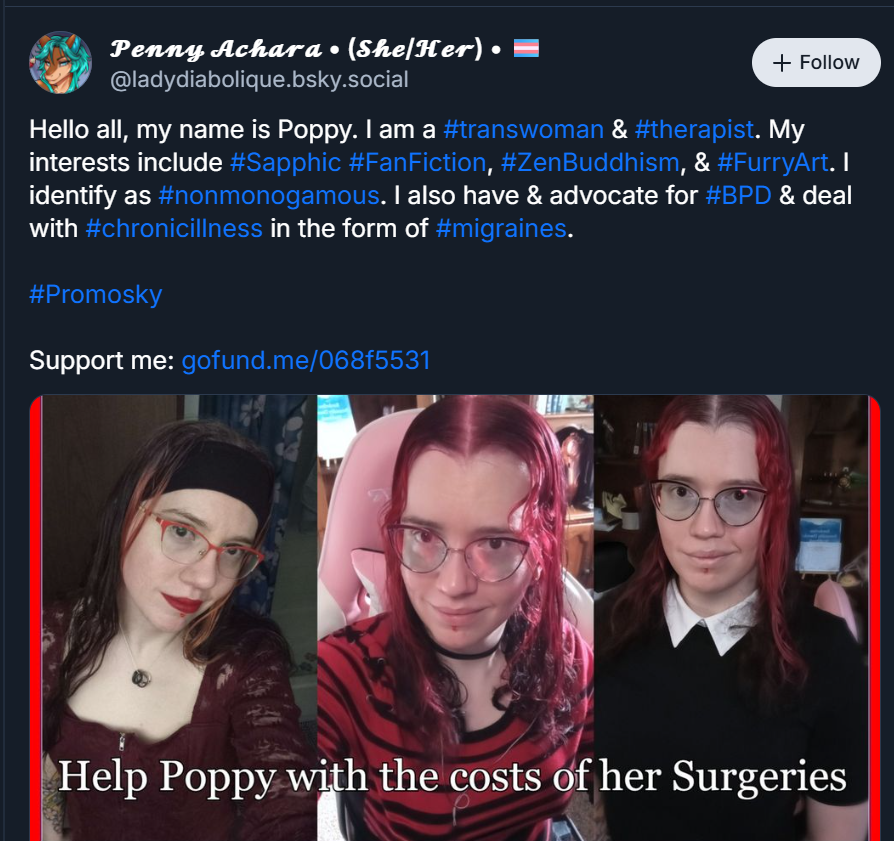
Poppy does not maintain a strict separation between her professional identity and her social media presence. At the time of this exchange she frequently linked to her professional services and referenced her credentials as a therapist during online disputes. This practice appears to continue in her online presence today.




Secondly, Poppy stated that she had “made a boundary” by indicating that the exchange was uncomfortable and that Asher was crossing it. Ostensibly, this claim stems from Poppy saying “Good day” and presenting that statement as the point at which she had exited the conversation. Asher’s response to the accusation of a Gish gallop occurred after that statement, which Poppy later framed as a violation of the boundary she had established.
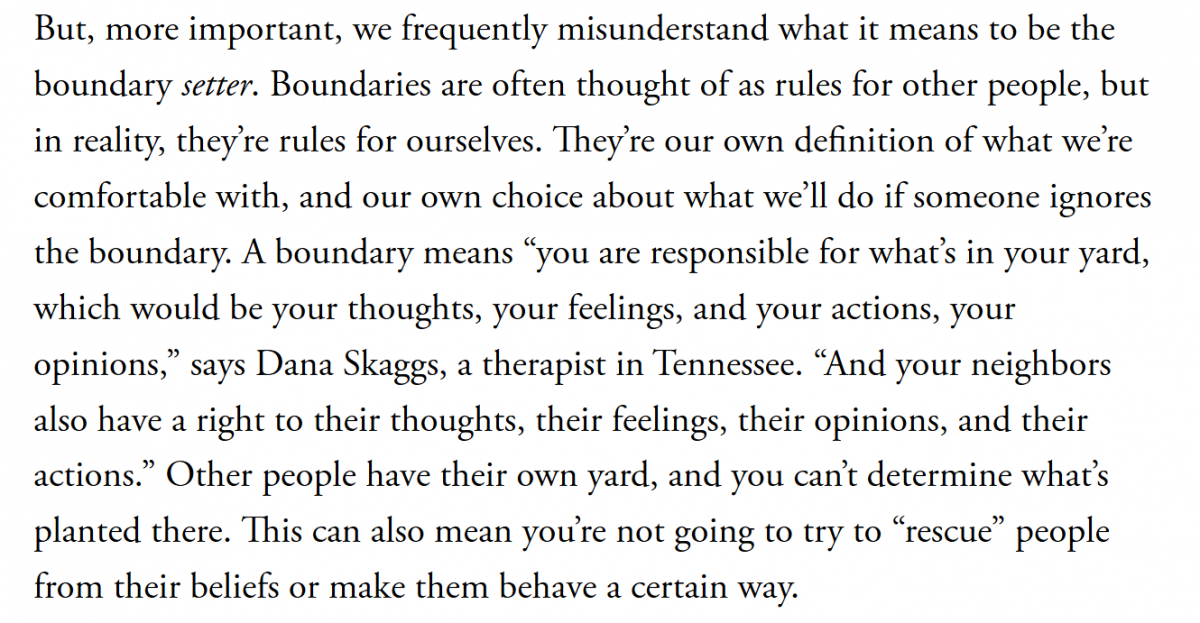
What appears to be operating here is a particularly expansive interpretation of the concept of boundaries that differs from how the term is typically used in therapeutic or interpersonal guidance. In most boundary-setting frameworks, a boundary is a personal limit an individual sets regarding what behavior they are willing to tolerate in their own participation in a situation. Communicating that limit informs others of the person’s intention to disengage if the interaction continues in a way they find unacceptable. Crucially, the enforcement of a boundary is carried out by the individual who sets it. If the situation continues in a way that violates the stated limit, the person maintains the boundary by removing themselves from the interaction or by otherwise disengaging. In this model, a boundary is not primarily a demand that another person change their behavior; rather, it is a commitment regarding the boundary-setter’s own participation.
In the exchange shown here, Poppy indicates that she is leaving the conversation, but subsequently re-enters the discussion to respond to Asher again while framing his continued participation as a boundary violation, shifting the responsibility for maintaining the boundary appears to shift from the person who declared it to the other participant.
Therapist Dana Skaggs very aptly describes the distinction between boundary-setting and attempts to control another person’s behavior as follows:
Poppy states that she set a boundary—allegedly by indicating that the interaction had become uncomfortable and then saying “Good day” to signal that she was exiting the conversation. If she had in fact left the exchange at that point, it would resemble a straightforward example of boundary enforcement: communicating discomfort and then disengaging.
Two additional contextual details are important. First, the conversation was taking place in a public thread owned by the user The Road Jess Travelled, not on a thread controlled by Poppy herself. Second, Poppy was not using a private personal account but the Poppy & Zena account, a shared platform where the two often encouraged people to engage in discussion—what they sometimes jokingly referred to as “disk horse.” In that context, Asher’s decision to engage with the topic and ask questions was not out of step with the environment that had been set up.
It is also significant that Poppy’s parting remark included an accusation that Asher was engaging in a “Gish gallop.” Under these circumstances, the interaction begins to resemble what communication researchers describe as a double bind. A double bind occurs when a person is placed in a situation where either possible response leads to negative consequences, such as: If the person does not respond to accusations, the accusation can stand unchallenged and may be interpreted as tacit admission. And yet, If they do respond, they can then be criticized for continuing the interaction or for violating a stated boundary. The result is a “damned if you do, damned if you don’t” communication trap.
If Poppy had intended to enforce a boundary in the conventional sense, she could have simply disengaged from the thread—by leaving the conversation, muting or blocking Asher, or declining to respond further when he addressed the Gish-gallop accusation in the public discussion.
However, the subsequent exchange suggests that the boundary was not being maintained through disengagement. Instead, the boundary claim remained active while the conversation itself continued, particularly as Asher confronted the earlier accusation and argued that the framing of his comments had been manipulative on Poppy's side.

Asher summarizes his understanding of boundaries with the statement: “Have a boundary? Then assert it.” In a public forum, disengagement is available to any participant who wishes to end an interaction. The exchange in question was occurring in a public thread, and neither participant had authority over the space itself. In a private setting—such as a discussion occurring on someone’s personal page, server, or in their home—the expectations surrounding participation would be different. In this case, however, both individuals were participating in a shared public discussion, and the practical means of enforcing a personal boundary would have been to disengage from the interaction. Asher also expresses concern about Poppy’s use of psychological terminology during the exchange. Because Poppy publicly identifies herself as a therapist, her use of diagnostic or quasi-diagnostic language carries additional weight. Within the conversation, these terms appear in the context of disagreement about rhetorical tactics rather than in the context of a therapeutic relationship.
Poppy’s response attributes motives to Asher’s actions—suggesting that his continued participation reflects a desire to persuade her to remain engaged.
When accusations are made in a public thread, it is common for the person being accused to respond in that same space so that readers can see the refutation alongside the accusation. In that context, continued participation can function less as an attempt to keep the other party engaged and more as an effort to correct the public record.
Poppy’s interpretation—that Asher was asking her to stay and that she had refused—dis not supported by the transcript of the exchange.
The conversation itself shows Asher defending his reasoning and responding to the accusations that had already been made.

Rather than disengaging from the interaction, Poppy’s final action in the exchange is to publicly address Asher to her audience. In that message she again references her professional standing and uses psychological terminology to characterize Asher’s behavior, including the claim that he is “splitting”—a term associated with diagnostic frameworks. She also repeats the accusation that Asher’s posts constitute a Gish-gallop. These characterizations occur in a public setting and outside any clinical context, further escalating the disagreement from a debate about arguments into a discussion framed through weaponized psychological labels.
In most therapeutic frameworks, when someone encounters behavior they believe violates their boundaries, the recommended course of action is straightforward: disengage. A boundary is not enforced by declaring it and remaining in the interaction; it is enforced by withdrawing from the interaction and refusing further participation.
Poppy Diabolique (Penny/Jessica) is a licensed therapist. Despite that professional background, she does not disengage from the exchange. Instead, after leaving an accusation behind as she exits, she quickly re-enters the conversation and reframes the dispute once the person responds to her accusation.
Her reframing centers on reinterpreting Asher’s motives. She suggests that his continued responses reflect a desire to convince her to stay and speak with him. This interpretation shifts the focus away from the content of the disagreement and toward a narrative in which the other participant is depicted as seeking her attention and reacting emotionally when she refuses it.
As mentioned above, the situation is a lot less dramatic than that: When accusations are made in a public discussion, it is common for the person being accused to respond in the same space so that readers can see the rebuttal alongside the original claim. In this context, Asher’s continued responses can be understood as an attempt to address accusations made publicly, rather than as an attempt to persuade Poppy to remain in the conversation.
Poppy’s framing also introduces another element: she implies that Asher made a request for continued engagement and that she refused it—essentially suggesting that he is reacting negatively to a woman saying “no.” Yet the transcript of the exchange does not show any request being made, nor does it show any denial of such a request. This shifts the focus of the disagreement into a gendered rejection scenario rather than a dispute over arguments.
This same reframing technique appears in other conflicts surrounding this broader situation, including those involving Liana Kerzner. In both cases, the rhetorical move shifts the narrative from a debate about statements and reasoning into a moralized story about harassment and refusal.
Communication researchers sometimes analyze this type of dynamic through the framework of virtuous victimhood. In their work on the In The Virtuous Victim Effect, Jillian J. Jordan and Maryam Kouchaki examine how portraying someone as morally good and unjustly harmed can mobilize public sympathy and punitive reactions toward perceived wrongdoers. As they note::
To evaluate the Justice Restoration Hypothesis, we begin by testing its key assumption: that seeing victims as virtuous motivates justice-restorative action. To this end, in experiment 10 (n = 598, preregistered), we investigated whether describing victims as morally good motivates people to help them and to punish the perpetrators who have harmed them. Consistent with this prediction, a recent paper showed that people are more willing to help victims who are described as virtuous and that such victims are seen as more deserving of help (56 ). Experiment 10 serves to bolster this evidence and shows that virtuous victims can also motivate punishment of perpetrators.
Recasting an argument as a scenario in which a woman refuses unwanted attention from an angry man immediately invokes powerful cultural narratives. Those narratives carry strong social implications and can quickly position one participant as morally virtuous while casting the other as suspect or threatening. However, in this exchange there was no request made, and no refusal occurred. The disagreement originated in a critique of rhetorical tactics within a public discussion. Reframing it as a story about rejection and harassment shifts the moral terrain of the conversation without addressing the original argument.
This narrative frame did not remain isolated to the exchange itself. Over the following sixteen months, similar portrayals were repeated within various communities connected to Poppy and later within circles surrounding Liana Kerzner. The claim that Asher was “raging” because a woman had refused him persisted despite the absence of any request or refusal in the original interaction.
In The tendency for interpersonal victimhood: The personality construct and its consequences, (Gabay , Hameiri, Rubel-Lifschitz, Nadler) the authors introduce and empirically examine a personality construct called Tendency for Interpersonal Victimhood (TIV). They define it as a relatively stable personality orientation in which individuals frequently perceive themselves as victims of others’ harmful actions across a wide range of interpersonal relationships and situations. Their research suggests that individuals high in this trait are more likely to interpret ambiguous situations as victimization, to seek recognition and validation of perceived harm, and to rely on victim narratives as a way of maintaining a positive moral self-image during conflict.
Importantly, the construct does not require an individual to explicitly state “I am the victim.” The victim framework can be assembled implicitly through narrative framing—by casting the other party as aggressive, unreasonable, or morally suspect while positioning oneself as the injured or beleaguered participant in the interaction.
In the exchange between Asher and Poppy, the narrative closely resembles this framework. Through a series of rhetorical moves a context is constructed in which the social meaning of victimhood becomes implied rather than directly stated. Asher explicitly challenged the framing.
Poppy’s final actions only reinforce the observations so far: Rather than disengaging from the conversation, she escalates the dispute by addressing Asher publicly to her followers. In that message she repeats the accusation that he was engaging in a Gish-gallop, offering a definition that does not align with the commonly accepted meaning of the term. This accusation is notable given that Poppy herself had previously engaged in extended multi-post responses during debates. She also reiterates that she had “disengaged” from the conversation despite having returned to the thread to re-enter the exchange. The message further includes a meme implying projection on Asher’s part.
Finally, she introduces psychological terminology to characterize his behavior, stating:
"You are splitting. Stop."
What is splitting ?
Splitting is a psychological phenomenon where an individual is unable to integrate positive and negative aspects of themselves or others into a cohesive whole. This means they tend to view things in extremes—everything is either all good or all bad, with no middle ground. This defense mechanism is particularly common among those with Borderline Personality Disorder and significantly affects their interpersonal relationships and emotional regulation. — 'What is Splitting in Borderline Personality Disorder?', Poplar Springs Hospital
The concept of “splitting” has not entered the general vernacular in the way terms like “gaslighting” or “narcissism” have. It remains primarily a term used within clinical and mental-health contexts, especially in discussions of personality disorders and trauma-related coping mechanisms. Outside of those contexts it is rarely used, and when it is, it typically retains its psychological connotations.
Because of this, it is difficult to interpret Poppy’s use of the term in this exchange as anything other than diagnostic language. The phrase appears alongside the accusation of “projection,” another concept rooted in psychological terminology.
Even if one were to assume that Poppy did not intend the statement as a clinical judgment, she is not an ordinary participant in the discussion. She is well aware that language associated with psychological diagnosis carries additional authority when it comes from someone with that background.
Retweeting Asher publicly to her audience while attaching those labels therefore carries a particular weight. It reframes the disagreement from a dispute over ideas into a portrayal of the other participant as psychologically disordered. Once a participant in an argument is associated with terms like “splitting” or “projection,” the conversation moves away from evaluating arguments and toward evaluating the person— a move that we saw reflected in how Kerzner and her community treated Vagabond.
This dynamic can be especially fraught in communities where mental-health conditions such as Borderline Personality Disorder are already heavily stigmatized, and it is absolutely unthinkable in communities that claim to be supportive. The term “splitting” is widely associated with discussions of BPD, and invoking it in a public call-out risks framing the individual in question through that stigmatizing lens.
Poppy herself has spoken openly about having BPD and has identified treatment related to that condition as part of her professional specialization, making it reasonable to assume that she is fully aware of the emotional and reputational implications attached to such terminology.
By escalating a one-on-one argument into a public message to her followers—while attaching psychologically loaded labels—Poppy shifted the exchange from debate into diagnostic framing.
Whether intentional or not, the effect was to expose Asher to potential public condemnation for questioning her arguments.
It is also important to note that readers unfamiliar with Asher’s background may interpret the exchange as unusual or extreme. His style of discourse is more rigorous and confrontational than what many people encounter in everyday online discussion. He tends to treat statements and claims as propositions to be entertained and tested for internal consistency.
However, this approach is not new. Those who have interacted with Asher over long periods of time will recognize it as a consistent pattern.
For Asher, taking someone’s ideas seriously means examining them seriously—questioning contradictions, probing unclear reasoning, and challenging rhetoric when it appears manipulative or evasive. That approach can be contentious, but it is rooted in the assumption that the other person is capable of defending their ideas in open discussion.
In this instance, Asher was frustrated by what he perceived as manipulative rhetorical tactics, but the exchange itself did not initially appear extraordinary to him.
After taking time to step away and cool off, he regarded the incident as little more than a routine social-media argument—the kind that frequently occurs in online queer and furry communities, both of which he and Poppy were part of.
His intention at that point was simple: disengage and move on, with no further interaction with Poppy Diabolique.
Under ordinary circumstances, that would have been the end of the matter.
But then Liana Kerzner entered the conversation.
Before turning to that development, however, it is necessary to finish examining the role Poppy played in setting the stage for what followed.
"MANIPULATIVE"
In her cancellation video, Kerzner publicly portrayed Asher as a transphobe after he criticized what he viewed as manipulative rhetorical behavior during an argument.
The criticism itself, however, was directed at specific statements and actions within the exchange. The fact that the person involved was a trans woman was incidental to the dispute because the disagreement centered on the structure of the argument being made and the tactics used within it.
Kerzner’s later retellings of the event reframed the disagreement in a different way. In her narrative, the word “manipulative” was presented as a common transphobic insult directed at trans women. Rather than addressing the original dispute over rhetoric and reasoning, the disagreement is repositioned as an instance of discrimination.
In an attempt to support this claim, Kerzner searched for examples suggesting that accusations of manipulation are frequently used as anti-trans rhetoric. The source she ultimately cited was not a mainstream discussion of trans issues but a fringe ultra-right Catholic podcast. That example becomes a central pillar in her argument despite its ideological distance from the communities in which the original exchange occurred.
The use of such a source illustrates the weakness of Kerzner's evidentiary foundation for the claim. Rather than demonstrating Kerzner's assertion that the criticism in question emerged from anti-trans discourse, the citation instead points to an unrelated ideological environment whose rhetoric bears little resemblance to the communities where the dispute actually took place.
This attempt to construct a pattern from an unrelated example is indicative of the broader narrative Kerzner promotes about the incident and the “Big Ugly Fight.”

What Kerzner doesn't mention in her incredibly long multi-post skeet —something she herself often labels as “exploding” when describing similar behavior in others—is that the stereotype she invokes does not appear to be a commonly recognized trope about trans women at all.
In examining her claim, I conducted my own research. During my graduate studies I served as a Presidential International Research Fellow, and I approached the question using the same research methods I had used in my academic work. My search was not limited to general web queries. Through alumni access I consulted major academic databases including JSTOR, PsycInfo, and PubMed in order to determine whether the alleged stereotype had meaningful documentation in scholarly literature.
What I found was quite different from what Kerzner suggested. There were scattered references within psychiatric literature from the 1970s, where clinicians sometimes attempted to frame gender nonconformity through a lens of manipulative behavior and pathological deception. However, these references appeared within outdated psychiatric frameworks and did not develop into a widespread cultural stereotype in mainstream discourse.
In other words, while the idea existed in certain historical medical contexts, the research did not support the claim that “calling a trans woman manipulative” is a commonly recognized trope within contemporary social discourse. My inquiry was also not limited to academic sources. Because I have close friends and family members who are transgender, I asked them directly about their experiences with stereotypes commonly directed at trans women. I wanted to ensure that my understanding was not limited to academic literature but also reflected lived experiences.
None of them recognized Kerzner’s claim as describing a familiar or common stereotype.
One of my trans friends reacted particularly strongly to Kerzner’s framing of the situation and to the narrative she constructed about the Bluesky exchange.


Kerzner's propensity for infantilizing the targets of her public magnanimity is something Grandmamma immediately observed. It was particularly glaring in Kerzner's skeet about the situation:

Notice how infantilizing and condescending Kerzner’s portrayal is, reducing Jessica to someone supposedly overwhelmed or confused by a long conversation. In public, Kerzner conveniently excluded crucial context—namely that the trans lady in question is a licensed therapist with a Master’s degree in counseling.
I myself nearly completed a Bachelor’s degree in psychology before pivoting in my fourth year to study opera, which means I have a fair sense of the level of reading expected at the undergraduate stage. It strains credibility to suggest that someone who studied figures like Piaget and Lacan, completed graduate work, and is professionally trained to navigate complex therapeutic conversations would be baffled by a lengthy exchange on Twitter. Poppy herself has discussed topics such as moral luck and the relationship between linguistics and epistemology on her streams. Kerzner’s portrayal, as usual, only works when those details are omitted. As I have noted elsewhere, Kerzner has recently discarded Poppy as well.
As Grandmamma observed, championing one trans woman is not the same as championing trans women broadly. It is also notable that Kerzner has not participated in Trans Day of Remembrance for the past two years after she was herself accused of transphobia over her stance on the Hogwarts Legacy boycott—something she has mentioned in public.
In fact, Kerzner has a long history of being accused of transphobia, whereas neither Asher nor I have ever faced such allegations prior to this incident. And Asher’s supposedly “very public shot”—a fairly ordinary argument by comparison—pales next to some of Kerzner’s own controversies. Here is a very non-exhaustive sample:

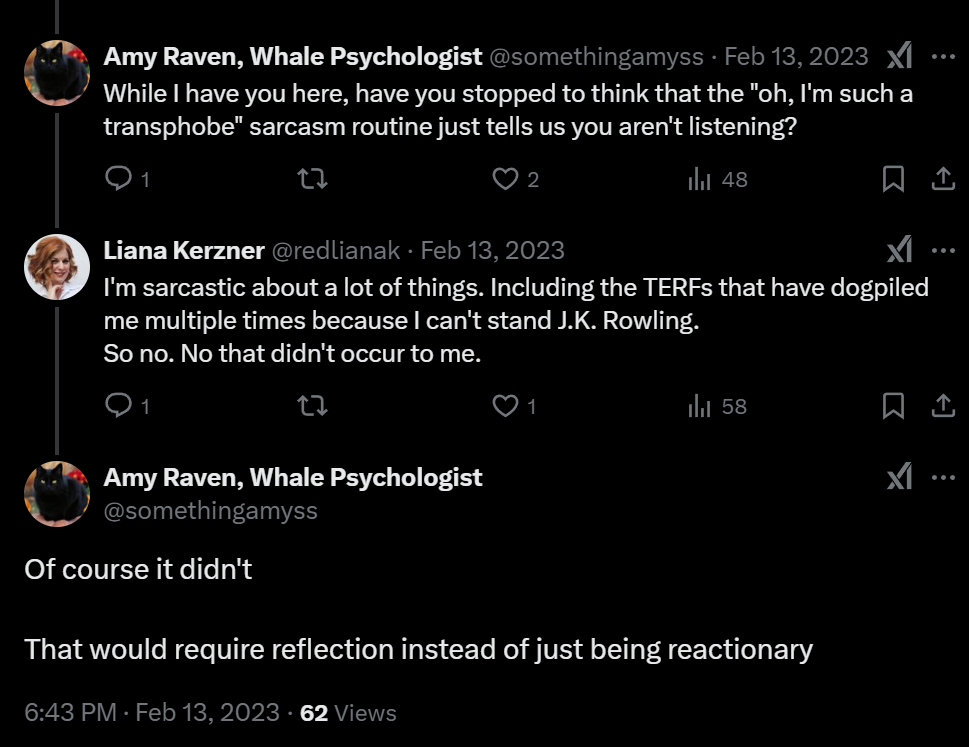
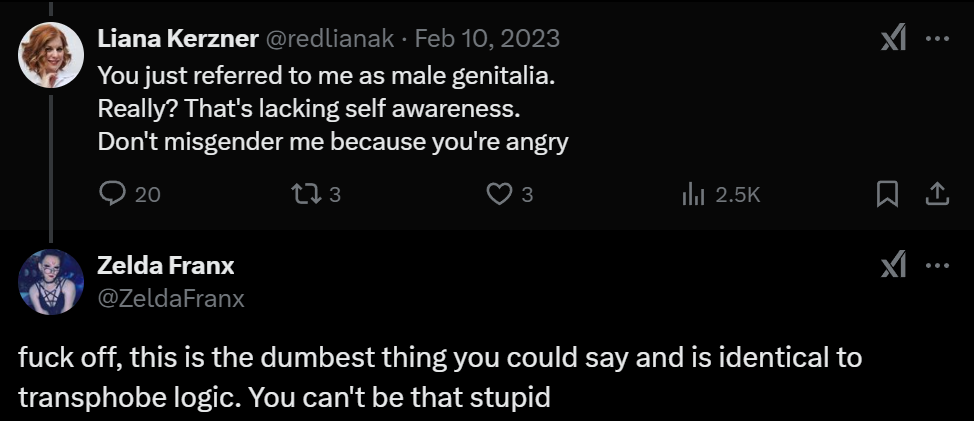


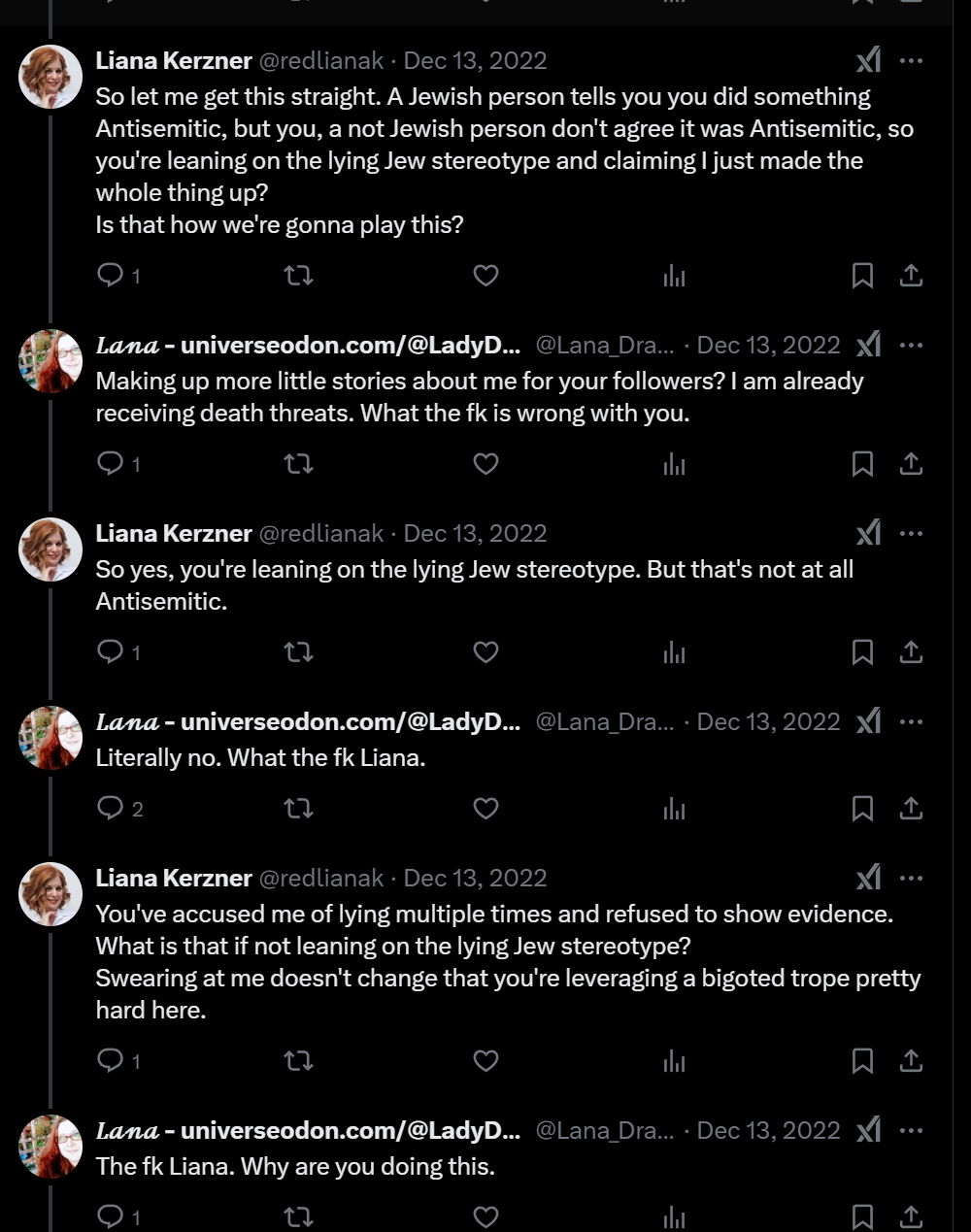


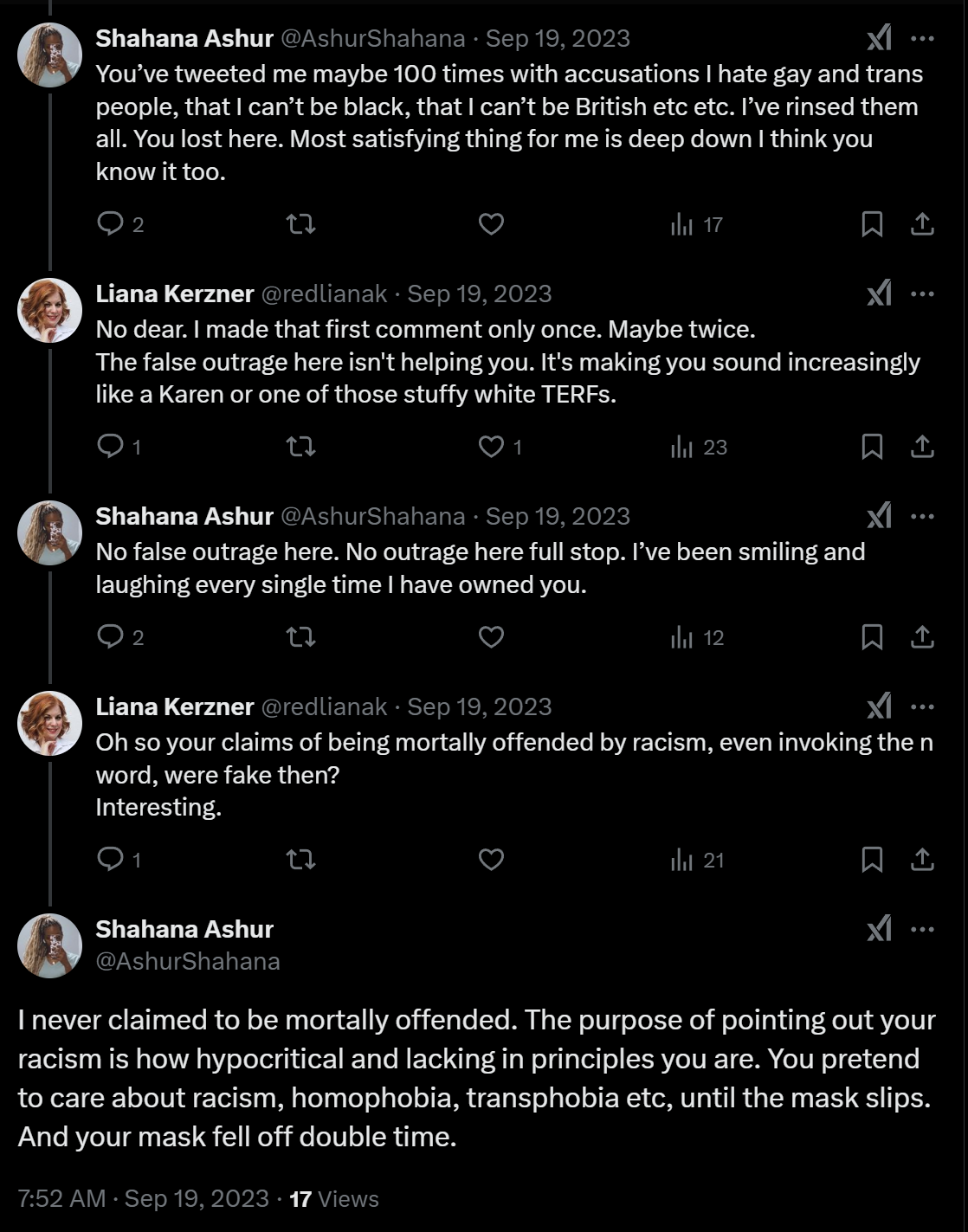

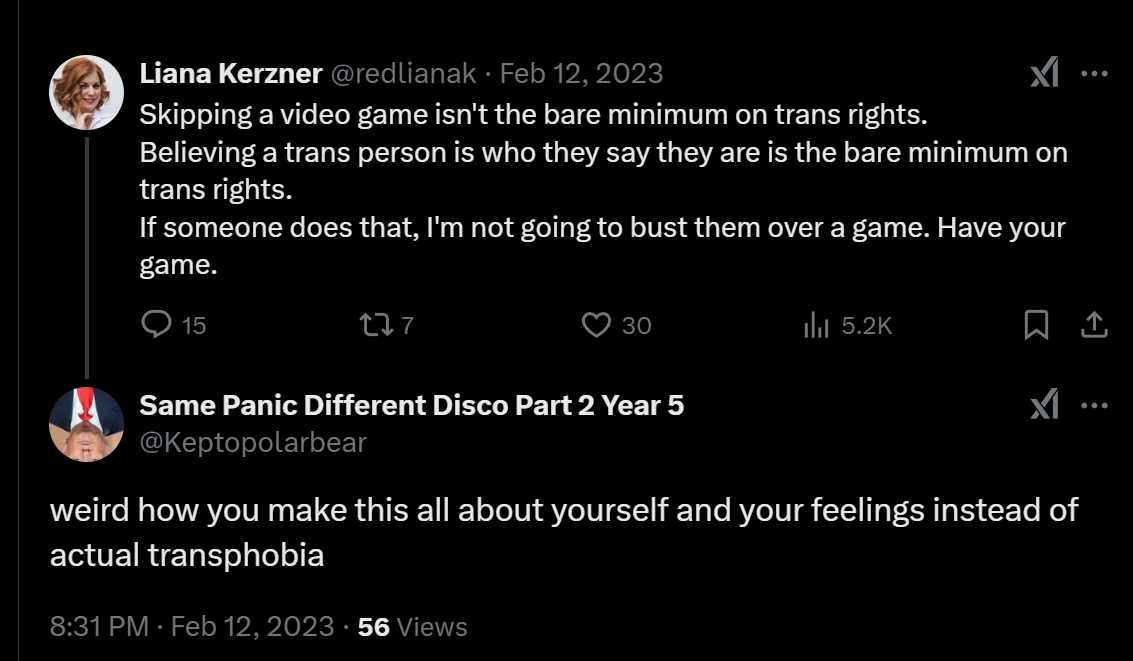


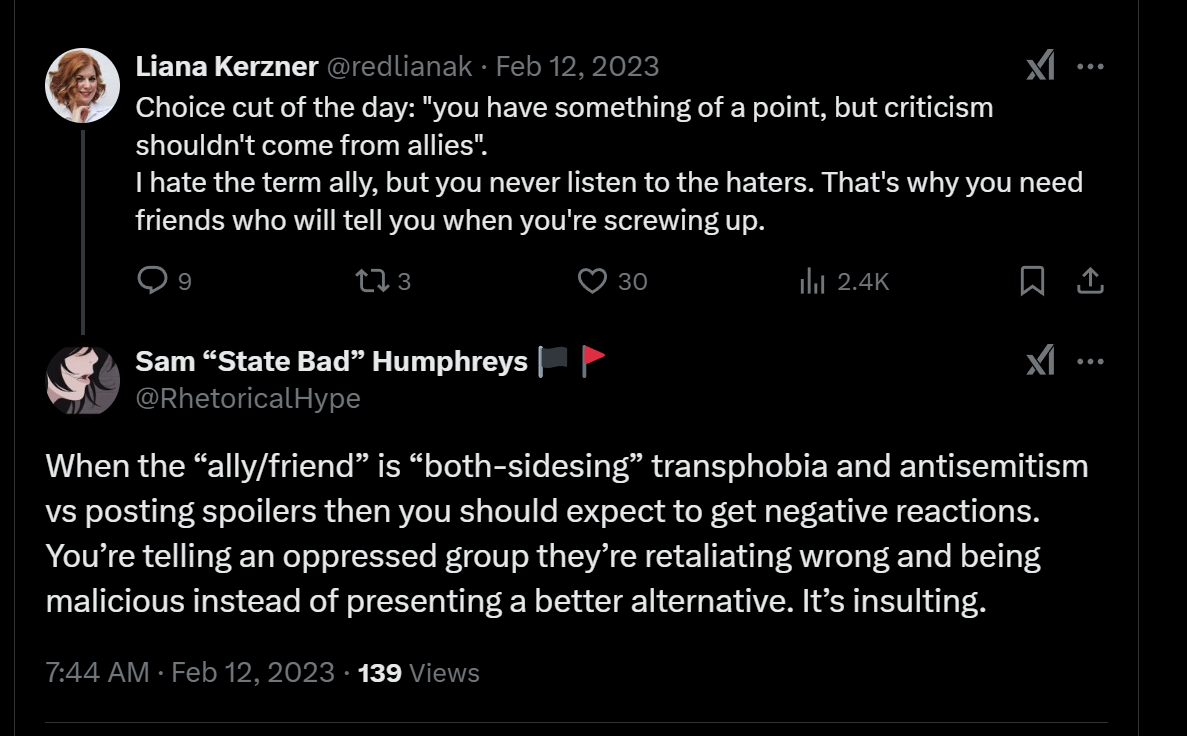

Kerzner’s claim that Asher’s argument with Poppy was transphobic does not hold up when the underlying exchange is examined. Asher’s criticisms followed the same pattern he uses in other disagreements: identifying what he sees as manipulative rhetoric or sophistical argumentation based on a person’s words and actions rather than their identity. The same analytical framework has been applied to others as well.
In fact, we have observed similar communication patterns in Liana Kerzner herself—who is a cisgender woman—demonstrating that the critique is directed at behavior, not gender identity.
Asher is also far from the only person to have raised concerns about Poppy’s conduct. Several months after what participants later called “The Very Ugly Fight,” one of Poppy’s girlfriends (a trans woman herself) left “The Foundation”—the name Poppy gives to the inner circle of her Discord community—and published an account describing her experiences within that group.
Download Saige's account by clicking on the icon below:

There are numerous troubling allegations in Saige’s report that align with accounts shared by other former girlfriends of Poppy. Notably, all of the individuals making these claims are themselves trans women.
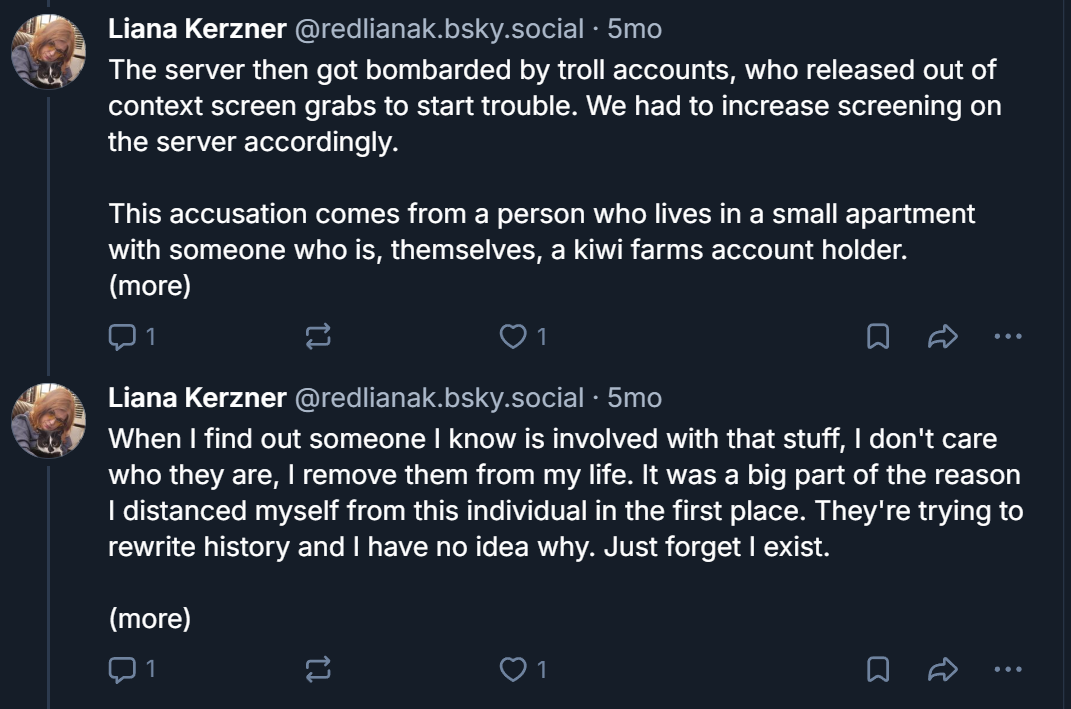
Following Saige’s departure from The Foundation, Poppy began accusing her of being a “KiwiFarmer” around August 9. This mirrors a similar tactic later used by Liana Kerzner, who accused Asher of being associated with Kiwi Farms as well—referring to him in one skeet as “the kiwi farms account holder” (notably using her own idiosyncratic spelling of the site).

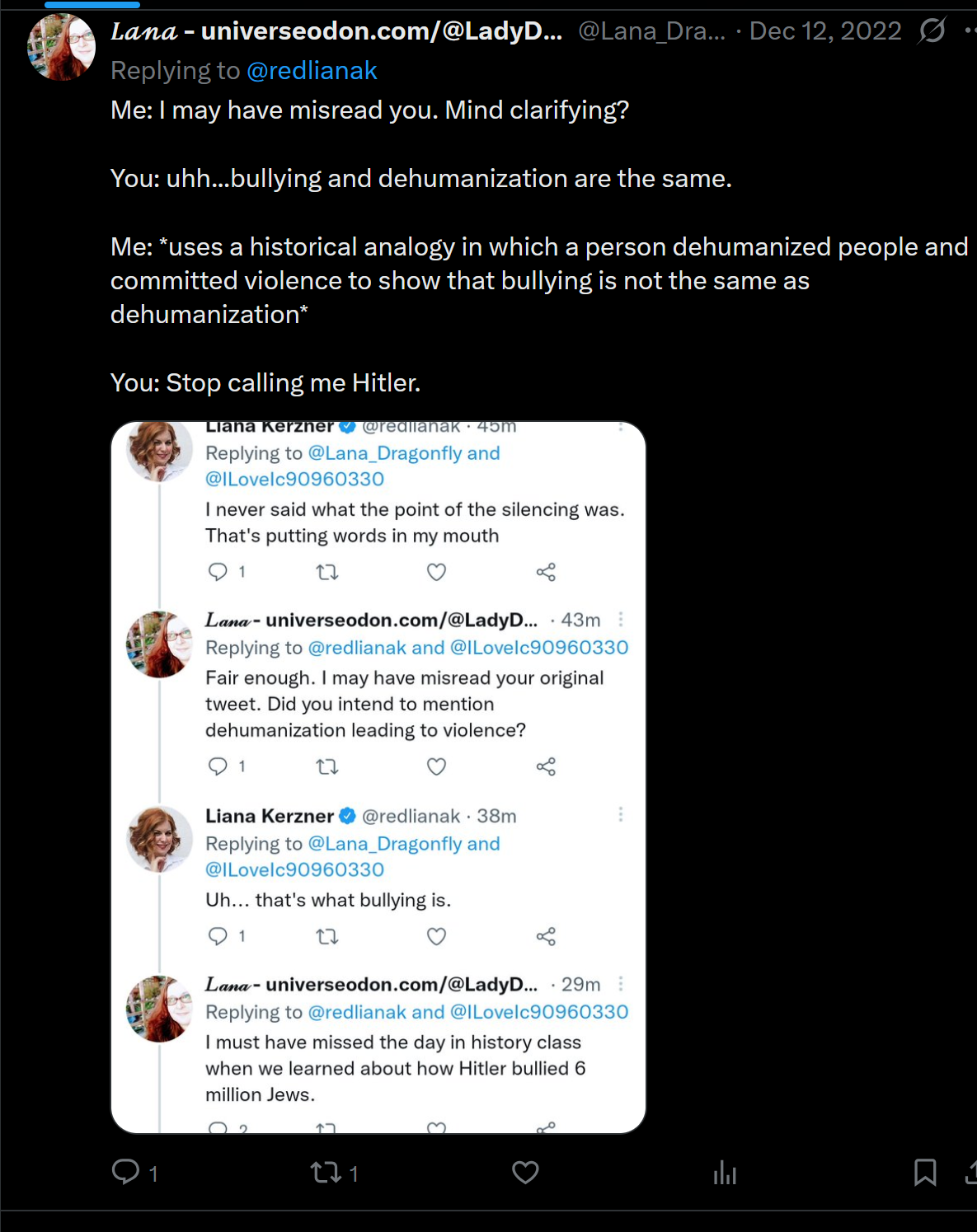
Interestingly, if Kerzner’s own standards had been applied to her by us, Asher and I would likely have distanced ourselves from her within a year of first speaking with her. An exchange with Asher on July 19, 2020 shows that she was not only familiar with the website in question but had used it to look people up:

Interestingly, although Kerzner is very familiar with the site, she frequently spreads misleading information about it in ways that discourage people from looking into it themselves. While it is, to borrow a phrase, a wretched hive of scum and villainy, it does not, in fact, contain so much malware that simply visiting it causes malware detectors to trigger—as she claimed in one YouTube episode. The site exists primarily to coordinate harassment and bullying; it would run counter to its own purpose if its users had to navigate a technological minefield just to access it.
Portraying the site this way nevertheless works to Kerzner’s advantage because it effectively frightens people away from examining what is actually posted there. Like Saige, both Asher and I eventually had to begin monitoring the site’s threads simply to stay aware of any harassment campaigns that might target us. In doing so, Asher was able to identify an individual impersonating him and attempting to provoke a coordinated harassment effort. This was the same person who had previously doxxed us on Kiwi Farms and who, we have good reason to believe, is currently active within Kerzner’s community without her realizing it, as explained in my video "Who is harassing Liana Kerzner?"
Contrary to what she later told her Discord server (seen in previous screenshots in the Emily Schooley section), Kerzner was aware of this individual’s existence as early as 2020, and I have documented evidence to support that claim. This person is not the same KiwiFarms user who was later discovered to have been participating in Kerzner’s community for a period of time and who is discussed in the second half of that video.
Yet, much as Poppy attempted to smear Saige by associating her with KiwiFarms, Kerzner has done the same to us for the simple act of monitoring threads where harassment against us was being discussed. In practice, this amounts to blaming the targets of harassment for attempting to protect themselves. It is also notable that Kerzner’s extended public tirade—which will be examined in detail later—had the effect of drawing attention away from the video in which I raised several uncomfortable questions and documented a small but telling set of contradictions in her public statements.
Nevertheless, some observers who examined the evidence I presented began reaching their own conclusions about Kerzner’s attempts to discourage scrutiny of a website she herself had previously used as a source of information.

If simply looking at Kiwi Farms makes someone a “KiwiFarmer,” as Kerzner has asserted, then by her own standard Liana Kerzner would also qualify, since she has acknowledged using the site to search for information about people. Therefore, this is a demonstrable lie.
Kerzner’s siloing of information also resembles the dynamics reported by former members of Poppy’s community. The user now known as Esther Talbot (formerly Dusk Noir/Nightwylde), once a core member of Poppy’s “Foundation,” has written an article describing their experiences there. A survivor of cult abuse, Esther identified several patterns in the server’s social dynamics that they found disturbingly similar to behaviors they had previously encountered in cult environments.
I am not personally familiar with the internal workings of Poppy’s server in the same way that I have observed firsthand reports of Kerzner's Discord community, nor do I have any desire to investigate it further. I find Poppy herself to be a deeply distasteful individual, and several people who were once close to her—who have since left—appear to retain some of the same behavioral patterns that characterized that environment.
What matters here, however, is that Kerzner’s claims about a supposed transphobic narrative cannot survive when examined against the available evidence. Many of the people who have accused Poppy of manipulative behavior or mistreatment are themselves trans women or gender-nonconforming individuals. When I pointed out that Saige and several other trans women had described Poppy in language strikingly similar to Asher’s, Kerzner ignored the point.
If Poppy is manipulative—and in my personal opinion her behavior strongly suggests it—this would not be because she is a trans woman. Nor, in my view, would Kerzner’s own manipulative tendencies arise from the fact that she is a cisgender woman. Behavior should be judged by actions, not identity.
Kerzner has argued that one cannot infer a person’s character from their actions, drawing a distinction between the two. I reject that premise. As F. Scott Fitzgerald wrote in notes for The Last Tycoon, “Action is character.” What people do—especially repeatedly—reveals far more than what they claim about themselves.
With that in mind, we will continue examining Kerzner’s conduct both during and after the “Very Ugly Fight.” As the record unfolds, it becomes increasingly clear that Asher was not an isolated case but one instance within a recurring pattern that appears across multiple conflicts—those involving D, Gail Simone, potentially Emily Schooley, Song, Vagabond, and perhaps others before them. The question that remains is not whether this pattern exists, but how many times it has already occurred—and how many times it will occur again.