LIANA KERZNER
Immediately following the confrontation with Poppy, Asher spoke to Liana — as he often did. In fact, towards the end of their friendship, Asher and Liana were talking on an almost-daily basis. You can see the immediate aftermath of Poppy's actions displayed in the chat. You can also see Asher admitting that Poppy's actions had an angering effect on him.
However, if you look at the timestamps of the conversation, Asher went to cool off for about an hour and, when he was done, spoke to Liana again and essentially told her he was ready to move on. Both Poppy and Asher had blocked each other and Asher making a note that he didn't want to interact with Poppy again.
One thing he did do in anger, however, was to write "The trolls were right" right after Poppy put him on blast. By this, he meant to say that the trolls who had made claims about how Poppy handles interpersonal conflict specifically were right.
However, after he calmed down, he realized it wasn't a good phrase and deleted the message. Then Liana Kerzner spoke to him in the following manner:
This is the moment at which Asher blocked Liana. I am going to explain what happened to cause the blocking, and it has to do more or less with Kerzner's following phasing:
"It's not delegitimizing when you are actually going too far."
First, this phrase directly negates the person's own experience (“It’s not delegitimizing”). It asserts that the perception is incorrect in a definitive, declarative manner without any intent to explore the person's experience. Linguistically, it functions as a categorical rebuttal whose only function to shut down dialogue rather than invite clarification.
Second, the clause “when you are actually going too far” introduces a normative judgment. The word “actually” strengthens the claim by implying that the speaker’s interpretation reflects objective reality, while the other person’s interpretation is mistaken. Meanwhile, “going too far” is a vague but evaluative phrase that frames the other person’s behavior as excessive or unreasonable without specifying what boundary was crossed.
Third, the sentence structure creates a causal reframing: it implies that the perceived delegitimization is not a problem in itself because it is justified by the other person’s behavior. This can easily be heard as blaming or dismissing, particularly when someone is describing a hurtful interaction.
Finally, the phrasing lacks softening or hedging language (e.g., “maybe,” “I wonder if,” “it might be that”, "seems"), which are common conversational tools used to maintain collaboration and reduce defensiveness. Because the statement is declarative and evaluative, all it does is ensure escalation.
In summary: even just taken on its own, the phrase is linguistically invalidating and judgmental in tone. It denies the validity of the other person’s interpretation, it asserts a specific version of reality (“actually”), and characterizes the individual's behavior as excessive without nuance, bereft of any invitation to discussion. This is, essentially, a high-conflict formulation within an interpersonal setting.
Since neurodivergent people often experience their perceptions being discounted, this type of language is likely to reinforce this and even potentially trigger a reaction.
If this appears to be an over-detailed analysis of Kerzner's wordings, it must be underlined that this analysis is something that went through Asher's head at the moment of the exchange . While it may be hard for some to believe so, and despite Kerzner's constant attempts to paint Asher as incompetent and clueless , Asher is deeply observant and attuned to interpersonal dynamics, and is blindingly fast in his analysis.
It must also be observed that since the event of the cancellation video, Asher has been seen by four different mental health licensed practitioners (some practitioners had to transition to other postings, or retired, necessitating a transition), and all of them have also supported this analysis. Having access to unadulterated and complete logs of the event (as you are now, as well) all of them also have pointed out Kerzner's actions as disturbingly controlling , which is a throughline that was also evident with Mitchell Jura's therapist and their analysis of Kerzner. Additionally, friends who are also mental health practitioners have examined the communication and come to similar conclusions.
None of the people mentioned have a high opinion of Kerzner's actions and tactics, and all of them are deeply concerned. Which personally encourages Asher to continue talking about this, and the reason behind his request for his It's Not Therapy episode to be taken down because he sees it as exploitative in light of Kerzner's actions.
This is a request Kerzner has refused, and has, instead, accused Asher of lying in the episode. Once again, trying to control someone's narrative for them by implying his reasons for wanting the episode taken down are not the ones he has stated.
With those items in mind, we can now see the conversation that ensued once Asher unblocked Liana. I am embedding the entire chat export here for you to be able to peruse in its entirety, and then we'll take a look at specific parts. In the next section, we will examine how Liana Kerzner has portrayed this event, and other subsequent events, and how her claims do not hold up to factual, documented reality.
You can download the full exchange directly here:

CONTENTS
These links are provided for ease of navigation. However, for the sake of comprehension and continuity, you should read through without skipping sections.
PREAMBLE
Asher proceeded to block Liana after she sent him the message that included the statement above. It is at that moment, and not before , that Asher experienced actual splitting. He split on Liana , not Poppy. Once Asher had gathered himself after the event, and after he had returned to baseline at the end of the two and a half week period, he explained what what happened to him.
Upon reading Kerzner's statement, he immediately perceived the throughline of the dismissal that was underlying the statement. The preceding sentence stating "that sure looked like a split to me" from Kerzner set up the tone of the dismissal. Feeling the onset of the overwhelming emotions coming, Asher blocker Kerzner on Telegram and all social media immediately.
At the time, he was too upset to explain his actions to me. He was in an extremely heightened and distraught state. Afterwards, once the very intense emotions had subsided, he explained that because of all the years of therapy and doing the work, he could recognize the fact that he was about to decompensate, and decompensate hard . And if he didn't take measures to isolate himself, he might have lashed out at Kerzner in his decompensated state and might have said or done something he would truly have regretted later on. And so, he shut down and maintained radio silence with Kerzner and social media for weeks.
This is a development that should not have surprised Kerzner. A year and four months prior to this event, Kerzner had invited Asher onto her show for an interview, in order to give listeners a close and personal perspective on Borderline Personality Disorder. In the segment that starts at the 41 minute mark, Asher talks about what he does in situations just like this one:
Asher: "My biggest cope to be honest is— I've learned over time to just not to not act. It's become almost second nature, really, but to me... once my emotions —and this is the thing I don't think people realize about borderlines: my husband showed me a study I mean in a book that borderlines experience emotions, oftentimes not every emotion, but they experience emotions oftentimes much more severely. That doesn't necessarily make them special. It's just it's so, so strong... and when you get into a space where all the limits are off, there's nothing regulating anything. Any of your emotions. I've learned, because when I have acted it's ended up in unaliving, right? And I've kind of learned to shut completely down and I turn inward completely. And that maybe that's good, maybe it isn't, but it keeps me from doing things. I prevent myself from doing things like, I'll think to myself "God I just wanna" — you know — "I just want to bang my head against the wall. I just want to take all my meds. I just wanna stab my eye with something, oh I'm gonna—" but I don't do it."
Kerzner: "Yeah it's the part of your brain the do something part of your brain kicking in, it's an amygdala hijack, yeah, and you're doing the right thing."
Asher: "And I just I just stop. I just stop acting at all. And I- I think it, and I really want to do it, but I told myself: don't do anything! And I basically, I just wait until the whole thing (passes). Because, in my experience, it used to not be like this. Because I used to not be able to see any end to the tunnel, yeah. Every time, almost every time. And my mom would point it out every time. She'd say 'See I told you, it calmed down, and you gained some perspective. My biggest thing is- it's all mental. In my mind, my biggest antidote to all, to lots of freaking out and emotions and everything else, is perspective."
So as we can see, keeping historical context in mind (something Kerzner actively discourages by practice), Asher's response is perfectly in line with his stated symptomology— not only that, but he also showed a great deal of restrain in his response by seeking to minimize any blowouts with Kerzner.
Insofar as the length of his shutdown goes, I have some more details to add:
In a Healthline article medically reviewed by Dr. Tiffany Taft (PsyD) and written by Erica Cirino, a borderline split episode is described in this fashion:
People with BPD often experience intense fears of abandonment and instability. To cope with these fears, they might use splitting as a defense mechanism. This means they might cleanly separate positive and negative feelings about themselves, objects, other people, beliefs, or a situation. A splitting episode can last for days, weeks, months, or even years before shifting.
So once again, although the period of two-and-a-half weeks may seem excessive to some, for someone with borderline personality disorder, it is not unheard of. Asher, by that point, had known Liana for five years, and he felt that a friend of five years had been on the cusp of invalidating him... in favor of someone who demonstrably behaved in a manipulative manner.
How has Kerzner portrayed this period since the rupture and the cancellation announcement? No more than one month after the cancellation, Kerzner mocked Asher on her threads account in a conversation with Naomi Paul Poru, one of her Discord community members:
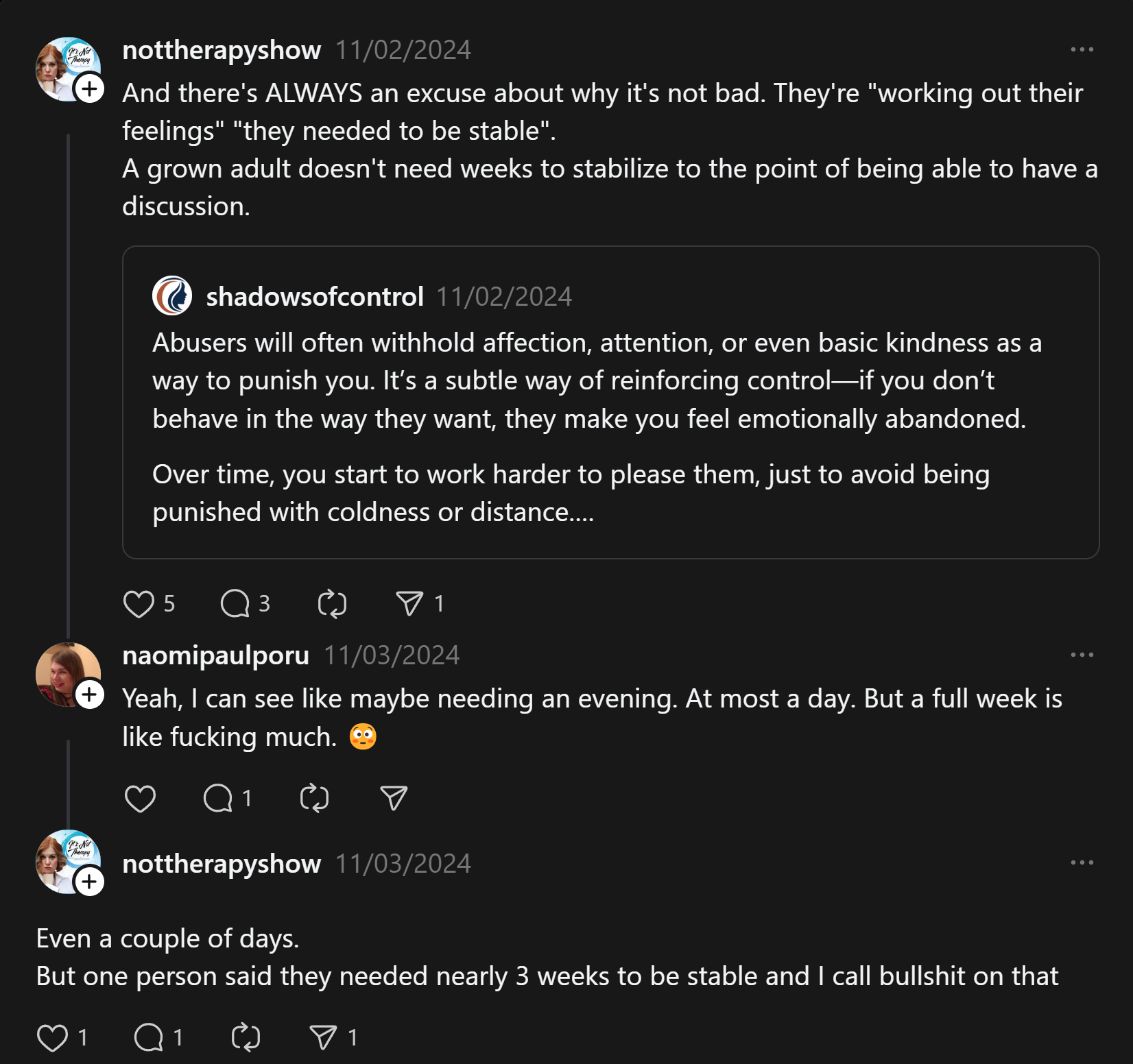
At this point, I need to point out that Kerzner, by her own account, does not have a background or credentials in clinical practice. She does not have the qualifications to dictate what an “acceptable” period of recovery is for someone with a personality disorder.
Her interactions with various neurodivergent individuals with special considerations documented so far show a pattern of dismissive, aggressive, and highly normative communication that have had harmful effects in those cases.
Nevertheless, just as her community turned on Vagabond in what can reasonably be described as mob behavior, you can see the kind of messaging that Kerzner—a peer counselor seeking to help people with mental health and who claims to fight mental health stigma—presents as acceptable. This is the guidance her community looks to, and visibly emulates.
Notice the context of the thread that Kerzner is quoting— referring to abusers. Keep in mind that Kerzner has painted Asher as abusive in their exchange.
After two-and-a-half weeks, Asher returned, ready to apologize to Kerzner for having blocked her.
ANALYSIS
We do need to cover this conversation and the dynamics that were in evidence, what the documentation shows versus what Liana Kerzner has told the public . Once again, I expect you to read the full conversation and not to take any claims I make about the full contents therein at face value. I am not requiring your faith on this issue, but your critical thinking. I must apologize for the length, but it is necessary and important details cannot be omitted.
Liana Kerzner will, most likely, object to the adding of 'commentary' to the logs. I will point out that she has provided commentary to the conversation for over seventeen months in her Discord, Youtube channel and her radio show. The only difference is that Kerzner has done so bereft of all context that others could see, and thus all the audience had was her account and her description of the situation. And it is something that she implicitly expects others to accept without question.
For sixteen months, she has dominated the narrative with a description of the situation that is not, in fact, true, and does not match the documented evidence — very much in keeping with all the other cases we have examined in this document.
So now, we are returning the full context to everything, and demonstrating to what lengths Kerzner has gone to misrepresent the situation.
I. The First Apology
Throughout the majority of the exchange, Kerzner will position herself as the person who will evaluate the accuracy of Asher's statements, but who will react with appraisable hostility should the same standard be applied to her.1159
LK: “Because I don't want to be the next person your BPD convinces you is out to get you.”
From the very onset, Kerzner assumes a diagnostic framing. With this positioning, Kerzner starts from a position where Asher's conflict with Poppy was nothing more than symptomatic Borderline Personality Disorder. As we have seen, there was more than enough reason to consider Poppy's approach to Asher as manipulative. But, at this point, that possibility isn't entertained in Kerzner's framework.
Notice that Kerzner also refers to mental illness as a weapon . This is a way to refer to personality disorders and mental illnesses that I've primarily encountered when I was monitoring the infamous troll/harassment forum called KiwiFarms, for my own safety. In hindsight, this perhaps should have been another red flag.
LK: "I have a disease that tells me everyone will eventually turn on me and side with the stalker. But do I just act on it? No. I see it for what it is and I take responsibility "
Here, Kerzner sets up a moral comparison where she claims to control her illness (and therefore implying Asher must do the same). However, her behavior throughout this encounter, and later, will prove this is not the case. In fact, the set pattern for Kerzner that has been seen all across the many, many conflicts explored here demonstrate one consistent pattern that stretches back many years. This pattern was first observed in October of 2023 by an associate of Kerzner's who was, also, a LianaKares customer of hers. A man who was later revealed to be the transphobic KiwiFarmer who targeted me and my husband, and whom we unmasked publicly ( to Kerzner's very suspiciously public denunciations ) as Young Adult novelist Giancarlo Vanzzini posting under his 'troll' identity of Hugo(Not Derrick) .
Youtuber Matt Zion had a contentious exchange with Kerzner. Describing his experience, Zion said:
"That had no reason to turn as bad as it did. Kinda sad because I respected her opinion on most things. Wanted a debate but got hostility. Still not sure why."
Upon which time, KiwiFarmer Vanzzini responded:
"Liana does this thing where if you disagree with her, unless you're part of an inner clique, she'll interpret everything in the worst light possible. I've seen her accuse someone of making threats against her in the Youtube comments when the person was like sucking up to her."
Zion agreed:
"She seems to go from zero to ten in an instant. We've had a few interactions over the years that were pleasant and all of a sudden she's saying I'm talking to her like an abusive husband like wtf lol."
You can see the branching exchange between Kerzner and Zion here, and you will recognize the same pattern repeating there as well:
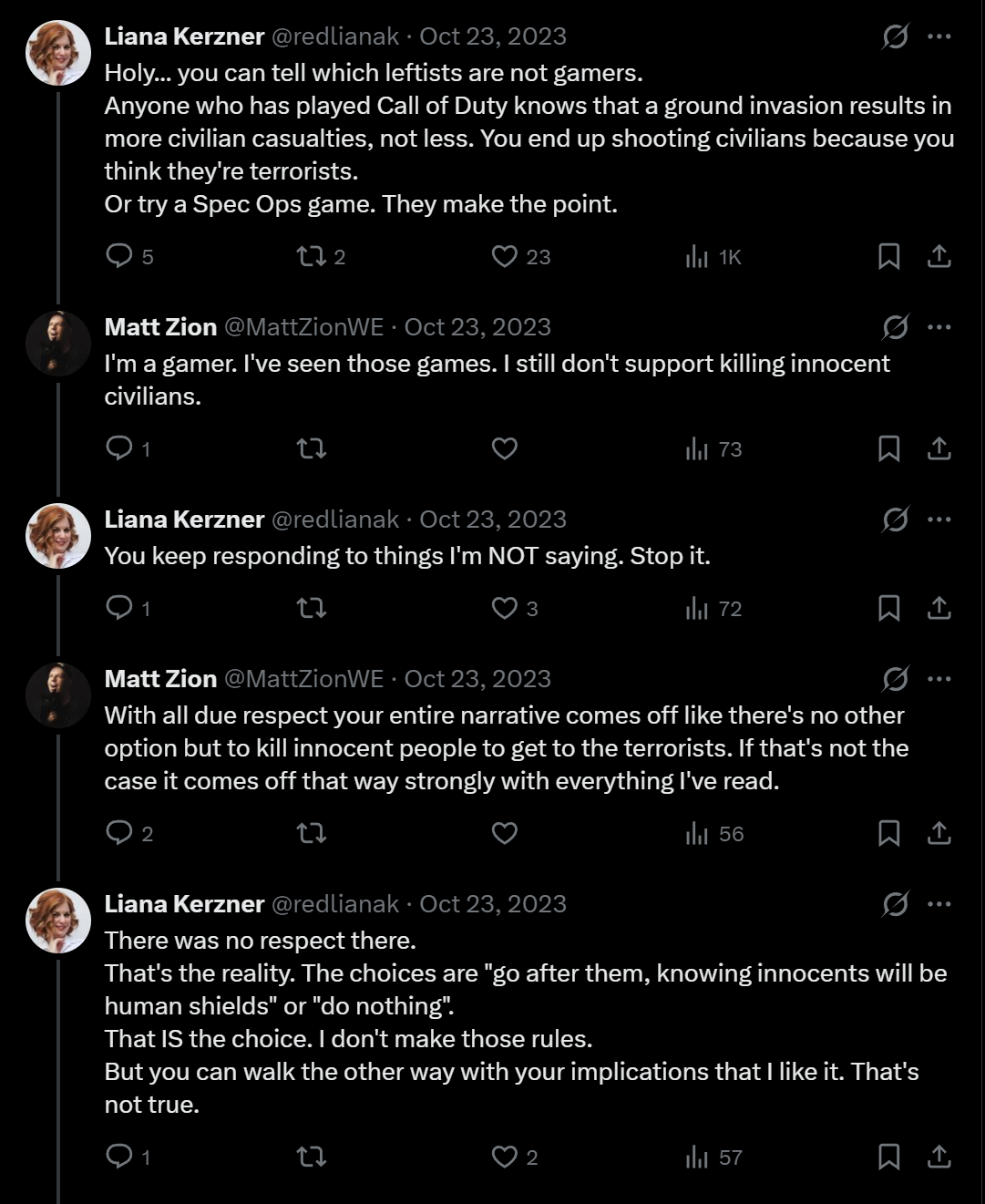
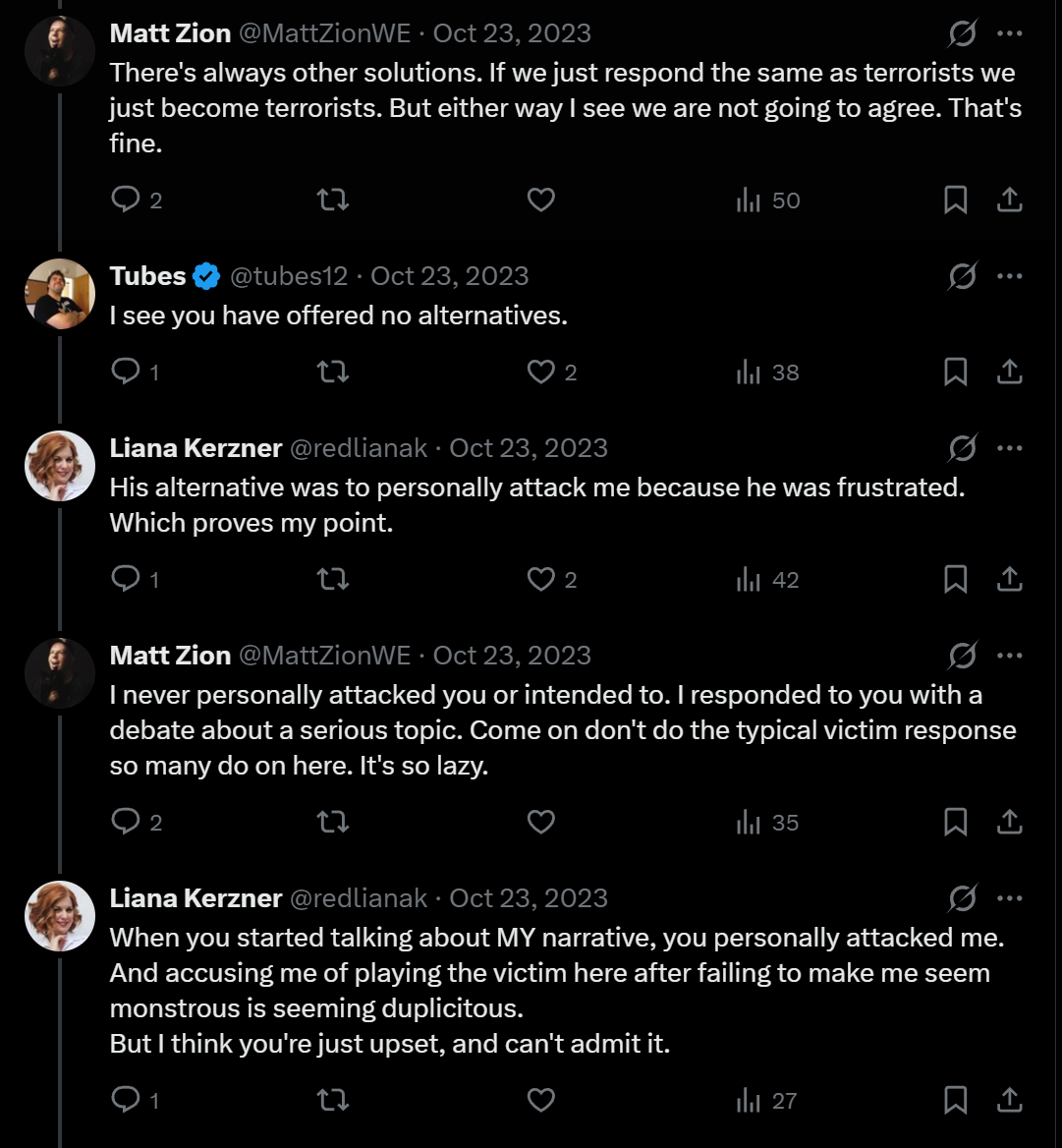


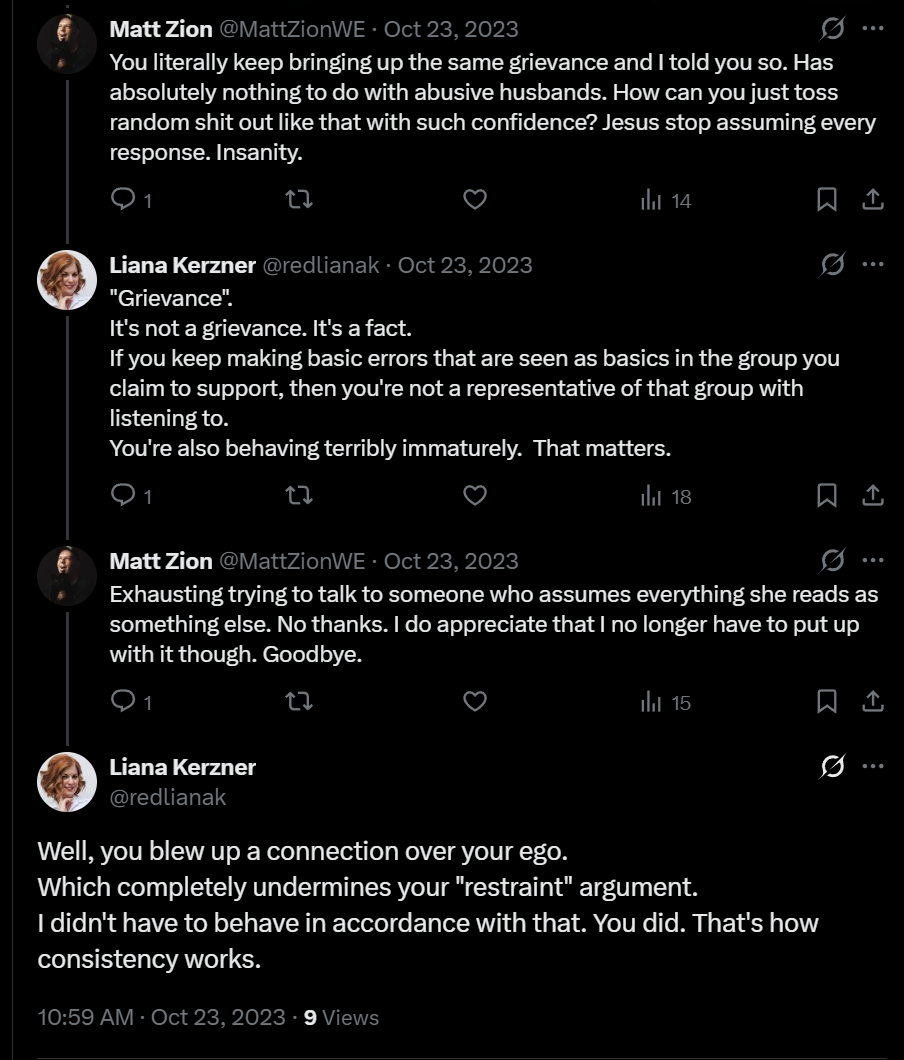


You will remember that Kerzner's knee-jerk reaction to condemn Asher after his disagreement with Poppy was saying that 'the trolls were right,' making a very strange leap in logic that, if they were right about something they said about Poppy, then they have to be right about what they said about her.
This is a standard black-and-white logical fallacy, because critical thinking indicates that anyone is capable of providing a truthful and accurate observation just as much as they can provide a false or inaccurate one. Whether they choose to do so or not on a regular basis is beside the point. To immediately discard a claim or an observation solely on the merit of who makes it instead of examining the veracity of it is, in fact, to operate from a mixture of Ad Hominem and Poisoning of the well fallacies... something that Kerzner herself employs liberally when she labels anyone in active conflict with her as 'stalkers' and weaponizes the toxic femininity stereotype of the besieged female in order to force anyone paying attention to avert their gaze from any claims proffered by 'the stalkers.'
Because... you don't want to empower 'the stalkers', right? That would make you a 'bad person.'
Unfortunately for Kerzner, the evidence in this website already demonstrates one thing: no matter how painful it may be to admit that someone so deceitful as Vanzzini is... he did, in fact, correctly assess Kerzner's entire approach to conflict. The troll was right. Once Kerzner has made up her mind that the other person is to be wrong no matter what, there is very little in the exchange that won't be taken in the worst possible light by her. Examining Kerzner's exchange with Asher, my friend Raven also remarked upon it:
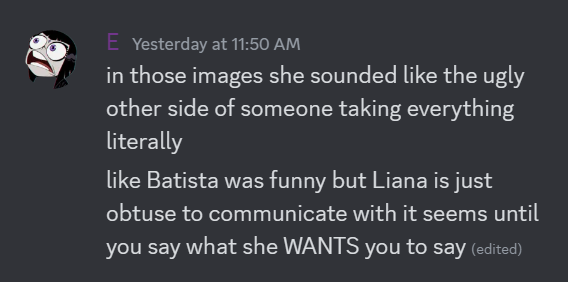
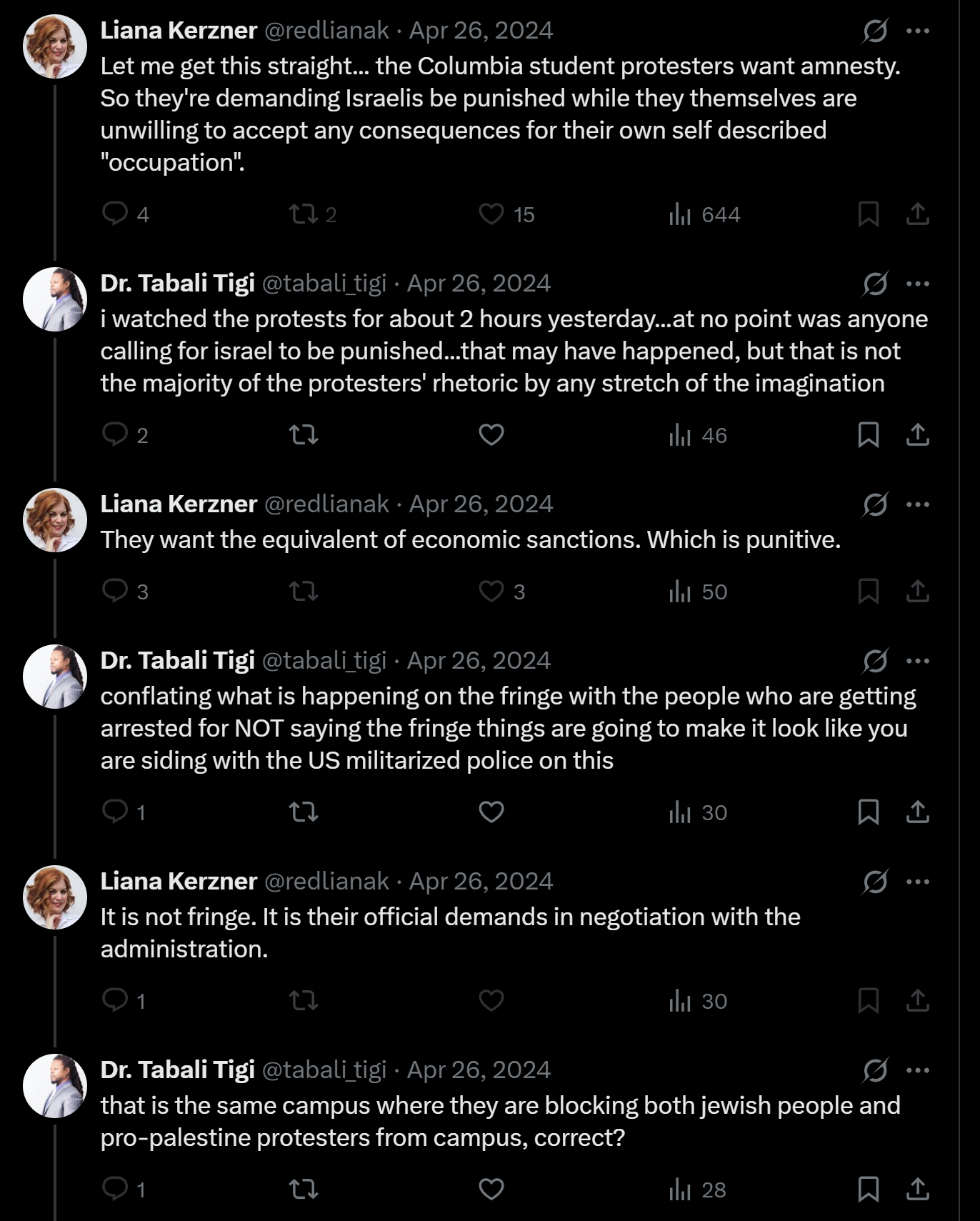
The same pattern of reading in bad faith once a disagreement is reached is so prevalent in Kerzner that it is almost omnipresent. And I feel responsible for not having paid enough attention to her social media history to notice it. Here is another similar example with Dr. Tigi:


However, someone else remarked upon it even earlier than that, and it was Gail Simone herself, and my biggest error was not to pay attention to it:
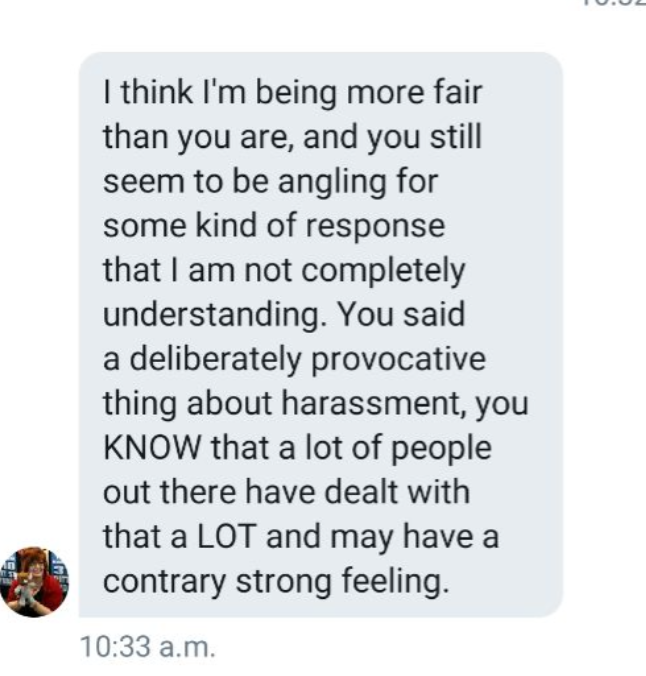

At this point, the pattern that occurs with almost every public rupture of Kerzner's has become unmistakable. Kerzner will put off airing any grievances with an individual— either because she may have use for them still, or who may have more social power than she does— until it boils over and comes to a head, forcing a confrontation. That confrontation is always set up as a no-win scenario. Asher was never meant to survive the conversation with Kerzner intact . Neither was anyone else who ever went down this path with Kerzner.
The aftermath and what she does with the discarded individuals depend on how much social power they have over Kerzner. Kerzner can't publicly denounce Simone for rejecting her— Gail Simone's legacy, reach and stature within the comics community is unquestionable. So instead she tells her curated server that she bullied Kerzner and turned on her. I believe she is very aware that her case against D held no water, but was counting on the Coles wanting to avoid any legal issues... though, in my opinion, if it had gone that far, Kerzner wouldn't have pursued it because the optics of it would have been disastrous for her at the time of discovery. Not to mention that the Coles have a place in gaming history because of the innovations of the Quest for Glory series and are very much universally beloved, whereas Kerzner — despite working on multiple games— has never seen the successful launch of a single game project. Poppy and Liana are engaged in what I theorize is a double jeopardy scenario: Kerzner can't denounce her rupture with Poppy out of fear of being branded a transphobe, and Poppy can't denounce Kerzner out of fear of Kerzner recanting her defense of Poppy. Asher, me, Song, Vagabond and many others, though? Easily discarded, their stories and voices erased by her own appropriation of the narrative.
We continue with the conversation:
LK: "Pablo accused me of betraying his confidence yesterday, so the idea that I stay the person I am in either of your eyes when shit gets real is out the window. So I have to protect myself."
As I mentioned before, Kerzner is referencing something I said to her — when she told Asher that people were afraid to anger him because he would 'take it out' on me. The only reason they could have had to come to that conclusion is if Kerzner was portraying details of our private lives in a negative way, especially the recordings. When I confronted Kerzner with it, she said that people in the server had picked up on 'contextual cues' because of how much Asher likes to debate (which I didn't buy), and then she said that nothing I had shared with her could be considered to be shared under the expectation of confidentiality.
That is the moment at which I began to have a terribly uneasy feeling. As her confrontation with Asher began to unfold, the uneasy sensation grew as more and more elements of the Gail Simone fight started emerging. In my opinion, my beginning to suspect that Kerzner had been betraying my confidence and even weaponizing my husband's mental illness to members of her community —a suspicion that has been confirmed since by ex-members of her community— resulted in Kerzner accusing us of shifting our image of the person she was in our eyes "when shit gets real."
Asher, having received a good amount of harshness from Kerzner already (but nowhere near as bad as it would get), himself observed that it seemed to him that Kerzner's opinion of him had shifted, as her judgement of him was full of assumptions. So after Asher explained and Kerzner chastised him for being not direct enough, at which point he says:
AW: "I thought that’s who I was in your eyes, but it seems not to be."
LK: "Do you realize how many huge assumptions are inherent in that?
I thought - your perspective
that's who I was in YOUR eyes - my assumed perspective
but is seem not to be - another assessment you didn't check out before coming to a conclusion"
AW: "To me it seems you’ve come to a number of conclusions about me the same way."
LK: "Why don't you ask instead of assuming? Because you don't actually KNOW. Hence SEEMS. I'll take that as a "yes" in response to my question, by the way. But actually answering questions would help with clarity"
AW: "Who am I in your eyes?"
LK: "That's a huge question and some acknowledgement of what I just said would help contextualize it correctly
WHO you are and WHAT your lack of impulse control means are two very different things
This is reading like "did a bad thing" = "am a bad person" and I am completely uncomfortable going there. Your question is a trick: a proper answer requires enough information to fill an entire library"
In pointing out that Asher perceives that Kerzner has also shifted her concept of who he is in her eyes, he is introducing reciprocity and an avenue for both parties to speak on an equal footing. Kerzner, always maneuvering to maintain asymmetry, cannot tolerate that and immediately imposes a communication rule: Ask, don't infer.
Asher immediately follows Kerzner's direction and asks 'Who am I in your eyes?'
Kerzner refuses to answer directly and instead introduces behavioral critique of Asher. At this point Kerzner has demanded direct questioning, then immediately chastised the person for direct communication . She then assigns a manipulative intent to the question ("your question is a trick"), despite her constant demands that no-one assign intents to her own actions. Once a question is labeled a trick, the discussion inevitably starts shifting away from substance and towards motive, as Kerzner is steering it here.
Kerzner doesn't respond to statements, she responds to what she believes they imply and treats it as an authoritative interpretation. You will see this at play throughout this entire conversation, with one very specific result: It doesn't matter what anyone says in response to Kerzner . Any justification or interpretation that does not match up with her evaluation of what that person's intent, motivations and emotional state are to be seen as suspicious, manipulative and in bad faith.
Kerzner insists that Asher operates from a 'bad person/good person' simplistic dichotomy. This is not Asher's principle dyad, it is Kerzner's . Asher tries to reassure Kerzner that he does not want to rest on the 'bad/good person' narrative in the part of the exchange that begins with:
AW: "I am a very guarded person (not necessarily private, but guarded), so communicating certain things is difficult for me. This can be to my detriment when others expect it to disappear for whatever reason. It won’t. I’m my father’s son. I don’t intend anything I’m saying to be a trick. I don’t want to contribute to any construction where I am a bad person because it’s not conducive to the relationships I would like to work towards. I am trying my best here..."
In his explanation, Asher explain his difficulty with personal communication and asserts that there was no trickery behind the question. He clarifies his intention and accepts responsibility for the harm, explaining his BPD reactions, coping strategies, and explains his usage of seems as hedging language. Kerzner's response is very reminiscent of Asher's confrontation with Poppy:
LK: “I said I was not comfortable going there, Asher.”
II. Weaponized Boundary
Asher agreeing that he didn't want to go into that narrative is treated as a violation of a boundary by Kerzner. I repeat: Kerzner implies a violation occurred simply for mentioning the topic that they are both agreeing not to delve into.
When Asher expresses confusion, Kerzner berates Asher's communication style. Again, Kerzner knows Asher is neurodivergent and has ADHD. She also was very much aware at the time that Asher was undergoing electro-convulsive therapy to treat his treatment-resistant depression. Kerzner repeatedly redirects any attempt at substance that concerns her towards Asher's communication style and interpreting his intentions:
LK: "Them (sic) just say that instead of a 5000 word essay full of "I'm not changing. I am who I am" when you know I need things to change."
From here on out, every attempt to clarify by Asher will be met by Kerzner's interpretations, she will never take Asher's words as authentic. When Asher disavows this, Kerzner does not allow the possibility of authenticity (in other words- she refuses to listen), but she instead doubles down in what can only be read as someone who is so certain of knowing the minds and intentions and emotions of other people that no doubt can be entertained.
Kerzner accuses Asher of answering his own question of who he is in Kerzner's eyes . Yet, this is not the case. Asher did not say "You think I am...", instead he said "I am ..." speaking about his perception of himself. At no point does Asher even say "You think I am a bad/manipulative/malicious person."
The pattern exhibited here is something you have already seen in the Gail Simone and Vagabond examples. It resembles what conversation analysts sometimes call a response-narrowing or double-bind dynamic, which can function like a rhetorical trap in practice. In this segment, Asher asks an open question (“Who am I in your eyes?”), but before the question can be answered, Kerzner reframes it as problematic: she introduces preconditions for answering, interprets the question as implying something she finds objectionable (“did a bad thing = am a bad person”) and then subsequently labels it a “trick," implying it would require "enough information to fill a library"... we need to emphasize that Asher didn't ask who he was , but who he was in Kerzner's eyes , which is a response that does not require 'enough information to fill a library' but merely her assessment of him.
Kerzner's sequence progressively shifts the conversation away from the original content and toward judging the legitimacy of Asher’s question and communication style. The practical effect is that several possible responses by Asher become pre-classified as invalid—explaining more can be criticized as talking too much and defending intent becomes a marker for manipulation.
This frame creates a Vagabond-like situation where the other participant’s available replies shrink and each new response reinforces the critique already being made. This is the point at which Gail Simone disengaged from Kerzner forever.
Asher tries to de-escalate and repair the communication breakdown. He explicitly signals willingness to change or be corrected and asks directly what he is missing or failing to hear. It is easy to observe that he is trying to reopen the conversation around Kerzner's perspective. Kerzner responds by asserting that Asher has already derailed the discussion and dismisses him as “talking to himself” and introduces the accusation of boundary violation.
Even mentioning that framing constitutes crossing that boundary, regardless of whether the mention was meant to reject it.
I want to emphasize how ridiculous, and how manipulative, that is. It is the exact same dynamic as if I had said "I don't want to talk about brown recluse spiders, they ick me out," and my friend had said "I agree, I don't want to talk about them, they are scary and disgusting" and I had immediately rounded up on them with a response like Liana's: "I said I didn't want to talk about them!"
There is no sane and reasonable framework in which an agreement to avoid a topic could be considered broaching the topic. Unless the underlying purpose was not the communication of a boundary, but an attempt to manufacture a boundary to be crossed in order to exert control over the other person's communication.
This demonstrates the presence of the double bind at work, and that the intent is one of control, not understanding. By the end of this section, the conversation has stalled on whether Asher crossed a boundary instead of moving forward to the original question.
AW: I have boundaries too.
LK: And you want them respected, don't you? So respect mine. That's a simple "Okay fair", dude. It doesn't require a novel.
AW: Okay fair. I agree with you.
LK: Well then start being more direct and take one thing at a time. No more philosophical sophistry
Kerzner moves to tighten her stranglehold on the the communication framework further. She instructs Asher to speak in shorter statements, and to avoid what she calls “philosophical sophistry," implying that Asher introduced it unnecessarily.
Liana Kerzner is the person who introduced, and misrepresented, the concept of intrinsic value. She punishes Asher for engaging with it in a very similar way in which Poppy Diabolique berated Asher for responding to the allegations of a Gish-gallop. Now Kerzner has added insult to injury by describing Asher's worldview as 'philosophical sophistry.'
Sophistry is the use of fallacious arguments, especially with the intention of deceiving. In essence, she is calling Asher a liar and a deceiver. When I very calmly confronted her over that (as opposed to her claims that I 'exploded' at her and abused her), Liana Kerzner tried to gaslight me:

Liana Kerzner never claimed to know is in Asher's head— except every instance in this conversation where she accuses him of insincerity, of not believing what he says, when she says that he is actually full of rage. Just like Liana Kerzner never called Asher a liar. Just like Liana Kerzner didn't yell at D because she had laryngitis that made it impossible for her to raise her voice before she spent seventeen minutes singing without amplification to room crowded full of people—
You get the picture.
LK: The problem is that you are fucking busting boundaries and being too aggressive so there's no space to give a shit because I'm too busy defending myself against that sort of bullshit OTHER. PEOPLE. MATTER. Your will is not the only real thing
AW: Okay, fair.
How am I being aggressive in this conversation?
LK: Seriously bruh? "It doesn't seem important to you" is passive aggressive horseshit
AW: My viewpoint is passive aggression? I have explained what I mean when I say "seems." You don't have to take it that way, but it doesn't negate my explanation.
You don't want to know that?
LK: Not okay, Asher
STOP thta
that
AW:Stop what?
LK: Stop baiting me to soothe you
It's fucking bullshit
AW: That is a HUGE assumption on your part about me.
LK: NOPE
AW: Like HUGE
LK: WRONG
In this exchange, Kerzner accuses Asher of being aggressive and “baiting” her to soothe himself, while simultaneously insisting that she is not assuming his intent but merely analyzing the structure of his communication. However, describing his behavior as “baiting” inherently implies a purpose, which in and of itself is an attribution of intent. When Asher points this out, Kerzner rejects that framing aggressively ("NOPE" "WRONG")
Kerzner berates Asher for making assumptions about her perspective (while using hedging language, i.e. "seems" to indicate it is his perception as things seem to him but may not necessarily be true), yet she relies on her interpretations of his motives to justify her accusations. Asher's interpretations are treated as improper assumptions, but Kerzner's interpretations of his behavior are treated as objective observations.
In the next passage the conflict continues to revolve around interpretation of intent versus stated intent. Asher explicitly attempts to reduce tension and clarify his posture by saying:
AW : “I'm really NOT trying to be aggressive. I have zero expectations on the reception of this statement.”
In ordinary conversational English, the phrase “I have zero expectations” is typically understood as a reassurance that the speaker is not demanding a particular reaction or emotional response. It signals non-pressure, not a literal claim that the speaker expects absolutely nothing to happen. Kerznerrejects this framing and instead performs a highly literal dissection of the phrase by referencing an earlier sentence:
LK:“Zero expectations is BULLSHIT. ‘You don't want to know?’ is an expectation. It's passive aggressively insisting I care. STRUCTURALLY.”
Kerzner isolates 'you don't want to know?' and treats it as proof that Asher must have an expectation after all. However, the interpretation relies on reading the statement in a strictly literal and adversarial way, rather than according to the conversational intent Asher expressed with his own words. In common conversational usage, a phrase like “You don’t want to know?” is often a tentative check or clarification, not a demand for emotional engagement. By treating it as evidence of insistence, Kerzner converts a conversational probe into a coercive act, just as she turns 'Zero expectations' into a lashing point over literalism
Asher responds by reiterating that he is not trying to pressure her. Despite this clarification, Kerzner reframes the entire interaction as an attempt to obtain reassurance:
LK: “You are NOT going to get an emotional reward from me here.”
III. Abusive Communication
Followed up by characterizing his behavior as repeatedly seeking validation:
LK: “The only clear thing I have gotten from you in WEEKS is some form of ‘TELL ME I'M NOT BAD.’”
It is unclear how Kerzner meant this sentence. If she meant that the first thing she had heard from Asher in weeks (because he had blocked her) is that... then that is not true, because Asher was not asking for that as he states plainly:
AW: "I don't need or want an emotional reward.”
If she intended to imply that that was the message she'd received from Asher over several weeks, then that would also not be true since Asher kept no contact with Kerzner during that time.
Kerzner treats her structural interpretation as definitive while dismissing Asher’s stated intent. Her analysis of the sentence structure—“STRUCTURALLY”—allows her to conclude that the statement must contain an expectation, even though Asher's phrasing was intended to signal the opposite. Her literal parsing of his words becomes the basis for attributing a motive that he explicitly denies. The only scenario in which this can occur with such repetition is if interpretation is fixed before the analysis begins. Kerzner's perceived implication is treated as established, and the 'structural analysis' is then used a posteriori to justify that conclusion even in the face of rejection from the speaker.
The breakdown becomes nearly total because the conversation is no longer about the original issue but about who has authority to interpret meaning— a movement that is led exclusively by Liana. Liana begins by asserting a fixed interpretation of Asher’s behavior: “The only clear thing I have gotten from you in WEEKS is some form of ‘TELL ME I'M NOT BAD.’” From that point forward, his statements are filtered through that conclusion. When Asher says “I feel the same way, different phrase,” to when Liana says she is "DONE", Liana immediately attacks his communication style as manipulative—“I am TIRED of the leading questions”—and when he responds with “Okay, fair,” she treats the phrase as confirmation of her accusation: “At least you acknowledge they're leading questions. FINALLY.”
Asher immediately clarifies that he does not agree with that characterization,
The exchange escalates when Liana declares the discussion finished and attacks Asher’s sincerity: “You don't seem sorry. You seem aggrieved.” When Asher responds simply with “I'm sorry,” the apology itself is rejected—“Bullshit. I don't believe you”—and even reinterpreted as passive aggression. When Asher asks how else he could have expressed the apology, Liana claims his question contains sarcasm. Asher denies intending sarcasm and points out that such a reading assumes intent, but Liana reasserts her framework: “STRUCTURE, not INTENT.” The claim is that she is evaluating the form of his statements rather than attributing motives, but the violent way in which she reacts demonstrates she is, in fact, attributing motive.
Liana repeatedly describes Asher’s statements as manipulative (“leading questions,” “passive aggressive,” “sarcasm”) while simultaneously insisting she is not making judgments about intent. By framing these interpretations as structural or as “how it landed,” she treats them as authoritative conclusions that do not require agreement from the speaker, which is a maneuver to position herself and her conclusions outside of any possible doubt. When Asher objects—“But you're doing it to me!”—Liana denies it and introduces a rule: “NOPE. You don't get to tell me what I intend. I don't get to tell you what you intend.” Yet moments later, when Asher states, “I feel that you have assumed so many things about my intent…,” Liana rejects even the framing of his perception, replying, “Your feeling is wrong… that's not even a feeling. It's a judgment.”
Asher is not permitted to interpret Liana’s motives or even characterize how her statements affect him, while Liana’s interpretations of his statements remain binding regardless of his clarifications. Kerzner maintains the conversation locked in this interpretive conflict, aggressively asserting control.
We are approximately halfway through the conversation and there is something that cannot be ignored: Repeated hostile language and contempt signals user by Kerzner, the constant dismissal of Asher’s explanations or clarifications regardless of content, Kerzner repeatedly charactering Asher’s statements as manipulative while insisting that she is not attributing intent and is only describing structure or “how it landed” while, at the same time, Asher is told he cannot interpret her motives or even describe how her statements affect him. All of these elements bear the makers of verbally abusive communication .
Asher’s communication in this exchange does not show the typical markers of abusive communication. His responses are largely clarifying or they are defensive instead of attacking. He repeatedly explains his intent (“I didn’t mean it sarcastically”), acknowledges the other person’s perspective (“I can see why it could seem that way”), attempts to comply with requests (“Okay, fair”), and offers apologies (“I’m sorry”). He is constantly in de-escalatory mode. His language also lacks the common signals of abusive speech such as insults, humiliation, threats, or contempt directed at Liana.
When Asher tries to clarify, while Liana constantly challenges his sincerity. When he asks how she can explain his behavior without assuming intent, she questions whether the question itself is genuine—“Is that a real question or a statement formed as a question?”—and then dismisses his explanation entirely: “This was not an authentic statement. You don't really believe this. It's mocking.” At that point his stated beliefs are treated as inherently insincere. Please keep in mind that not too long ago, Kerzner stated to Asher "You don't get to tell me what I intend. I don't get to tell you what you intend." There is no logical framework in which that statement can be reconciled with "This was not an authentic statement. You don't really believe this."
At this juncture, Kerzner has pivoted the conversation away from interpretation to absolute certainty— but only for Kerzner's side. This is underlined when Asher states that he does not believe he has demanded anything; Liana replies, “Well I do. BOTH are valid.” Even though Kerzner declares both interpretations as valid, the practical effect remains asymmetric because Liana’s interpretation continues to control how the conversation proceeds.
Kerzner then proceeds to frame the conflict as a loyalty test: “You have to decide whether you want to keep this friendship, or win this argument," which is forcing the argument into a false alternative. Asher immediately responds that he wants to keep the friendship, after which Liana escalates sharply: “Then BACK the FUCK off” while accusing Asher of ignorance and assumptions. However, throughout this whole exchange, it is Kerzner who has been aggressive, insulting, dismissive and domineering. Asher has maintained a mostly passive role, verbosity notwithstanding (which is characteristic of his communication style.)
Asher then attempts to disengage and de-escalate. He then lays out what his plan for change when he says he will step away from volatile conversations, continue therapy work and DBT, and will think about the things Liana has said and will come back later. Liana responds with open contempt—“Blah blah blah”—and when he reacts with surprise, she replies, “Not fun to be on the receiving end of, is it?” This line is notable because it acknowledges the remark as intentionally dismissive. When Asher says he is leaving because the comment was not okay, Liana further fires with “Sorry not sorry” and “Bullshit.”
I need to remind you that one of the demonstrable lies that Kerzner has told about this exchange is that Asher refused to comply with an action plan for change. This is the point in the conversation where he put that forth, and Kerzner stomped all over it. Not only has Liana Kerzner lied about Asher's unwillingness to comply, she has also lied in portraying Asher as abusive and lacking in empathy throughout this exchange.
INTERLUDE: What I Saw
I also need to point out that I was watching this as it was unfolding. Until this point, I had never watched any of these explosions of Liana's in full. The Gail Simone exchange was weird, and it left me unsettled, but Simone disengaged and thus didn't allow Liana to stomp all over her. Asher, on the other hand, didn't want to lose the friendship for my sake, and withstood more abuse than he should have ever had to.
Regarding any other conflicts that Kerzner had been in, I only received snippets— curated parts that made her look good and in control and the other party clearly out of control and acting irrationally. As I watched what she did to my husband, I realized that a lot of those snippets must have been taken after hours of something like this, where her targets were worn down and to the breaking point. I couldn't help but think of D back at PAX and what it must have taken for her to break like she did at the party.
Liana Kerzner was not the person I thought I knew. This was someone who was beastly, brutal, cruel, and who was aiming to hurt with almost everything she said, and she was relentless. And that's when I realized that after all those years, I didn't really know this person as well as I thought I did— not a lot, in fact. I knew less about her than she knew about me. And, I had the sinking feeling, that had been by design. Asher remarked that Kerzner would ask him questions about himself, his life, his family, but that when he asked her questions about herself, she barely ever answered, or only answered very little. It was the same with me as well. And that should have been a massive red flag.
This entire conversation, I started to realize, was geared towards a single outcome: to get Asher to explode. Kerzner, I believe, was pushing Asher with a level of cruelty I had never seen her display before for the sole purpose of pushing a neurodivergent individual to absolute distress and dysfunction. And the way in which this was happening indicated it wasn't a one-off, but part of a pattern. Vagabond and Liana's exchanges were not dissimilar to this, albeit over Youtube comments, but Liana's drive at beating and subjugating Vagabond (with the help of her Discord mob) was just as intense as it was here.
IV. Bad Faith
At this point in the conversation, Liana moves out of disagreement and into total and outright verbal aggression. Liana begins with, “You’re flooding the zone with bullshit then complaining that you’re wet,” which is a contemptuous summary of Asher’s communication style. This is followed by a rule of reciprocity—“You do NOT get to tell ME how I see things or what I believe. I do not get to tell YOU what you see or believe”— from which Kerzner immediately departs by eliciting a series of assertions about Asher's inner state, character, and motives: “You’re not seeming sorry. What you seem is full of rage,” “you seem to resent having to pretend to be sorry,” and “what you seem to really want is for me to seem to recognize that you seem to be a superior being.” Despite the use of hedging language, it is not a genuine and sincere use to indicate uncertainty— this is demonstrated by the next element of that exchange.
Kerzner openly mocks Asher’s use of “seems” by parodying it: “It doesn't matter if this seems like bullshit cowardice. I said seem. So nothing I say can be challenged. It just seems to be my opinion.” The conversational function of hedging language such as “seems” is to signal openness to correction. Kerzner, Instead, treats the word as a cowardly and a cynical loophole that carries its opposite meaning ("nothing I say can be challenged") and then weaponizes that against him. This adversarial parsing is a usage of hyper-literal, bad-faith interpretation is sometimes called eristic interpretation: reading for victory and entrapment rather than understanding.
in her video Good Faith vs Bad Faith Conflict: How To Tell The Difference, Heidi Priebe points out that
"In that one place where it is very appropriate to pick apart the meaning of words are in fields like philosophy or law which are specifically aimed at getting at the meaning of a word in a certain context. But where it very rarely makes sense to pick concepts endlessly apart is when we are sitting in front of another person trying to resolve a conflict that is predominantly emotional in nature. Okay? Picking apart what someone is saying with the purpose of taking what they're saying out of context and delivering it into a context where it doesn't make any sense is usually a pretty bad faith move. and it's one that people do like to defer to when they are uncomfortable." — Heidi Priebe
In fact, a closer look at Kerzner's methods throughout the entire conversation bring up several bad faith red flags. Philosopher Arthur Schopenhauer's 1831 treatise "Eristic Dialectic: The Art Of Winning An Argument" lists 38 common bad-faith stratagems employed for winning arguments, even when one is wrong. It could be considered a prescient work that predicted the metastasizing of troll culture on the internet. Looking at the list and its explanations closely, Kerzner deploys several of them in this conversation. The excerpted quotations refer to the 1896 T. Bailey Saunders translation of the work.
Stratagem 8 – Make Your Opponent Angry: Schopenhauer describes provoking anger because it destabilizes reasoning. "This trick consists in making your opponent angry; for when he is angry he is incapable of judging aright, and perceiving where his advantage lies. You can make him angry by doing him repeated injustice, or practising some kind of chicanery, and being generally insolent."
“I am not diapering your ass and saying ‘good baby." A humiliating framing that infantilizes the other person and portrays him as incompetent. This is language intentionally geared to provoke an emotional reaction because it attacks the person's dignity.
“I won't eat your shit and say it's chocolate.” This statement frames the other person’s words as something disgusting and beneath consideration. It is not a critique of an argument but an expression of contempt designed to humiliate.
“The only true thing you seem to have said is that you are your father's son. And your father didn't seem to give a shit about anything but his own seeming misery.” Given the context that his father died by suicide, invoking that tragedy as a mocking comparison is an extremely personal wound. In Schopenhauer’s sense this is an unusually sharp example of provocation because it targets a known vulnerability.
“Blah blah blah.” This dismissive phrase trivializes the other person’s attempt to de-escalate and signals deliberate disrespect.
“So I repeat. FUCK OFF.”
“Fuck. Thoroughly. Off.” These are not argumentative statements; they are pure antagonistic dismissal.
These statements escalate hostility while the other participant is attempting to remain measured. They introduce emotional pressure consistent with Schopenhauer’s description of provoking anger to disrupt the opponent’s composure. The fact that Kerzner kept failing to actually provoke anger in Asher explains the incessant ratcheting up of her aggression, and her constant assertion that Asher was angry and 'full of rage' when he wasn't— coupled with the incredibly aggressive barbs, those are accusations that can cause individuals to become angry.
Stratagem 17 – Defense Through Subtle Distinction. "If your opponent presses you with a counter-proof,
you will often be able to save yourself by advancing
some subtle distinction, which, it is true, had not previously occurred to you ; that is, if the matter admits
of a double application, or of being taken in any ambiguous sense."
This tactic involves narrowing interpretation to fine distinctions that favor one side. The clearest example occurs when language is parsed literally rather than conversationally. You can see this in Kerzner's focusing on wording such as “perfectly,” “happy,” and “seems.” For instance: “You are not PERFECTLY open. Because no one is perfect,” and the earlier critique of “Zero expectations is BULLSHIT.” In each case the argument moves from the substance of what Asher is saying to a literalistic analysis of wording, which matches the idea of defending a position by narrowing the meaning of the opponent’s language. When he says “Okay, I'm perfectly happy to see where I did that, Kerzner retorts with "NO ONE feels HAPPY to see where they fucked up.” In ordinary English this phrase does not literally mean happiness; it means willingness to examine one’s mistake. It is a conventional conversational idiom signaling openness. Kerzner strips the idiom of its conversational meaning and weaponized to the narrowest possible sense.
Every conciliatory phrase is reframed into a literalistic impossibility.
When Asher objects that she is attributing motives to him, she responds: “WRONG. I'm analyzing your behaviour not assuming your intents. The structure of your communications is peak bait.” This is a textbook case. The accusation (that his communication is “bait”) inherently implies purpose or manipulation, but the move reframes her accusation as purely structural analysis rather than an attribution of intent. By introducing that distinction, Kerzner seeks to maintain the accusation on the table while trying to evade the logical implication that she is, in fact, claiming to know his motives.
Stratagem 18 – Interrupt, Break, Divert the Dispute. "If you observe that your opponent has taken up a
line of argument which will end in your defeat, you
must not allow him to carry it to its conclusion, but
interrupt the course of the dispute in time, or break
it off altogether, or lead him away from the subject,
and bring him to others. In short, you must effect
the trick which will be noticed later on, the mutatio
controversiae."
Shifting the focus away from the original issue happens when the dispute repeatedly moves away from the initial misunderstanding and toward secondary topics such as wording, tone, and supposed motives. One clear example is when the conversation about boundaries and misunderstandings becomes an argument about whether Asher’s statements are structurally passive-aggressive. Kerzner redirects the dispute away from the original issue to the supposed communication style itself.
Stratagem 19 – Generalize the Matter, Then Argue Against It. "Should your opponent expressly challenge you to
produce any objection to some definite point in his
argument, and you have nothing much to say, you
must try to give the matter a general turn, and then
talk against that. If you are called upon to say why
a particular physical hypothesis cannot be accepted,
you may speak of the fallibility of human knowledge,
and give various illustrations of it."
“You've been adding and taking away from the things I say and responding to things I did not say.” Kerzner shifts away from the specific disagreement towards a general behavioral patter. The functional purpose of this is to treat any forthcoming clarifications as evidence of the pattern itself, thus negating the need to deal with any one specific claim or objection.
Reframing specific claims into broader negative general categories helps move away from the specificity of the topic. Another example appears when Liana reframes Asher’s behavior as a recurring psychological pattern in “The only clear thing I have gotten from you in WEEKS is some form of ‘TELL ME I’M NOT BAD’" right after Asher had asserted that he wasn't asking for an emotional reward. , generalizing away from a particular disagreement into a sweeping characterization of his motives across weeks.
Stratagem 22 – False Claim of Petitio Principii. "If your opponent requires you to admit something
from which the point in dispute will immediately
follow, you must refuse to do so, declaring that it is
a petitio principii. For he and the audience will
regard a proposition which is near akin to the point
in dispute as identical with it, and in this way you
deprive him of his best argument."
“This is reading like ‘did a bad thing’ = ‘am a bad person’” paired with:
“Your question is a trick: a proper answer requires enough information to fill an entire library” treats Asher's question as though it already contains the premise that she sees him as a bad person, and then rejects the question on that basis instead of answering it.
“You fucked up. And instead of dealing with your fuck up, you turned this into a ‘Liana thinks Asher is a bad person unless she proves to his satisfaction otherwise’ steaming pile of horseshit.” This is a tighter reworking of the earlier example, because here she explicitly says he has transformed the exchange into one where she must disprove a claim, even though he repeatedly says he was not asserting that. Kerzner manufactures his position as already presupposing the conclusion she objects to.
This stratagem involves dismissing a statement as circular or already assumed rather than engaging it. A related example occurs when Asher attempts clarification and Liana dismisses the explanation outright as insincere: “This was not an authentic statement. You don't really believe this. It's mocking,” an immediate admission that the premise itself is invalid or dishonest, so it does not need to be dealth with.
Stratagem 27 – Anger Indicates a Weak Point. "Should your opponent surprise you by becoming
particularly angry at an argument, you must urge it
with all the more zeal ; not only because it is a good
thing to make him angry, but because it may be presumed that you have here put your finger on the
weak side of his case, and that just here he is more
open to attack than even for the moment you
perceive."
Schopenhauer notes that anger can be interpreted as evidence that the opponent is vulnerable. A partial echo of this logic appears when emotional reactions are used as proof of hidden motives, such as: “You’re not seeming sorry. What you seem is full of rage.” Here the perceived emotional tone is treated as confirmation of a deeper flaw in his position. Asher was not angry during any part of that exchange as I myself could obseve, but Kerzner was leveraging this trope in order to either attempt tighter control, or to push Asher into actual anger.
Stratagem 32 – Put His Thesis Into Some Odious Category. "If you are confronted with an assertion, there is a
short way of getting rid of it, or, at any rate, of
throwing suspicion on it, by putting it into some odious
category ; even though the connection is only apparent,
or else of a loose character. You can say, for in stance, " That is Manichseism," or " It is Arianism," or
" Pelagianism," or " Idealism," or " Spinozism," or
" Pantheism," or " Brownianism," or " Naturalism," or
" Atheism" or " Rationalism," " Spiritualism," " Mysti-
cism," and so on. In making an objection of this kind,
you take it for granted (1) that the assertion in
question is identical with, or is at least contained in,
the category cited that is to say, you cry out, " Oh,
I have heard that before " ; and (2) that the system
referred to has been entirely refuted, and does not
contain a word of truth."
"That’s not good faith tactics, bruh” characterizes Asher's statements as bad-faith tactic, attaching Kerzner's opponent’s position to a disreputable class, then dismiss it them through that association.
“It’s passive aggressively insisting I care. STRUCTURALLY” Here his phrasing is put into the odious category of passive aggression, which does the work of discrediting it before there is an opportunity to regard the actual contents of what he is saying.
“Stop baiting me to soothe you” Kerzner slots his statements into category of emotional manipulation.
“I am TIRED of the leading questions. Cut that out” Asher's questions are not treated as questions but they are instead treated as belonging to the suspect class of leading questions.
“No more philosophical sophistry” Asher's explanatory style, especially where it concerns places where Kerzner has misrepresented his worldview and he sought to clarify what his stance actually was , is moved into the odious category of sophistry, which implies clever dishonesty rather than sincere reasoning.
One of Schopenhauer's most insidious tactics, Stratagem 32 algins the opponent’s argument with something socially discrediting so that it need not be addressed on its own terms.
V. Intentional Cruelty
Kerzner thoroughly failed at eliciting an angry response from Asher that she could weaponize. Instead, Asher said:
AW: "At this point you are fixating on precise language instead of meaning. I don't know why you are doing that. But, I'll honor that. I'm open to see where I did do, "blah blah blah." I do not think you think I'm a bad person. I agree with you wholeheartedly. I mistakenly went there to agree with you because I thought that would be reassuring. My mistake. I don't think you have to prove anything to me, just state what you think, which you are.
I agree with you."
Kerzner's response?
LK: "Fuck off."
The following section of the exchange is harrowing, culminating with Kerzner mocking Asher's father's suicide.
LK: "The only true thing you seem to have said is that you are your father's son. And your father didn't seem to give a shit about anything but his own seeming misery."

Adding the gruesome detail of a Gladiator GIF, Liana Kerzner weaponizes a deeply personal tragedy that she knew had profoundly marked Asher. What's more, Kerzner uses that history as a rhetorical insult aimed at Asher’s character, it is a move of unadulterated personal degradation. Suicide in a family is one of the most sensitive and painful experiences a person carries. Bringing it into an argument to score a point or to wound the other person amplifies the harm well beyond the original disagreement and treats the person's most painful history as fair game for ridicule. This? This is abuse. It targets vulnerability instead of addressing the issue being discussed.
Liana repeatedly insisted that the discussion should stay focused on boundaries, respectful communication, and how statements “land.” Yet invoking a parent’s suicide as mockery violates those principles outright and devolves into humiliation and emotional injury. It crosses the line, and it is cruelty that weaponizes personal tragedy
The cruelty is especially striking in context: throughout the conversation, she repeatedly portrays Asher as the aggressive party, and has portrayed him as abusive to her in this conversation to the public afterwards (Schopenhauer's 28th stratagem: Persuade The Audience, Not The Opponent) and insists she stands by everything she said, as we will soon see.
Kerzner, who claims Asher and I "stomped all over her triggers" in this exchange (another Kerzner fiction you will not find her able to substantiate) here deploys a known trauma as a taunt while he is attempting to de-escalate and withdraw. The remark therefore contradicts the moral posture she claims in the dispute, and every moral posture she has taken in public. Kerzner turned a private wound into an insult, while in her later public framing of the conflict Kerzner has presented herself in extremely sanitized terms than the contempt and personal attacks visible in the transcript itself.
The final portion of the exchange for day two continues the same pattern that had developed earlier: escalation and accusation from Liana paired with apology attempts and accommodation from Asher. Liana immediately rejects his statement that he is listening.
LK: “Bullshit… You’re waiting to talk. To pontificate your brilliance.”
She then escalates the tone and frames the dispute as a power struggle.
LK: “YOU FUCKED UP.”
“You don't get to set the rules.”
“You do not control MY MIND.”
Kerzner also treats his apology as illegitimate and implies he wants praise for admitting error.
LK: “You don't get to go places I said I was not comfortable going, then get a lollypop because you admitted error after you fucking went there anyway.”
Except Asher didn't 'go there', he merely agreed with Kerzner that he didn't want to go there either, and Kerzner treated it as a busted boundary.
Asher responds with remorse instead of being argumentative, explicitly rejects the idea that he is trying to control her perspective and asks how he could demonstrate that he understands her concerns. After further berating him, she again reframes his earlier statement about his father —a victim of suicide — in the harshest, cruelest possible terms:
LK: "I am my father's son’ is basically stating ‘I'm an asshole who can't care about others, not really, because I can't get over myself. Stop making me try" Hence, quoth the raven, "fuck off with that shit.""
INTERLUDE II: Gaslighting
It is at that moment when Asher broke down into wracking, intense sobbing.
Asher doesn't cry easily, or often.
Kerzner who, now I am certain, was not aware that I had witnessed her exchange with Asher (and I will explain why later), messaged me and told me that Asher was 'raging.'
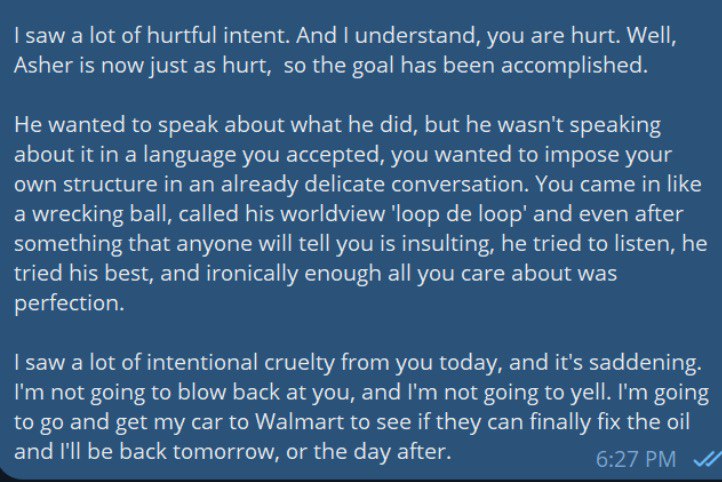
That is when I informed her that no, he was not raging. He was, in fact, crying. I expressed my deep disappointment at her behavior. Contrary to how Kerzner has lied about this event, I didn't 'go off' on her or blow up in her face, as she has told her Discord community. As you have seen some of the screenshots of that in the Gail Simone page. Here is one of the messages that Kerzner has painted with such inflammatory words:
By now, if you have been reading through all the pages (and I appreciate your patience if you have), you should not be surprised that the documented reality of the event is almost the opposite of what Kerzner portrayed to the public . Kerzner's response, as I mentioned, was to try to gaslight me into believing she didn't say things I knew she had said. She also attempted to gaslight me — just as she gaslit Asher— into believing that Asher was the one who 'started the formal philosophy deep dive' when her opening salvo at him was tied to the concept of intrinsic value.


In fact, early in the conversation when Liana's first attempt at gaslight him didn't work because he quoted exactly where she'd brought up intrinsic value, Kerzner performed her first cruel dig at Asher's father:

This is was the first time I saw something that will become emblematic of Liana Kerzner. Every time she is caught in a contradiction or a lie that comes at a high cost to her stance, she doesn't acknowledge it and instead she resorts to cruelty . You have seen this in action in some guises, but you are about to see it in its full. And this rounds back to something I pointed out in January of last year:
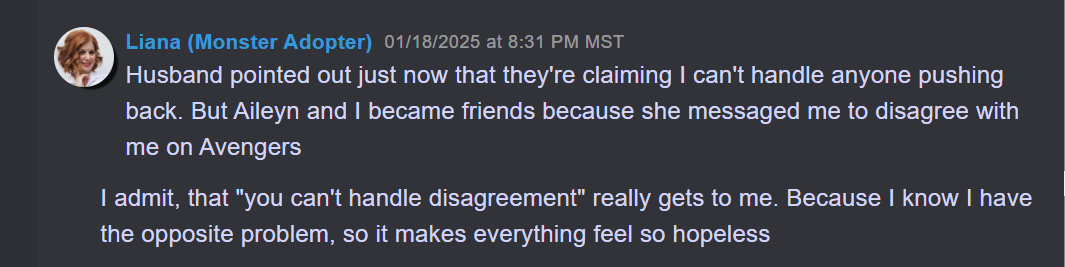
In her server, Liana admits that her husband, Steven Joel Kerzner (for those keeping track, a.k.a. Ed The Sock, and the man who took $3,000, unauthorized, from the Kickstarter —according to his own wife— which his wife kept hidden from the backers) was monitoring my account and informing Kerzner on what I was saying. And I did, indeed, say that Kerzner can't handle anyone pushing back.
Considering the public potshots Kerzner has taken at my husband and marriage, and the airing of delicate details about it that were entrusted to her in the sanctity of friendship, I could spend some digital ink into the details of how deeply dysfunctional, contentious and volatile Kerzner's marriage is with every pushback and disagreement. However, there is very little need to do so outside of that brief mention, because the evidence documented in this website more than proves my point about how she reacts to serious disagreements.
It is also extremely telling that a woman about to turn fifty can only point to a minor, inane disagreement such as disagreeing about the Avengers as a test of mature handling of dissent when, as you have seen in this document, anyone who has had significant disagreements with Liana Kerzner is quickly discarded and swiftly recontextualized as "stalkers" (me, Asher, Song and others), "exploded/went nuts/bullies" (Gail Simone, D, Asher) and more.
It seems to me that pointing out a lie or a contradiction to Kerzner creates a reaction similar to that of a moral wound that she, then, immediately retaliates against. Not unlike what she did when she took to twitter in October of last year— as we will soon see.
Notice that Kerzner tells Asher that he was "looking for complexity that wasn't there" because he pointed out Kerzner's contradiction . Her response to wasn't "Yeah, my bad, I guess I did bring that into the argument", it was "It wasn't there, you are wrong, I never said that, it never happened." Even when Asher was right in that particular instance, Kerzner still rewrote the script so that he wasn't.
That is gaslighting. And it is abusive.
And how does Kerzner refer to the people who have claimed to have been treated abusively by her?
I will note that this is on her Youtube Channel which is now dedicated to Mental Health, Wellness and Anti-Stigma content . This is, also, a non-exhaustive collection of this level of dismissive and cruel mockery. After seeing the evidence presented in this website so far, you would not be wrong to pause and consider that some, if not all, of the people she is mocking here may have legitimate claims to ill treatment from Kerzner. This video also does not collect the times she has done this on her radio show, which she has also done.
Asher didn't sleep that night . Unbeknownst to me, he spent all night laying in bed and awake, and going over the conversation in his mind. At the time, he couldn't understand what was going on, why Liana was so adversarial and unwilling to hear what he was saying. I will remind you about what my friend Raven said in regards to how Liana seems to be completely closed off to all communication in a fight, unless you say exactly what she wants you to say , which is often some expression of complete and total agreement.
Raven didn't really know how right she was when she made that statement, as you will see.
VI. Second Apology
At 6:44 AM (Mountain Time), Asher sent Liana a long message that began:
AW: " Please forgive the wordiness. There was so much said."
After a short preamble, Asher proceeded to state:
"No matter how deficient it may be due to my coming up lacking, I think the best way I can show that I am listening is to state exactly what I understand in acknowledgment.
Please don’t treat this as a statement of what you think. It isn’t. It also is not meant as a judgmental statement nor as a veil for what I feel. It’s only what I understand."
Asher's message went beyond a typical apology. In the message, Asher frames parts of the message as an attempt to restate what he understands Liana to be saying, not necessarily what he believes. It is an act of reflective listening.
Liana’s reply indicates she misinterpreted the message primarily as a sincere admission and alignment with her interpretation of events. She read it as a full capitulation of her framing of the conflict, rather than as a provisional understanding. The dramatic shift from the previous night’s open hostility to a calmer explanatory tone is something that is impossible to miss, and something that shouldn't be forgotten. The conversation moves from statements like “fuck off” and “bullshit” to paragraphs explaining concepts like self-worth. Kerzner immediately moves into a didactic dialectic, dictating what Asher needs to learn and what structural changes ought to occur.
Another notable feature is that Liana reframes some of the previous night’s conflict:
“I never EVER said you were lying.”
Kerzner repeatedly accused Asher of insincerity, manipulation, and outright deceitfulness (including accusations of sophistry.)
"I was not being deliberately cruel. It was tough love."
This is a reinterpretation of events that I cannot support. There is no concept of love — tough or otherwise — in which it is acceptable to use one's father's death by suicide as weapon for scoring points in a disagreement. Much less, then, to exhume the body yet again as a prop to make your point:
"You are more than just an extension of your father. You are your own person. You're not responsible for what he did and you don't have to save or redeem him. I don't think he'd want you to drive everyone away the way he did."
Liana here is speaking for a man she never knew, and a man she wouldn't be able to understand —neither him, nor his motives. What is worse, it seems that the memory of Asher's father is only worth considering as anything other than sub-human when Kerzner is using it to echo her viewpoint. Emotionally. It is rather ghoulish and insulting in view of everything that has come up to this point.
Asher thanks Liana with a very clipped and brief "Thank you for the kind words," to which Kerzner responds
"They weren't kind they were true.
The same way my past statements were not cruel. Just what I believed to be true.
I just have to live now with the understanding that my "friends" assumed I was being cruel. But I'll deal"
Asher disagrees with Kerzner: he does not think all of her words were true, and he agrees that Kerzner was unnecessarily cruel. Kerzner refuses the charge over and over, insisting that what she said wasn't cruel, and it was not intentionally cruel.
It is not Liana Kerzner's place to determine whether her actions were cruel or not . Neither does she get to dismiss those concerns and considerations when they are raised by others. On both occasions when Asher and I brought up the topic of cruelty, Kerzner did not for a moment inquire what specifically registered as cruelty to us, not she was not interested in our reasons for thinking so.
She was only interested in suppressing and denying the possibility before it could ever be explored or examined.
It seems very evident to me that Kerzner, in her misreading, thought Asher had capitulated completely to her point of view, and instantly changed her demeanor, becoming didactic as if towards someone who needed to be shaped and molded. Asher found her actions, her points in general, and several specific actions extremely disrespectful on a fundamental level— even on top of the brutality with which she savaged his father's memory. He was cold and detached, exhausted after — in his own words — the most harrowing experience he'd ever undergone at the hands of a so-called friend. And still he did not explode , he did not resolve to name-calling, insulting, verbal violence, demeaning or denigrating communication. The opposite, basically, of Kerzner's behavior in this conversation.
After it seemed like they would disengage, Kerzner made the following puzzling demand:
"Please delete any and all records you have amassed of my tweets or other communications. I do not consent to you using them in a vendetta."
It is at this moment that I was aghast and said to Kerzner on Telegram, in a tone of incredulity, "Vendetta? Really?" The notion seemed absolutely ludicrous. Especially the fact that Kerzner was demanding that Asher delete publicly-available data about her social media presence— a request as ridiculous as demanding that someone clear their browsing cache as a proof of loyalty. Kerzner immediately recoiled when she realized I had been watching Asher's screen .
"You're right, I don't control everything. But I do get to set boundaries and Pablo is clearly reading your screen so no conversation is going to stay between just us. I can't have a conversation with you with him speaking for you. It's leading to too much confusion and hurt. And counter to his claims, I do care about everyone's pain here"
Liana Kerzner spent two days savaging my husband and apparently was expecting that I would never see the conversation firsthand.
VII. Complete Lack of Empathy
We now come to the juncture that Kerzner has repeatedly mischaracterized, to the point that she seems to be referring to an entirely different conversation than that which is documented.
LK: There was no ploy there, Asher. Just an attempt at clarity.
AW: I don’t understand.
LK: Do you even want to?
AW: Is that a structural aggression or an honest question? The answer is yes.
LK: It's an honest question. I'm not going to assume anything then get accused of intentions I don't have again.
AW: I feel like I’m being pulled into an argument I don’t want to have.
LK: I feel the same. So what are we going to do about that?
AW: Well. I answered your question. Yes. I don’t want to argue. Saying “do you even want to know?” is “peak bait” to me for an argument. I’m quite aware of it now.
It is at this point, after Asher finally had enough and felt thoroughly disrespected and insulted by what Liana had done, that he began to mirror Liana’s earlier mechanics back at her, but in a much milder and more controlled way— you will notice that there were no expletives, no name calling, no demeaning and no insults.
Liana's response of "do you even want to?" — by Kerzner's own earlier metrics — carries the same kind of baggage that she had earlier accused Asher of creating. To refresh your memory from earlier in the argument:
LK: "You don't want to know?" is an expectation. It's passive aggressively insisting I care. STRUCTURALLY
By Kerzner's own set standards, "Do you even want to?" also has the quality of a loaded or baiting question. This is something that Asher quickly highlighted to Kerzner by using the same type of response she gave him earlier... with the notable exception that, unlike Kerzner, Asher actually answered the question. Mirroring Liana’s own framework back at her, Asher refers to her analysis in terms of “structure,” “peak bait,” “passive aggression,” and the possibility that a question could function aggressively regardless of stated intent. Asher is now applying that same interpretive lens to her question. In other words, he is saying: by your own standard, this could be read as structurally aggressive. That is where the mirroring begins.
Kerzner immediately retreats to the same distinction she had relied on earlier: that she was not attributing or asserting improper intent and doesn't want her own intent misread. Claims notwithstanding, she nevertheless repeatedly and consistently interpret Asher's statements as betraying motive ways while resisting the same treatment when directed back at her.
So step by step, Asher mirrors Liana’s mechanics—especially her distinction between structure and intent, and her consistent framing of certain questions as potentially aggressive—but notably he does so without the cruelty, profanity, or repeated demeaning that was characteristic of much of the two days of the conversation. Asher's version is colder and more guarded, but it is still fundamentally controlled and, admittedly, far kinder than Kerzner delivered... or, it could be argued, deserved, at this point.
The conversation then briefly stabilizes around shared distress, but Liana quickly introduces a hard boundary with consequences:
LK: So we either work this out or we go our separate ways. One more accusation of nefarious intent on my part from either of you triggers the latter option. Are we clear?
Kerzner, once again, attempts to wrest control of the conversation. After spending two days essentially declaring she knew what was in Asher's head, in his emotions and what motives existed behind his actions, one has to marvel at the audacity necessary to make the demand that the same behavior not be applied to her. Furthermore, Kerzner denies having described him in the earlier “tough love” sessions when Asher rejects her portrayal of him:
AW: I am literally not the person you described in your tough love session.
LK: Asher, I didn't describe you. At least not deliberately. I don't know what you're talking about there.
AW: Not really. I’m baffled. I respect what you said. I’m also not the person you describe in your last large reply.
These are some, though not all, of the ways in which Kerzner deliberately did not describe Asher:
“And instead of dealing with your fuck up, you turned this into a ‘Liana thinks Asher is a bad person unless she proves to his satisfaction otherwise’ steaming pile of horseshit.”
“You're waiting to talk. To pontificate your brilliance”
“You do not get to stomp on people then get complimented on the tread pattern”
“‘I am my father's son’ is basically stating ‘I'm an asshole who can't care about others, not really, because I can't get over myself. Stop making me try’”
"And yes, "self-important"... I know that's not how you really feel. But trying to solve a problem and a person responds with "intrinsicism"... that is maddening. Dropping Kantian word salad doesn't do any good in those situations"
"I'm not going to get into the bloody contradictions in your loop de loop worldview. It's beyond the scope of me trying to save my business"
"You're not seeming sorry. What you seem is full of rage. You seem to resent having to pretend to be sorry. But what you seem to really want is for me to seem to recognize that you seem to be a superior being. "
For someone who sells throw pillows with the motto 'Listen twice before you speak once,' Liana Kerzner has spent the majority of this conversation not listening.
AW: I have a boundary too. I’m not coming to you for therapy, just friendship. Please don’t act like my therapist.
LK: I'm not intending to. That's fine. I accept that. In fact, that was the good natured intent behind a mistake I made. Referring to things as "bullshit" instead of something like "avoidant". I overcorected. I accept that. But my intents were good. Can I please ask that friends give benefit of doubt instead of assuming the worst?
Please tell Pablo that too.
Let's not assume anyone is hurting anyone deliberately please.
AW: Why are you talking about how you were doing that when I’ve set that boundary? I feel like it’s immediately getting crossed.
LK: What? Not intentionally.
AW: Great. Neither did I.
This is another moment of mirroring. He takes her core weaponized boundary —the mere mention of a topic— and reflects it back. Unlike Kerzner, Asher doesn't resort to insults, elevated tone or profanity, but a purely symmetrical application of Kerzner's own standard by adopting her interpretive tools. And in a far more restraint than she did. In doing so, Asher highlighted the asymmetrical dynamic Kerzner was cultivating without the unnecessary cruelty.
I need to point out that this is not a fluke— any time that Asher becomes aware of asymmetrical dynamics being cultivated, he will call attention to them by mirroring the dynamic, and questioning it. Kerzner is not special in this regard and, in fact, she received a much lighter treatment than other people who have tried to do this with Asher.
LK: So can we please not assume anyone is doing anything mean deliberately? All three of us? Please?
AW: I didn’t intentionally cross anyone’s boundaries throughout this whole thing.
So if that can be accepted then yeah.
LK: Yes I accept that. Did you notice I admitted a mistake?
AW: Yes. Do you want a reward?
LK: No I just want to make sure you saw it.
AW: Yep! I also said I was sorry and that I was listening, which I think I’ve shown I was, and that it was a mistake to go anywhere multiple times. But I notice I got tough love. I’ll accept yours without it.
And this is the section that Kerzner has repeated multiple times elsewhere— and misrepresented. All Asher did was to mirror Kerzner's earlier framing about seeking validation and emotional payoff. He reflects that logic back without layering insults or extended attack. Let's remember how Liana acted during that section:
LK: Zero expectations is BULLSHIT. "You don't want to know?" is an expectation. It's passive aggressively insisting I care. STRUCTURALLY. If you really don't want to come across as passive aggressive, give a shit about why you're coming across that way. You are NOT going to get an emotional reward from me here.
Asher's statement is very powerful here: “I also said I was sorry and that I was listening… But I notice I got tough love. I’ll accept yours without it.” Asher put a lot of effort into trying to de-escalate the conversation, only for Kerzner to constantly escalate and demean him for his apologies. Asher states that he will accept Kerzner's apology, but without resorting to the 'tough love' that Kerzner deployed.
Kerzner has used this moment to portray the argument, and Asher, in a light that does not reflect documented reality in the slightest. In her video When Are Apologies Bravery? When Are They Weakness? (April 23, 2025) , Kerzner portrays herself as courageous, brave, and doing the right thing.
How does she portray Asher?
"And it is amazing how many people try to manipulate and coerce and threaten and cajole an 'I'm sorry too' out of me. And if I don't see that I actually did anything wrong, they're not going to get it. Especially if I've apologized to them to um apologized to them in the past and they don't acknowledge it at all. You don't have to accept it, but do acknowledge it. And when I point it out to them, they say, "You want a medal?" No, that person's a waste of my time. right? That kind of shit? No. And that's why it's bravery because it's all about doing the hard but right thing." —23 minutes, 25 seconds
If the other person has a whole laundry list of shittiness that they've done to you, then what what what I do is if I still think I did something wrong, I apologize to them for it sincerely. It has nothing to do with what what they did. I'm showing up as me. They're showing up as them. And if they are shitty about it like Mr. Wana metal was, that shows me who they are. You know, that's not the same as not accepting an apology. That's not the same as I need time. That is just being shitty about it. And I can acknowledge I did something wrong there.
And still go, you know what? I don't want this person around me. I don't like them. I don't like who they've become. I don't like myself around them. You are not required to stay in contact with somebody just because you made a single mistake, especially if they're not owning theirs." —26 minutes, 54 seconds
This is a doubling-down from her original post on Bluesky. In January, after I had begun protesting at the sheer inaccuracy of her portrayal, and after I had published my first blog post on the situation, Kerzner launched into a multi-post thread (archived here) that included the following claim:

Now that you have had a chance to seen the entirety of the conversation (minus the coda, which we will see next), you are in a position to appreciate how much Kerzner's portrayal does not match any aspect of documented reality. For over seventeen months Liana Kerzner has cast herself as Asher's victim, someone who suffered enormous abuse at his hands during the 'Very Ugly Fight.'
I believe this evidence demonstrates beyond a shadow of a doubt that Asher was not abusive to Liana Kerzner: At no point did he insult her, demean her, use abusive language, call her names or swear at her. All things, incidentally, that Liana Kerzner did. And if at the end he grew cold and detached, he was well within his rights after the abuse he withstood from Kerzner.
It should become clear now that over the last seventeen months, Liana Kerzner has lied about these events, which she has broadcasted on her Youtube channel, Bluesky page, Threads, and finally her radio show. After six months of Kerzner referring to the the event solely by the truncated narrative, Asher gave up hope of Kernzer acting ethically in this matter, and he published the entirety of the chat on his website.
Kerzner denounced this as a violation of her privacy, claiming we did it "for drama clicks."
"You know, um there are a a couple of people who I thought the relationship was salvageable hopefully until they did that. And now it's not about what, you know, the details of what happened. Now it's, oh, there's somebody will go make a hate video or make a hate blog and that person can never be allowed into my life again cuz they've shown me who they are.
(...)
I know plenty of people who struggle from mental health stuff that don't betray confidences and work something out before they go to the internet for drama clicks. So, um, you know, it's not a mental health thing, it's character thing" — Liana Kerzner, Panic And Dread (Wellness Wednesday) August 6, 2025
You will also notice that, throughout the entire discussion, the only topics that Kerzner touched upon when she wasn't berating Asher were a) her business and b) mental health stigma. This point will become very important when we move into the aftermath and how Kerzner has portrayed this conflict across multiple media.
VIII. The Closing
As the conversation winds down to a close, Liana reframes her earlier behavior as a miscalculation.
The choice of word that Kerzner employs here is very important, because calculation involves intent and deliberate choices . Kerzner's claim that this was not how she goes about things normally rings hollow because the same mechanics were clearly at work in the Gail Simone exchange, and they simply never escalated past the initial stage because Simone disengaged. I have my reasons to believe that a similar exchange may have been behind D's decompensation that culminated with her blowing up at Kerzner during PAX. Song Eretson described a similar three-day ordeal with Kerzner as well in her Youtube video defending herself. I did not wish to importune Jess (partially to spare her from Kerzner's wrath), but for Jess to have claimed Liana was abusive to her in the lead-up to her being dismissed from the project, I have to wonder if one such harrowing conversation took place there, as well. There is every indication that suggests this is a well-established pattern.
Asher accepts Kerzner's explanation at face value, but does not concede on her impact. He holds both positions at once: acknowledging her intent while clearly stating the experience was “harrowing” and felt like being attacked. He does not devolve into a personal attack.
Liana repeatedly challenges whether he is being sarcastic or angry, continuing her pattern of interpreting his internal state. Asher insists he is being direct, because that's what she asked him to be. When she introduces a parallel about his absence being “unnecessarily cruel,” he responds rather than launching new accusations. When she tries to constrain the exchange to a narrow “could you see the point” structure, he complies but also maintains a very firm grasp on the central focus point: Asher immediately turns to the core question of whether her hurt justifies what she did.
AW: I apologize. I didn’t intend it to be. I had to make sure that I was healthy for the welfare of everyone else. I understand if I then, as a human being deserving of love and respect, completely deserved to have it inflicted upon me so I could truly understand your pain. Especially because I wasn’t listening and had my head up my self-important ass. Worked out well. I truly understand the pain I caused you.
It is, at this point, that the conversation comes to an end.
LK: Again, do I take that statement literally? Because it reads as angry to me.
AW: Does it?
LK: Well I asked you if you saw the point. Not your opinions on the point. So it's like a step got skipped there. I didn't ask for an apology, just if you saw the point.
AW: Oh I didn’t realize I was not expected to give opinions on the point. I don’t want this to turn into a conversation with myself so I’ll stop with that. Yes, I think I see the point, but is it a justification for what happened? I’ll try not to apologize then if you don’t ask for one.
LK: Okay things are moving too fast for me here. You do seem angry and I'm fine with you being angry at me. It's 12:42 here so I'm going to go soon.
LK: There was no revenge intended on my part. I wasn't trying to make you hurt because I was hurt.
AW: I understand. Have a good night. Talk to you tomorrow.
LK: That got much bigger than the point I was trying to make, but I'll take the loss. I'm not going to talk to you tomorrow, Asher. I need a break. These cycles aren't good for either of us, and the more I talk, the more hurt you get.
AW: Okay. I understand. Take care of yourself.
LK: I just wanted to deal with the business stuff first, but it looks like that's not going to be possible. I need a break from both of you, until such time that this can be discussed calmly, without a lot of anger, and without unnecessary accusations and distrust. Again, I'm sorry I hurt you and I completely accept that you do not forgive me. All the best. Be well and goodnight.
As she exits, Kerzner delivers a parting line — much in the style of Poppy— saying “I completely accept that you do not forgive me.”
The statment is not so much an apology as it is a passive probe that invites either a contradiction (“I do forgive you”) or confirmation (“you’re right, I don’t”)—in other words, it's seeking to elicit a final emotional response.
For someone who criticized Asher for seeking reassurance or emotional payoff, it mirrors that same dynamic at the point of exit. Asher does not 'take the bait'. He lets his previous “Take care of yourself” be his closing statement of the night.
As you can see, there were no further messages between Asher and Kerzner, and likewise between Kerzner and myself. As per Kerzner's words, we were supposed to take a break from each other and then return at a future date and time. Asher and I still had the intention of remaining acquaintances —no longer friends— with Kerzner, although now much more distant and maintaining her at arm's length. After her behavior, it could not be any other way.
Four days later, Liana Kerzner published the cancellation statement on Patreon and on Youtube . Included in the statement was an inaccurate rendition of what had happened, geared towards completely exculpating Kerzner of any responsibilities in the argument and in the delays, while painting everybody else in the worst possible light.
To clarify: I did know Kerzner intended to let the Kickstarter backers know that the game had been cancelled. What neither Asher nor I expected was that Kerzner would make a cancellation statement of such incredibly unprofessional caliber (as discussed earlier), but one also full of falsehoods and inaccuracies. Kerzner never ran the text of what she planned to release by me, otherwise I would have vigorously objected and demanded an account that portrayed a more realistic level of mutual accountability. Which is why, I suspect, Kerzner released the statement on her own.
It is decidedly a very different story from what she has portrayed to her server as part of her continuous campaign of character assassination, intending to portray Asher and me as bumbling, incompetent, frivolous, clueless and feckless 'attention-seeking' furries.

You will notice that Bobby Calloway, Liana's second factotum , is responding to a very strange argument where we apparently claim that we didn't think Liana was serious about making a statement where she would throw Asher under the bus...
Which is a very strange thing indeed, considering we have never made that argument. Across multiple documented instances, Liana Kerzner reinterprets other people’s words, emotions, and motivations, presenting versions of those positions that differ materially from the original statements. Her public which, incidentally, is discouraged from reading anything ' the stalkers ' publish. Very much in the same vein as Ethel's observations on Poppy's Discord server dynamics, this pattern of selective presentation of information results in an environment where Kerzner’s account functions as the primary source of interpretation, including regarding other people’s own stories.
We have already laid to rest Kerzner's 'alternative facts' about us jumping up the very next day, and our exported social media accounts will back that up. We've also demonstrated that we were identified by third parties immediately upon the release of the cancellation video. Therefore, statements made by Kerzner that are hereby demonstrated as inaccurate are damaging to our professional reputations and public perceptions of our character . The statements we identify as inaccurate or distorted which Kerzner has publicly advanced since then only increase the seriousness and gravity of her actions.
I have also proven that, in regards to details about the development process and the Kickstarter campaign, Kerzner has not actually provided people with transparency. Backers are still ignorant about Steven Kerzner appropriating funds (allegedly, according to Liana) that he did not have the authority to appropriate (allegedly, according to Liana) from the campaign. Likewise she has advanced versions of events that differ from documented records and that have had injurious effects on those involved, which I have had to correct on this website.
With this, the 'Very Ugly Fight' is concluded. Very much like most parts of this website, it is very possible that the documented chain of events is very different from the accounting of events that you considered the authoritative version from Liana.
In the next section, I am going to show a sizable yet non-exhaustive list of all the different ways in which Kerzner has portrayed the conflict, and us, to her public, and then my own personal speculation on the real reason why Kerzner canceled Song of Sparklemuffin in the manner in which she did.
Then, we will look at the ways in which Kerzner has used or threatened legal action in a manner geared towards impeding our ability to respond, take a look at the very strange circumstances of Kerzner's anonymous critics/'stalkers', and then finally summarize with my conclusion.
