VAGABOND:
The Making Of A 'Stalker'
The case of “Vagabond” was brought to my attention in November of 2025. A user by the name of VagabondTE left the following comment under Kerzner’s video "Young Men Are Angry."
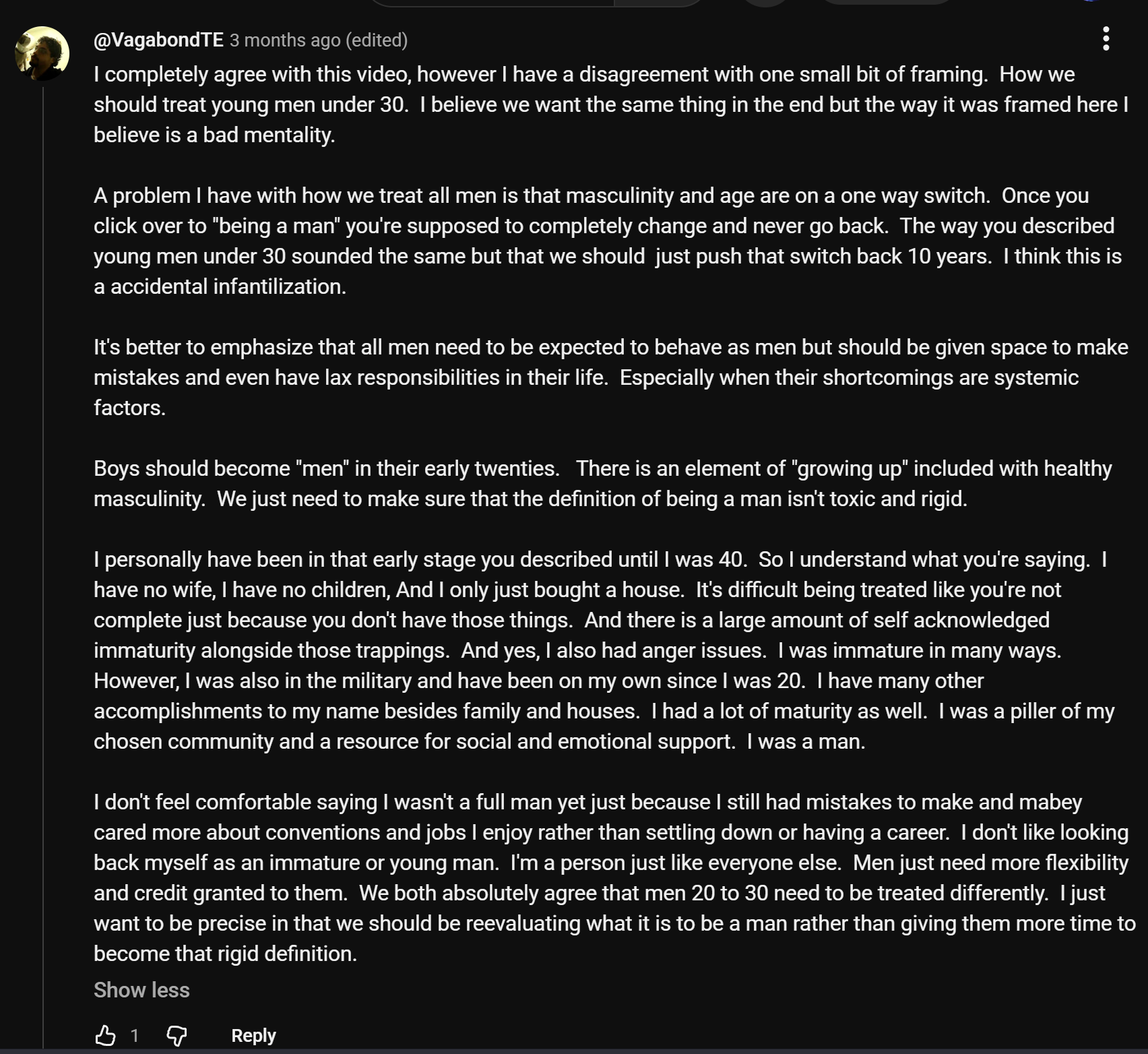
Kerzner’s response was entirely consistent with how she tends to react when confronted with a counterargument that is not framed in extreme deference. The reply was contentious, needlessly accusatory, and appeared to interpret the commenter’s words in the most negative light possible:
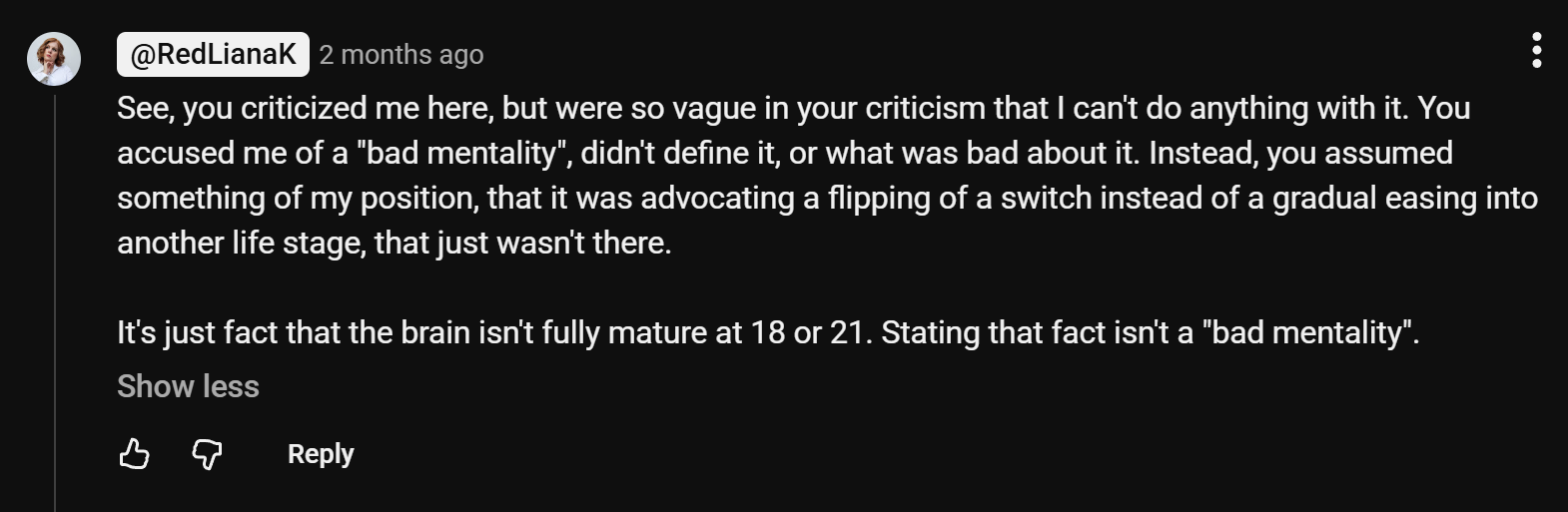
Kerzner’s style in this exchange is now familiar to me. The mordancy of her delivery may distract the reader from a more important element unfolding in the response: the reinterpretation of Vagabond’s original statement.
Ironically, Kerzner accuses Vagabond of making assumptions about her position while simultaneously making assumptions about his.
Nothing in Vagabond’s comment suggests that Kerzner is advocating “flipping the switch” on masculinity or that she suffers from a “bad mentality.” Rather, Vagabond’s argument appears to focus on the framing device itself, warning that the rhetorical framework she used could be dangerous depending on how it is interpreted or applied.
It is my personal observation that when Kerzner encounters anything resembling criticism or rejection, she often stops engaging with the argument actually being presented. Instead, she appears to respond to the argument she believes is being made—an interpretation shaped primarily by her emotional reaction. From there, she seizes upon particular words or phrases that can be used to support that reinterpretation.
The result is a patchwork argument constructed from fragments of the original commenter’s language but assembled into something with an entirely different intention.
In classical rhetorical terms, this resembles the sophistical device known as amphiboly, in which ambiguity or selective interpretation of wording is used to alter the apparent meaning of a statement.
A similar dynamic appeared in Kerzner’s exchange with Gail Simone.
In that conversation, Kerzner claimed that Simone had “dismissed” her rather than disagreed with her. Throughout the discussion, Kerzner repeatedly reinterpreted Simone’s responses as containing some unspoken but perceptible hostile meaning.
Simone recognized what was happening and made the prudent decision to disengage, maintaining her distance from Kerzner afterward. Vagabond—and, admittedly, we ourselves—held Kerzner in too high esteem at the time to take that route. Instead, the conversation continued.
Kerzner also appears to have a relatively low bandwidth when reading arguments. I say appears because it is the only explanation I can offer for how frequently she fixates on particular words while distorting the surrounding argument into something markedly different.
At times she seems to isolate specific phrases and then reshape the broader discussion around those fragments, producing a version of the argument that bears little resemblance to what was originally written. In other instances, crucial sections are simply omitted, leaving a truncated account that—when presented as her opponent’s actual position—cannot help but make them appear patently ridiculous
.
A week after the “Young Men Are Angry” video, Kerzner made another statement in a subsequent video titled Projection and Self-Awareness, Kerzner had something to say that is rather puzzling:
"The people that tend to go off this way are the ones that are pretty harsh on other people and are very big on "I can handle criticism." The minute you suggest they did anything wrong, they pick your words apart."
Bafflingly, this statement is almost an accurate description of the Kerzner–Vagabond exchange—except that it was Kerzner herself who “went off” on Vagabond when he disagreed and attempted to offer an alternate perspective with relatively mild pushback. In her response, Kerzner reduced his argument to two isolated keywords—“the switch” and “bad mentality”—and presented those fragments as though they represented the totality of his position. In doing so, she stripped the original comment of its nuance and context, effectively dismantling the argument word by word.
It was, in a very literal sense, a picking apart of Vagabond’s phrasing rather than an engagement with the substance of what he had said.
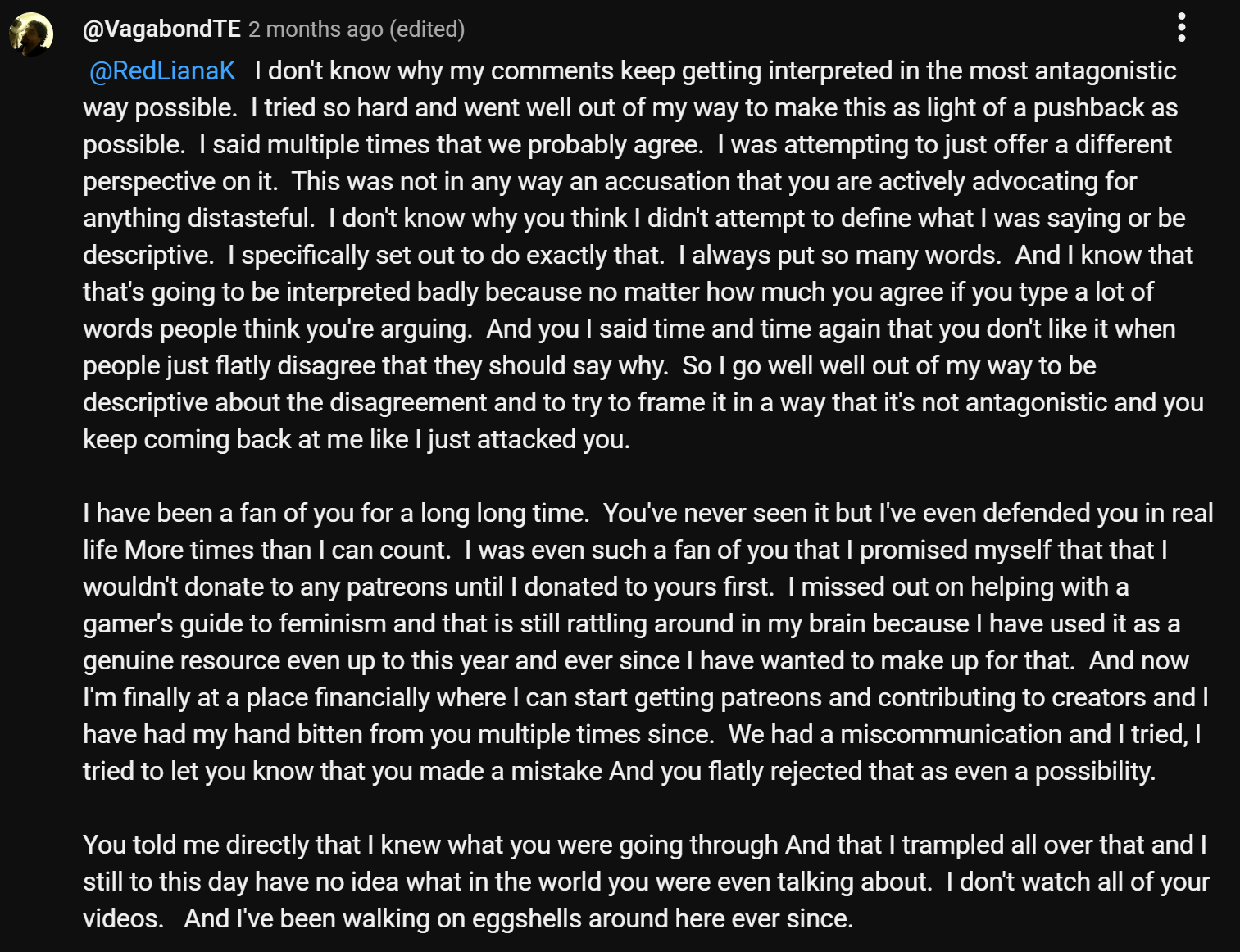
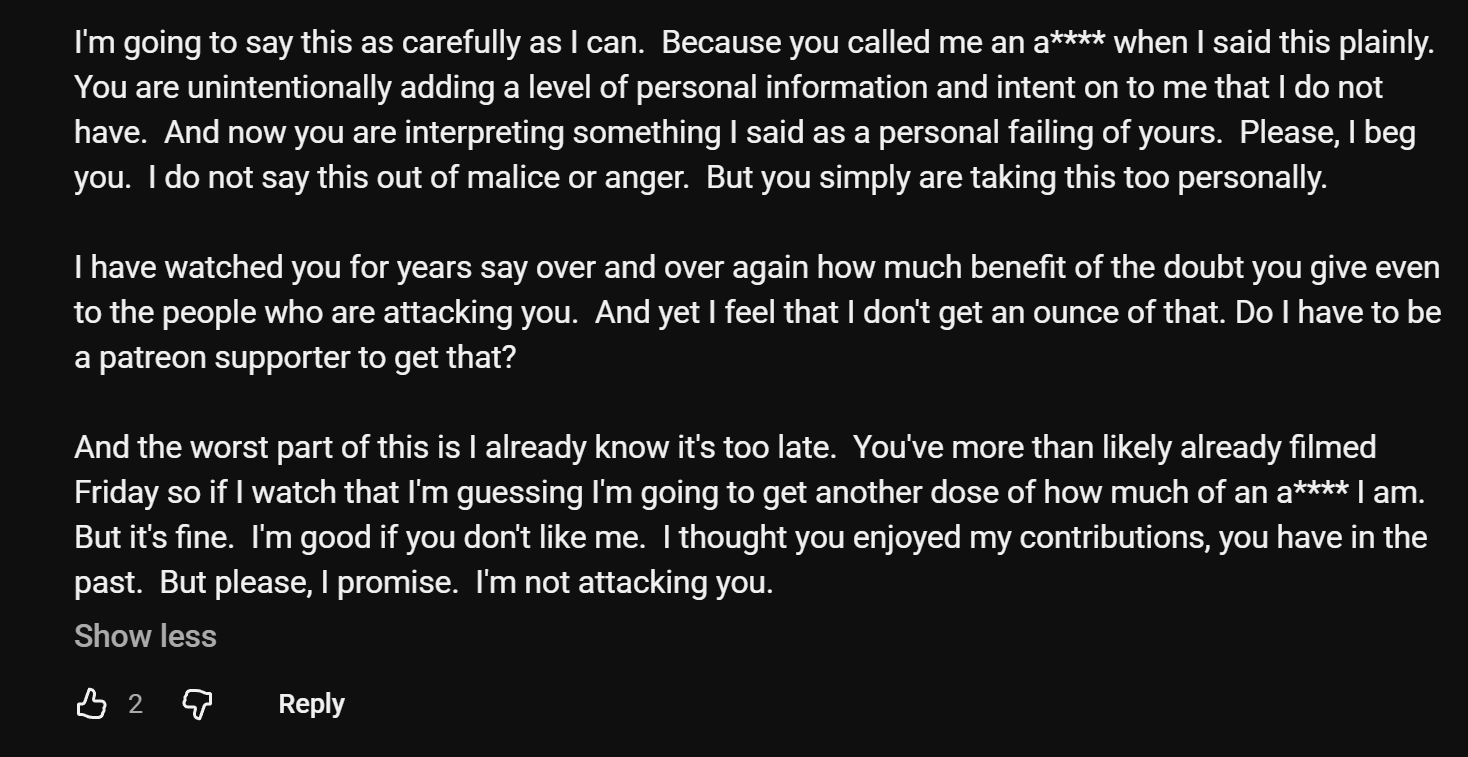
It is therefore perhaps not entirely surprising that Vagabond had posted the following comment earlier:

Early exchanges portray Vagabond as analytical and engaged. He frequently challenged the framing of Kerzner’s arguments, but generally did so without hostile language. In many cases, he explicitly labeled his responses as “constructive criticism.” Kerzner, by contrast, tended to respond firmly and often cuttingly. Where VagabondTE appeared to expect a dialogical exchange—one in which arguments would be addressed and refined through discussion—Kerzner operated in a manner that prioritized centralized interpretive authority.
As far as I was able to track, the beginning of the recurring downward spiral between Kerzner and Vagabond appears to have started with a comment he made under the 2024 video "
Let's Talk About Male Tears," which has direct significance to Asher and to me.
At the time, Kerzner had just released the Kickstarter cancellation video that contained numerous inaccuracies and falsehoods, several of which I am documenting throughout this report. In that period she appeared to be actively constructing a narrative framework around the situation.
It is important to remind the reader that when Kerzner published that video, neither Asher nor I had made any public statements—contrary to Kerzner’s later claim that Asher “jumped up the next day” and declared, “It’s me, she’s talking about me.” Our exported social media records corroborate this. We had not publicly responded at that time. Despite this, we were almost immediately identified by multiple individuals on Twitter and Kiwi Farms, as shown earlier in the section introducing those claims.
Kerzner’s actions during this period suggest that she was constructing what can best be described as a narrative disclosure trap: a situation in which, if we spoke up to defend ourselves, that response could then be framed as evidence of stalking or bad-faith behavior. This pattern becomes clearer when examining the videos Kerzner released immediately after the cancellation, each of which contained indirect references that appear to be directed toward us.
Let's Talk About Male Tearswas published three days after the cancellation video was released. The subject of this video directly overlaps with the final exchanges I had with Kerzner.
Shortly beforehand, Kerzner had brutally mocked Asher’s father’s suicide in a manner that I could only interpret as unnecessarily and intentionally cruel. After doing so, she informed me that Asher “was raging.”
I corrected her. I told her that no—Asher was not raging. He was, in fact, weeping.
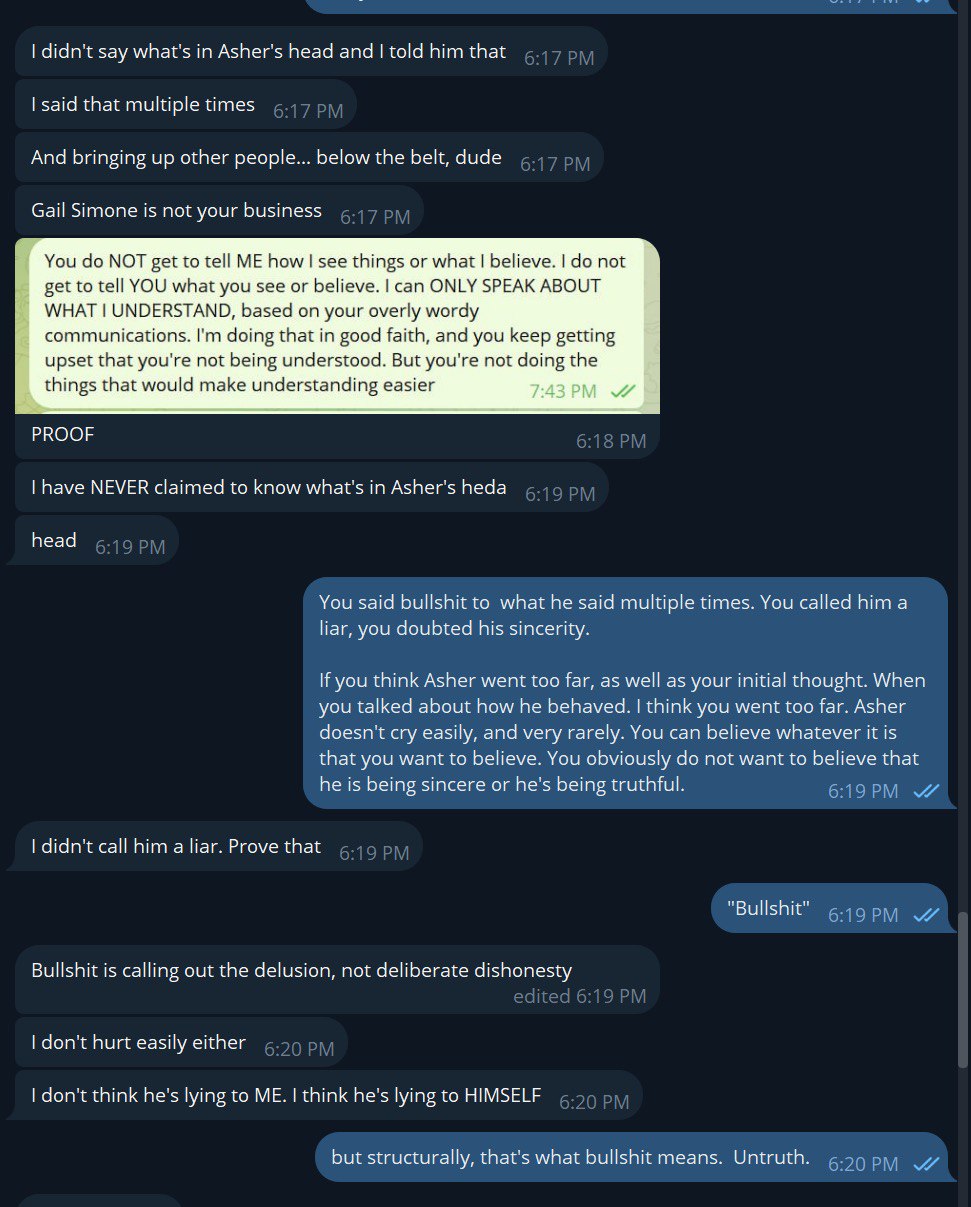
Kerzner proceeded to frame the situation in “Let’s Talk About Male Tears” as a manipulative one, while omitting the fact that the “two men” she described arguing with her were, in reality, a married couple. That omission, in and of itself, will become evident as part of a broader pattern later in this document.
Within that framing, Kerzner portrayed Asher as a toxic partner.
This interpretation was quickly taken up by the user Arceusftw, who expanded upon it in the comment section.
Arceusftw often functions as something of a Greek chorus within Kerzner’s channel, seizing upon the personal insinuations embedded in her videos and developing them further in the comments. Kerzner is then frequently inclined to quote or reference these comments in later videos.
In “Male Tears,” Arceusftw summarized the situation as follows:
"As for the whole 'Toxic partner who expects their significant other to fight their battles for them', that seems like the aspect of toxic, abusive manipulative behavior that goes absolutetly(sic) underdiscussed when it comes to red flags to spot in a toxic relationship." — TheAcreusftw
Vagabond, however, appeared to recognize that Kerzner was leaving out a significant amount of contextual information while simultaneously constructing a very specific narrative about the individuals involved. He made the following comment under “Male Tears”:
Without fully realizing it, Vagabond had stumbled onto a central feature of Kerzner’s rhetorical pattern. Kerzner often claims that she is preserving anonymity by avoiding the direct use of a person’s legal name, yet she simultaneously provides such a dense constellation of contextual details that the identity of the individuals involved becomes readily inferable to her audience.
This dual strategy allows Kerzner to maintain a public posture of restraint while still signaling the target’s identity to those familiar with the surrounding circumstances.
Among the more engaged members of her following, that signaling is frequently reinforced through private disclosures that effectively prime the audience with the identities behind the pseudonyms. We have already seen examples of this pattern: Kerzner privately confirmed that “Stalker Chan” referred to Emily Schooley, and she identified the account “Troll_patrol4” as Mitchell Jura, even supplying my husband with Jura’s social media profile and mental health history.
Taken together, these behaviors illustrate a method of disclosure that stops just short of formal naming while still enabling identification by a substantial portion of the audience.
Vagabond’s mistake—at least as I understand Kerzner’s conduct—was being overly concerned with the supposed broader issue while correctly noting that far too many personal details were being introduced. The presence of those details, however, is not accidental, but rather the point.
The personal details, and the carefully constructed image of specific individuals built through a curated narrative, appear to form a central engine of Kerzner’s online engagement.
Her commentary repeatedly returns to particular people with whom she has disagreements, presenting them through selective recounting that shapes the audience’s perception of their motives and character.
For that reason, Kerzner’s frequent protestations that hers “isn’t a drama channel” stand in noticeable contrast with the observable narrative arc of her content. In practice, her videos often revolve around conflicts, comments or disagreements with identifiable individuals, whose actions are interpreted for the audience.
In other words, what Vagabond perceived as an unfortunate surplus of personal detail may in fact be a defining feature of the format itself.
This is exemplified in Vagabond's next exchange with Kerzner. Following upon the Male Tears episode, Kerzner released the following episode:
In the October 9th Wellness Wednesday episode, Kerzner reframes her conflict with us as a traumatic nervous-system activation event triggered by people who “knew her well enough to hit those buttons” during what she refers to as the “Very Ugly Fight.” Through this phrasing, Kerzner situates her role in the argument as a PTSD flare-up, compounded by accusations of deliberate cruelty that she describes as heartbreaking rather than traumatic. This portrayal of her emotional state during the event will later be contradicted by a reframing Kerzner makes roughly a year afterward (a point that will be examined in a later section).
Notably, Kerzner makes a direct assertion of intent. She strongly implies that whatever responses were triggered in her nervous system were provoked deliberately—that we knowingly “pushed those buttons” in order to weaponize the resulting reaction against her. The timing of this framing is significant.
When this video was released, only five days had passed since the cancellation video on October 4th. During that interval, we had made no public statements regarding the conflict. In fact, between October 4th and October 19th—when Asher first began speaking publicly on social media—Kerzner released four YouTube videos and one radio episode. In these appearances she progressively overlaid her interpretation of the events onto the public narrative, effectively defining the situation and the people involved before any public response from us existed.
Within this narrative construction, Kerzner embeds the fallout from the “Very Ugly Fight” inside a broader autobiographical framework. She presents herself as a lifelong victim of gaslighting, stalking, mob harassment, and institutional failure, implicitly placing her critics—including us—into that same recurring pattern of individuals who misrepresent her and attempt to “break” her.
At the same time, Kerzner asserts that she lacks the capacity for intentional cruelty and refuses to engage in harmful conduct even when she is attacked. She presents herself as someone who operates from integrity and transparency, who did “the right thing,” and whose critics are therefore acting either from triggered misunderstanding, bad-faith interpretation, or the continuation of abusive dynamics from her past. This claim, as will be demonstrated later, stands in tension with documented examples of her own conduct.
Following a pattern that appears frequently in Kerzner’s comment sections, the user Arceusftw quickly summarized the framing of the episode while adding their own interpretation:
"That's the big struggle of PTSD, you end up attracting just awful toxic people who seek to kick you when you're down. And I get it, hurt people hurt people, and ccertain toxic traits are inherited from growing up in toxic enviroments. At the same time, some people are outright awful people who had that behavior fostered and enabled, thus giving them the mindset that they can treat others however they want, and no one can stop them. And when you decide to put your foot down, and decided you had enough; the instigator suddenly try to flip the script and suddenly act like they;re the victims. That's the real insidious part; when the antagonizer tries to frame themselves as the victim.(The Karpman Drama triangle rears it's head again.) And it's the type of thing that can really eat a person alive." — TheArceusftw
This commenter—whom Kerzner frequently quotes in later videos—performs a notable function within the ecosystem of her channel. By contrasting Kerzner with the targets mentioned in the video, the commenter helps reinforce an image of Kerzner that is dissociated from the behaviors being attributed to others. At the same time, the comment layers additional assumptions and moral judgments onto the individuals being criticized, expanding upon the narrative that Kerzner’s own framing has introduced, as seen in the excerpt above.
In effect, the commenter acts as a secondary narrator: restating Kerzner’s premise while extending its interpretive reach. This dynamic allows the harshest characterizations to appear as audience commentary rather than Kerzner’s direct claims, even when they are later echoed or cited by her.
Vagabond did not comment on this particular video. However, he did respond to the subsequent video that appears to have been prompted by Arceus’s framing—one in which Kerzner characterizes Asher and me as occupying two vertices of the Karpman Drama Triangle.
Which was, incidentally, Kerzner’s next video on the subject:
Continuing to develop her narrative, Kerzner argues in this episode that sustained criticism, requests for clarification, or accusations of bad faith are themselves signs of participation in “drama” and symptoms of what she calls “victim syndrome.” In doing so, she reframes the act of asking for specifics as unnecessary—an assertion that, under ordinary circumstances, should have raised concern among her audience.
Within this framework, ongoing critique is recast as harassment or as an inability to “let go,” while persistent detractors are compared to individuals exhibiting long-term stalking behavior. Kerzner further asserts that the only healthy response to perceived ill intent is disengagement.
Taken together, these claims function to invert the usual expectations of accountability. Requests for detail become evidence of pathology, continued disagreement becomes harassment, and disengagement—rather than clarification—becomes the only acceptable response.
Kerzner’s framework is beginning to click into place. What she constructs, in effect, is a trap: within the framework that is built, the only acceptable response available to someone who believes they have been harmed by her behavior is silence rather than protests. Victims of ill intent must remain silent in order to be considered healthy.
Who benefits from such a structure?
Throughout the episode—and indeed across much of her content—Kerzner presents herself as someone who has transcended “drama” through integrity and the careful setting of boundaries. At the same time, the implication that we were manipulative, symptomatic, or suffering from unresolved personal issues rather than expressing legitimate grievances is layered throughout the episode.
As often occurs in Kerzner’s comment sections, the user Arceusftw appears to reinforce this narrative framing. In their response, Arceus suggests that people who speak up, demand details, and seek accountability from those they believe have harmed them are merely “weaponizing their baggage” and using it as an excuse to lash out at people who do not deserve it.
The implicit contrast portrays her victims as unstable and vindictive in contrast to her stated lack of capacity for cruelty.
It should be noted that Arceus had no way of knowing the full extent of Kerzner’s conduct toward others at the time. Still, comments like these serve as evidence of a broader dynamic within her community, which is a self-perpetuating dual process in which Kerzner’s reputation is elevated while the reputations of her critics are simultaneously degraded.
"That's the big thing for me; I've seen time and time again people who let the victim mentality define them, and they end up being some of the most absolute toxic miserable people on the face of the Earth. Basically, instead of working to move past their struggles, they just weaponize their baggage and use it as an excuse to lash out at people who don't deserve it. It's like a high; sure it feels good in the moment, but in long term it will really mess you up for the rest of your life, and lead you to your own undoing. Again, I've been through a lot in my life(probably not to the same level of people who been through alot worse), but at the same time; i'm not going to use it as an excuse to be a toxic person, and perpetuate a vicious cycle. It's the classic case of taking the easy way out and never truely learnng a lesson, vs willing to go through the mud to not only better yourself but to build something bigger for the world as a whole." — TheArceusftw.
Despite Kerzner’s repeated claim that her channel “is not a drama channel,” a consistent viewing of her videos over any meaningful period reveals a recurring pattern in which individual grievances become the focal point of her content and centers her interpersonal conflicts. Particular comments or exchanges get elevated and framed as illustrative examples. One such instance involves Kerzner drawing attention to Vagabond’s comment and introducing it with the following statement:
"This is why I have a really bad reaction when I talk about things on this channel and they're like 'you didn't give me enough detail I don't know what's going on,' it's like, you know what that was just an example to set the overall topic? I'm not asking for your opinion about what happened." — Liana Kerzner
To begin with, Kerzner’s response misrepresents the substance of Vagabond’s original comment. Vagabond’s criticism did not object to the discussion of examples themselves. He pointed out that the examples presented in the video were too numerous and too personally detailed to function as abstract illustrations while still maintaining the anonymity Kerzner said she was preserving.
His point, in essence, was that the level of detail made the examples difficult to separate from the specific individuals involved.
Instead of supporting a broader principle, the anecdotes tended to draw attention to themselves and to the circumstances surrounding them.
At the same time, the remaining vagueness in Kerzner’s descriptions did not fully resolve the issue. For viewers attempting to follow the argument, the combination of specific details and incomplete context would be frustrating —he argued— leaving the discussion suspended between personal narrative and generalized lesson.
Kerzner’s response reframed Vagabond’s observation into a simplified version that only loosely reflected the substance of his original comment, and she proceeded to criticize that interpretation.
When Vagabond commented on the video, Kerzner responded quickly and in a notably confrontational tone:
After telling Vagabond that “not everything is about you,” Kerzner released the following video the next Wednesday:
"Something somebody said to me on Friday and as well I won't repeat how Blazen described it but uh it was it was a shared background let's say don't take things so personally is is a shit thing to say and I'm going to tell you why, right? Because a lot of people may not intend it some people do there's nothing more personal than trauma. I repeat there's nothing more personal than trauma. So telling someone not to take a trauma trigger personally is asinine." — Liana Kerzner
In the earlier discussion, Vagabond’s comment had focused on the structure of Kerzner’s “Male Tears” video. His criticism concerned the presentation of the examples: he argued that they contained both too many personal details to function as anonymous illustrations and too much vagueness to clearly support the broader point Kerzner was attempting to make.
In that context, Vagabond’s comment addressed the framing of the discussion and Kerzner’s reaction to his feedback.
The exchange, as it appeared in the comment thread, did not center trauma or trauma triggers. Instead, Vagabond’s criticism concerned how Kerzner presented the events and how she subsequently responded to criticism about that presentation.
In the episode above, however, Kerzner describes the exchange in terms of trauma and the personal nature of trauma triggers. The result is a reframing of the earlier disagreement: what began as a critique of rhetorical framing is presented instead as a dismissal of trauma.
This kind of shift—from a disagreement about presentation to a discussion framed around personal trauma—appears repeatedly across Kerzner’s responses to critics. In these instances, the disagreement being addressed in the original exchange and the version later presented to the audience do not fully align, the person's words have been completely re-interpreted by Kerzner.
Kerzner did not respond further to Vagabond on this specific point. However, echoes of her earlier exchange with Gail Simone are visible throughout the interaction. A full recounting of the subsequent back-and-forth between Kerzner and Vagabond would add little analytical value, largely because the pattern that follows has appeared repeatedly across Kerzner’s public exchanges over the years.
Disagreements of any significance—distinct from casual or trivial debates, such as those about pop-culture topics like The Avengers—are often met with a tone that shifts quickly toward dismissiveness and confrontation.
Those raising the criticism frequently find themselves attempting to clarify their point, soften their language, or otherwise manage the exchange in hopes of reaching mutual understanding. In practice, however, these efforts rarely alter Kerzner's trajectory.
Unless the critic ultimately completely capitulates to Kerzner’s framing of the issue, the exchange tends to move toward an increasingly adversarial characterization of the dissenter.
Kerzner’s ongoing interaction with Vagabond illustrates this pattern particularly clearly. What begins as disagreement over framing and interpretation gradually evolves into a situation in which the critic’s objections themselves become part of the narrative being constructed about them.
As of this writing (February 25, 2026), the trajectory of this exchange suggests that Vagabond—who continues to object to how his comments have been characterized—is being positioned within the same category of critics that Kerzner elsewhere describes as “stalkers” or “haters.”
Given the volume of comparable interactions documented over several years, it is impossible to deny the existence of this pattern.
For readers interested in examining the progression of events directly, the extracted publicly available comment archive from October 2024 through February 2025 can be downloaded here. A separate file contains Vagabond’s comments directed to Kerzner, Kerzner’s direct responses to him, and the first replies to those exchanges by other users, arranged in approximate chronological order here. Some responses by third parties to those replies were not included in that compilation. However, the most relevant interactions involving additional participants will be presented and discussed in the sections that follow.
In the video Men Liking Stuff: Positive Role Models In Media, Vagabond left the following comment:
Kerzner later released a video responding directly to this reply.
This Wellness Wednesday episode appears to respond directly to Vagabond’s comment, and Kerzner dramatizes that reaction by repeatedly describing her internal “snikt” moment—literally invoking Wolverine’s claw sound effect—as if she had to restrain herself from immediately responding to the argument. She quotes the structure of his definition of toxic gender roles and reacts strongly to his framing of the issue as “easy” and aligned with academic definitions, presenting it as reductive and intellectually arrogant (it has already been observed that Kerzner is frequently critical of academia and credentialed expertise).
Her central rebuttal is that healthy masculinity cannot be defined merely as the absence of toxicity. She argues that health is additive, risk-embracing, imperfect, and forged through engagement with temptation and failure rather than simple harm avoidance. But the tone is marked by those performative “snikt” moments where she frames the comment as something that instinctively triggered her claws, like a twelve-year-old with impulse control problems.
Despite the claim that will follow shortly, this reinforces the impression that the exchange was framed less as neutral intellectual disagreement and more as a personal clash.
Although Kerzner quoted his comment accurately, she reframed his argument as though it were attempting to define healthy masculinity purely as the absence of toxicity, taking a reductionist approach to Vagabond’s statement and, in doing so, altering its scope.
Vagabond was not presenting a complete positive theory of what healthy masculinity should aspire toward; rather, he was drawing a boundary line around harm. That approach functions as a baseline model, yet Kerzner treated that baseline as though it were intended to serve as a full philosophical account of health. At no point did Vagabond state that non-toxicity exhausts the meaning of health—only that toxicity can be defined in terms of coercion.
In responding to the comment, Kerzner shifted the discussion from that boundary definition to a broader claim about the nature of virtue, and then argued against that expanded interpretation. The result is that the response addresses a different formulation of the argument than the one Vagabond appears to have made.
Similar dynamics appear elsewhere in Kerzner’s exchanges with critics, including in her responses to concerns raised by me and my husband, where the arguments addressed in her commentary often differ from the specific complaints originally raised.
Following the release of the video, Vagabond posted a very perceptibly distressed response in the comment section. That response was quickly met by numerous replies from individuals participating in Kerzner’s community. The exchanges that followed begin to reveal a toxic tendency within the comment ecosystem surrounding Kerzner’s channel and Discord server—dynamics that I briefly referenced in my own videos when discussing the roles of figures such as Aileyn and Bobby Calloway.
What unfolded in that exchange was a very quick social consolidation against a single distressed participant. Vagabond opens from a position of visible vulnerability — “I am genuinely shaking,” “I am begging you,” “I could have clarified,” “I’m sorry” — and the responses that follow move quickly toward escalation. His attempt to clarify is described as “spamming” and he is mocked for expressing distress by Kerzner and her community, branding it as a “hissy fit,” which is contradictory to any messages about positive masculinity Kerzner may have tried to impart in her videos. Vagabond's attempts at conciliation elicited accusations that he was “playing the victim.” Aileyn’s claim that “literally no one replied” contrasts with the fact that the comment had already prompted a video response from Kerzner, and the exchange shifts toward status-lowering cues. You can observe how phrases like “find your hinge,” “manchild,” and “quit your ranting” function as signals about how the group should treat the commenter. Once that framing is established — unstable, overreacting, attention-seeker — subsequent responses largely follow suit in that same vein.
The dynamic is particularly striking within a community that publicly brands itself around mental-health discussion. In the exchange, therapeutic language such as “regulation,” “soothing,” “control,” and “seek counseling” appears in a disciplinary role, wielded to manage tone and behavior. Kerzner’s responses move away from engaging the substance of the comment and direct focus toward policing Vagabond's emotional tenor, complete with warnings about blocking. In an ordinary fandom community this sort of escalation might be unsurprising; however, Kerzner has increasingly presented her channel and community as part of a mental-health advocacy environment, and a large portion of her content centers on that subject. That positioning raises questions about the standards expected of a community framed in those terms, particularly as Kerzner has sought opportunities to speak at mental-health-related events.
My husband’s decision to raise objections with one such event organizer after Kerzner was done speaking at their event followed from this concern. Kerzner later characterized that objection as an attempt to “go after her livellyhood,” whereas our position is that the public record of a speaker’s conduct is relevant information when evaluating someone who seeks greater authority in a mental-health-adjacent space. You will note the sharp contrast between how Kerzner saw it acceptable for her to report Emily Schooley to her associated organization based on her concerns, but anyone else moved to do about Kerzner based on their own concerns could never have a legitimate reason to do so.
When Kerzner says “I am not here to soothe you,” she adopts a posture that appears frequently in her exchanges with distressed male critics, framing their emotional response as an expectation that she should provide comfort in some sort of maternal position. The distress becomes the subject of critique rather than the underlying disagreement or any points raised. Kerzner treats Vagabond’s reaction as illegitimate, enacting her trademark asymmetry between speaker and commenter. She has the platform and the audience while he is a single participant asking not to be turned into recurring negative content. Within that environment, attempts to defend intent can be interpreted as further evidence of wrongdoing by Kerzner, and his pleas for clarification are constantly reframed as instability.
Vagabond’s concerns about discussions occurring in Kerzner’s Discord community are therefore understandable in light of the broader pattern already described. Earlier sections have shown that Kerzner has often discussed critics in that private forum in ways that include judgments about their character, emotional state, and motives (and we will see many more before this document concludes). Much of that commentary involves interpretations that critics themselves dispute as inaccurate or incomplete. Without ever being aware about the contents of this document, Vagabond nevertheless appears to have sensed that such off-platform discussion was occurring.
Discord is not the only space in which critics are discussed. As with Song, Emily Schooley, and ourselves, Vagabond’s situation also became a topic within Kerzner’s Patreon discussion:
"Oh, there's this one guy who insists I'm not giving him the benefit of the doubt, but the only reason I haven't blocked him is I'm assuming he's just hurt and not thinking. Uh, and I'm trying to be nice to him, but I think that might be my mistake. But he is just taking up way too much oxygen. And um it just—he keeps saying “I am not going to comment anymore,” and he's back the next day and then blaming me for it. Um, I'm torn between it being amusing and it being like, all right, enough. And I don't know what the kind thing to do here is, cuz nobody seems to be terribly bothered by him. Uh, it seems to be a source of entertainment, which for the needs of the many is fine, but with him—like caring about him as a person—it's like maybe I should just sort of stop it, cuz I think his pain is real even if his arguments make no sense. But I'm gonna let it go for a while. I just really don't like blocking people. I don't like banning people from comments cuz I don't think it teaches someone anything. So, as long as I think there's hope that there can be something learned from something, I let it ride. But I'm baffled." — Liana Kerzner
In her Patreon remarks, Kerzner presents herself as restrained and benevolent—“assuming he’s just hurt and not thinking,” “trying to be nice,” and reluctant to block him because she hopes something might be “learned.” This posture appears to contrast with, and contradict, the tone of her public responses. In the YouTube comments, she tells him to “Stop spamming,” warns that she may block him, dismisses his emotional state, and dismisses him. In the Patreon discussion, she characterizes him as “taking up way too much oxygen,” reframing his presence as a burden on the community
The contrast becomes particularly notable in her statement that his distress had become “a source of entertainment (…) for ‘the needs of the many.’” That remark acknowledges that his visible distress was drawing attention from the audience and suggests that this dynamic was being tolerated because it was entertaining for others in the group. Although she also notes that his distress is “real,” the greatest consideration seems to be towards the utility of his distress to the community. In a community that frequently invokes mental health as part of its ethical framework, this juxtaposition—expressing sympathy while centering a distressed participant as the center of public vitriol—points to an irreconcilable contradiction between the stated values of the space and its practices.
Kerzner also expresses surprise that Vagabond does not believe she is extending him the benefit of the doubt, despite her earlier public mischaracterization of his behavior as manipulative and disruptive. I will remind the reader that one of the reasons Kerzner cited for ending our friendship was my statement that I believed some of her actions toward others were intentionally cruel.
Viewed in the broader context of these exchanges, readers may wish to consider that earlier dispute in a new light. A brief look at Vagabond’s more recent comments suggests that the interaction has continued to evolve, and the next Wellness Wednesday episode again contains material that appears to respond to one of his remarks.
Despite its appearance as a discussion of Jungian archetypes, this episode also serves as a double function of repackaging and reframing the most recent exchange with Vagabond. Kerzner interprets the "tantrums" or tactics of emotional control through the lens of archetypal categories tied to a broader cultural pathology. This framing places Kerzner in the position of observer rather than participant, while encouraging the audience to interpret the commenter’s distress as immaturity or a dysfunctional response that is out of bounds. Within that frame, the possibility that the commenter may have had a legitimate grievance is largely set aside— it isn't germane to her point.
The episode also illustrates another example of the asymmetry that appears elsewhere in Kerzner’s interactions. Around the 26-minute mark she states, “I am the only one who can know what I intended,” while also asserting that accusations require evidence and that strong emotions alone do not demonstrate wrongdoing. In the earlier exchange with Vagabond, however, she attributes motives to him—suggesting that he sought to minimize others or portray himself as a victim—while rejecting his own explanations of his intent. The language she employs is largely dismissive: “explosions” and "manipulation", using belittling imagery such as “tantrum,” “daddy I want a pony,” and “little boy” to describe dissent. The archetypal framework gives the discussion an appearance of analytical distance but closer scrutiny reveals a practical effect: to signal to the audience that the commenter’s behavior fits a recognizable negative pattern. Kerzner moves the focus away from whether a distressed individual was treated fairly and toward a broader narrative in which Kerzner presents herself as the adult resisting emotional immaturity.
At the beginning of the episode (around the five-minute mark), Kerzner explicitly references being accused of mocking by Vagabond. She states: “And you know, buddy who blew up my comments last week saw me laughing at my own reaction, the snikt, as I called it, you know, saw that as me mocking him. And it wasn't.” In doing so she acknowledges that the commenter from the prior exchange—whose remarks can be located in the comment thread—identified the Wolverine reference as directed at him.
As will be shown shortly, however, Vagabond’s criticism appears to have been directed at a different aspect of the exchange than the one Kerzner describes here.
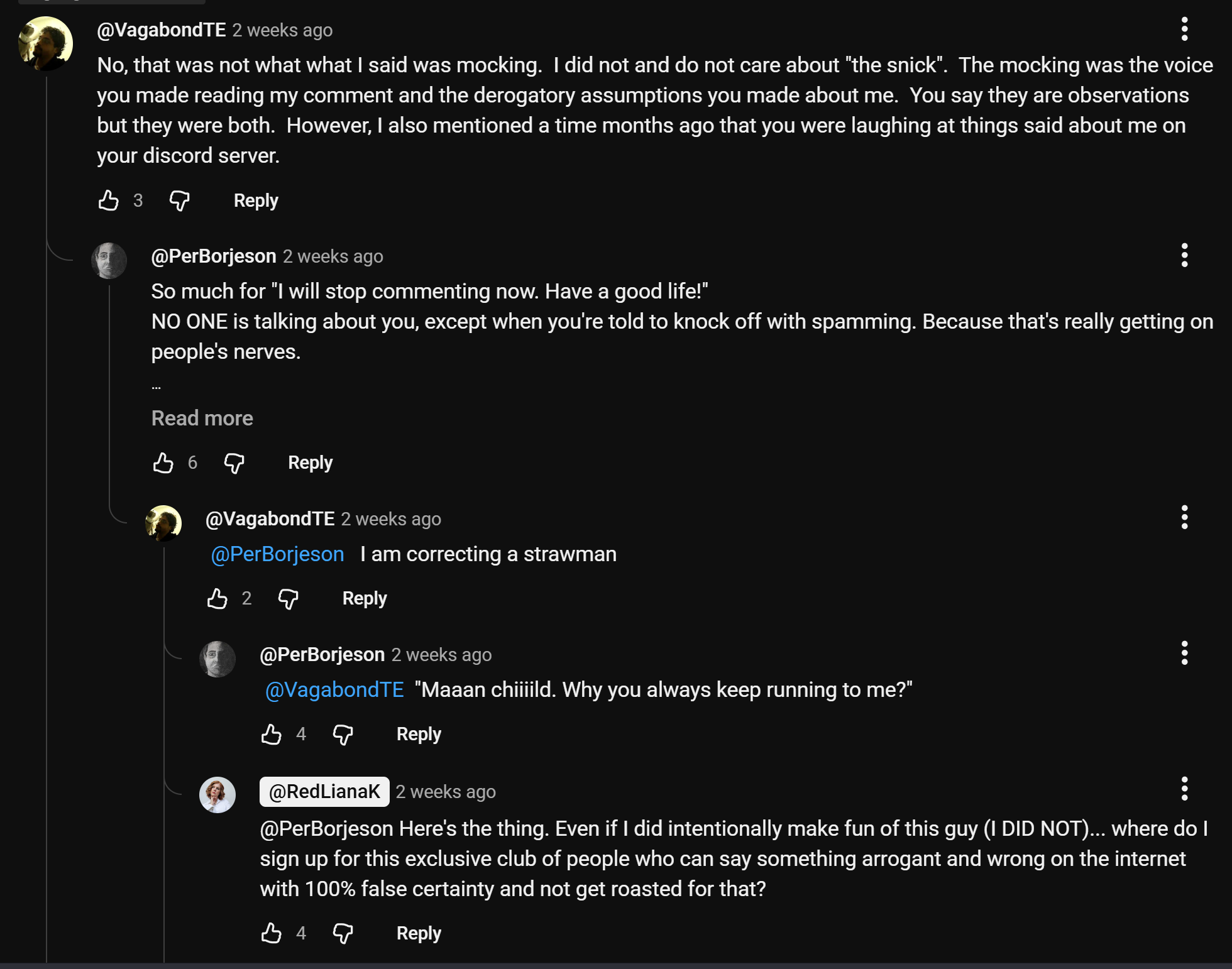
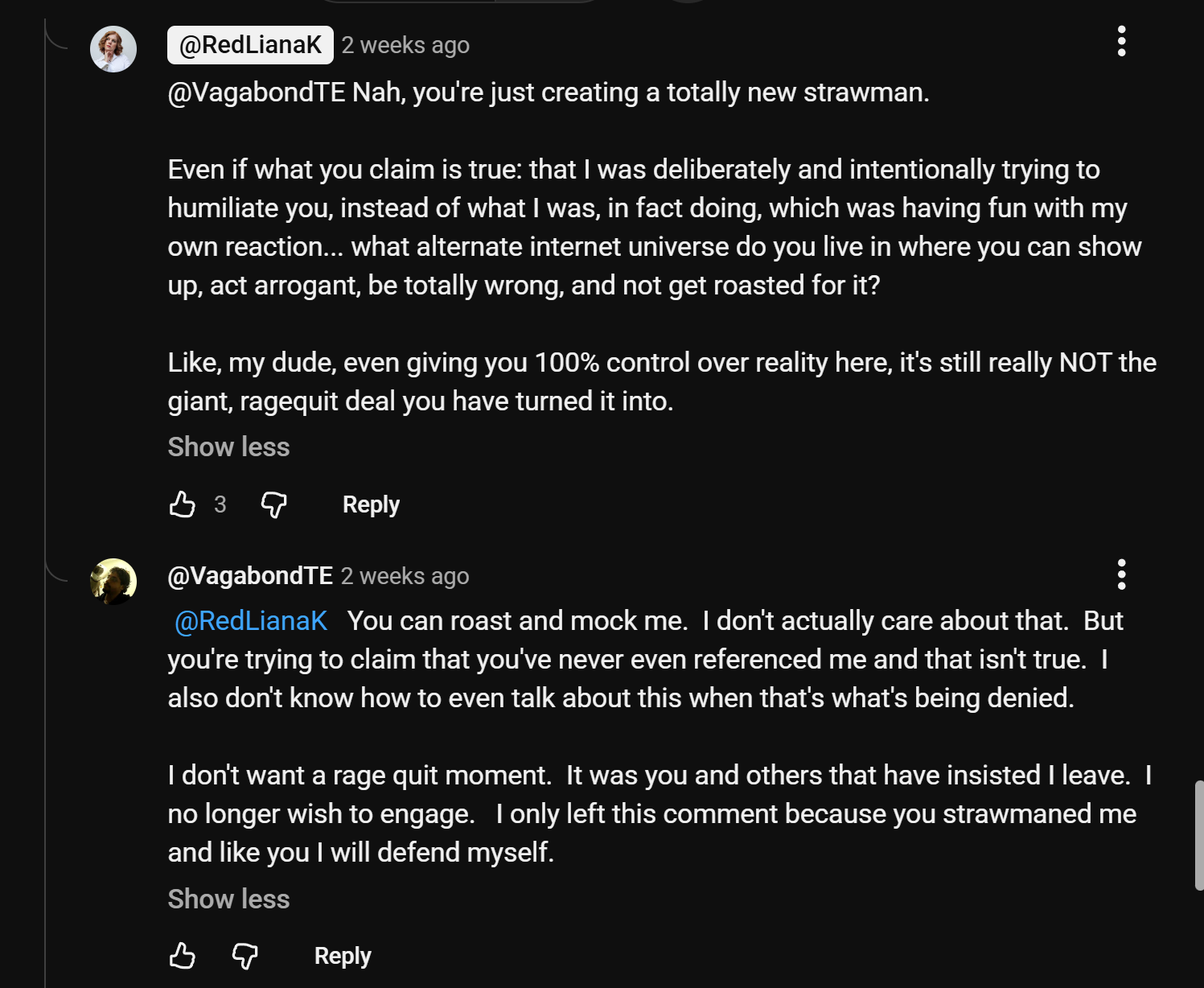
Although scrolling text is generally a clearer way to document YouTube exchanges than screenshots, I must briefly depart from that format here in order to illustrate the scope of what followed when Vagabond attempted, once again, to defend himself against what he viewed as a misrepresentation of his comments. Presenting the exchange in this way will also help convey the broader dynamics that emerged in the discussion and the tone that developed within Kerzner’s community during the interaction.
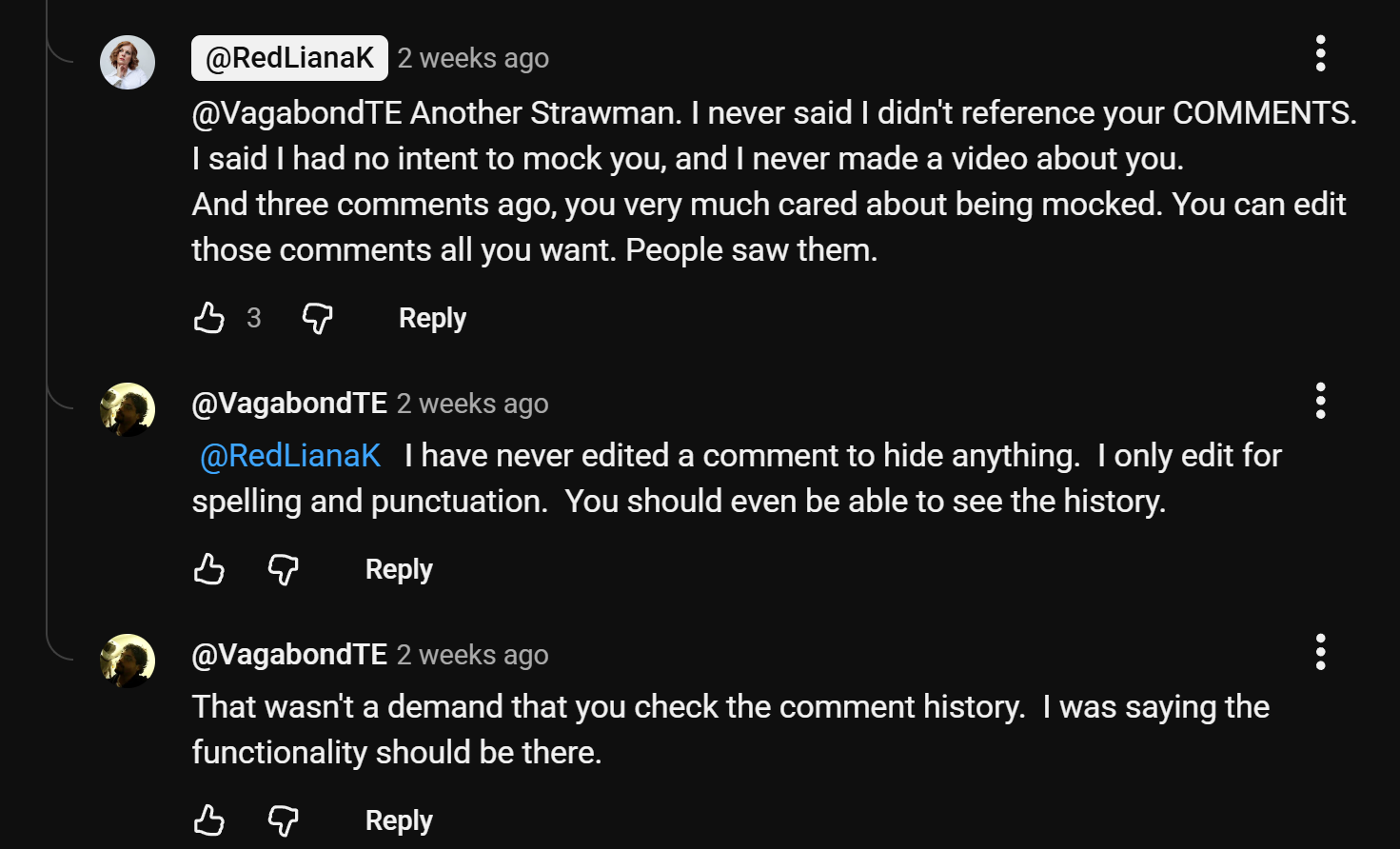

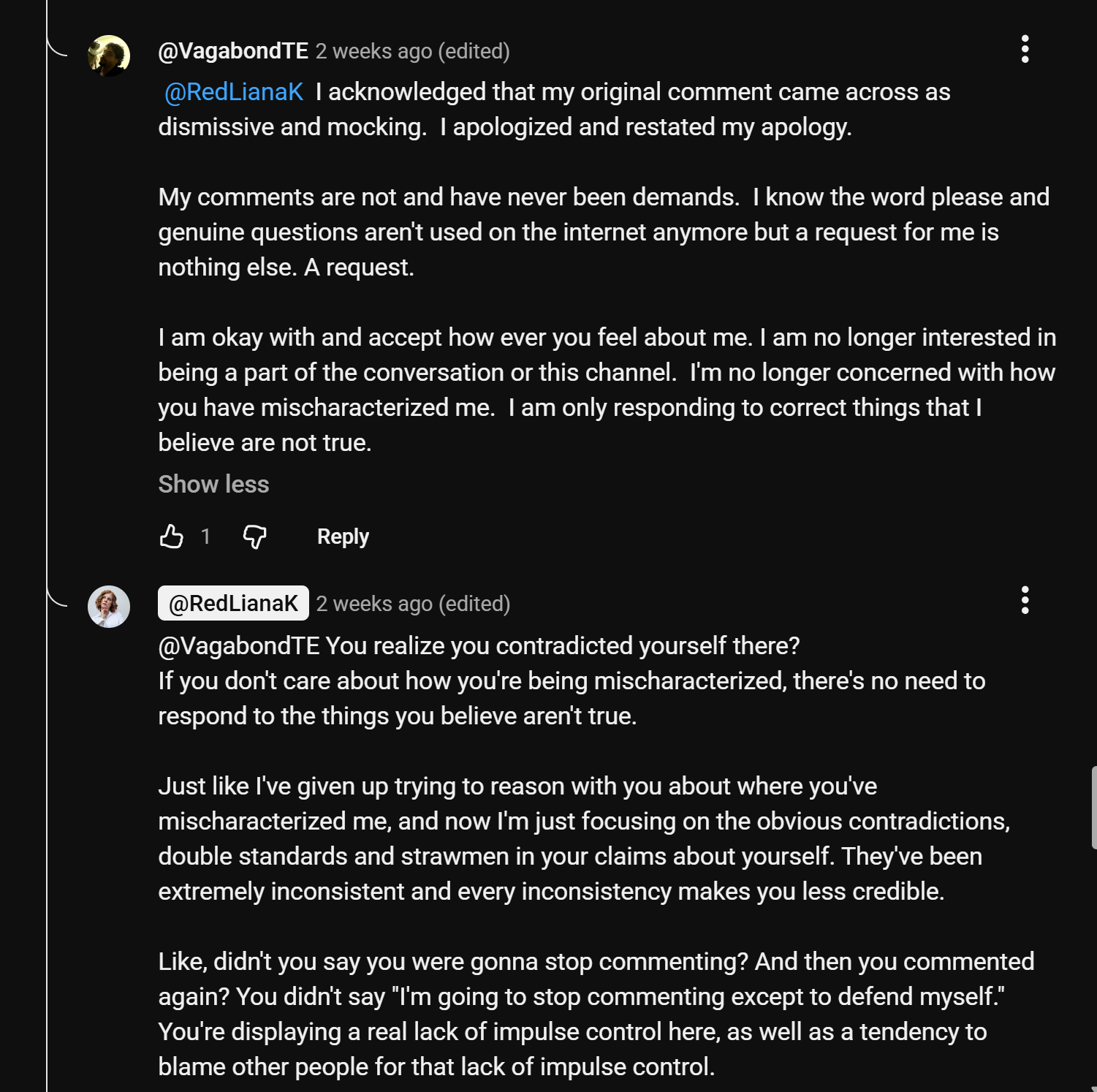
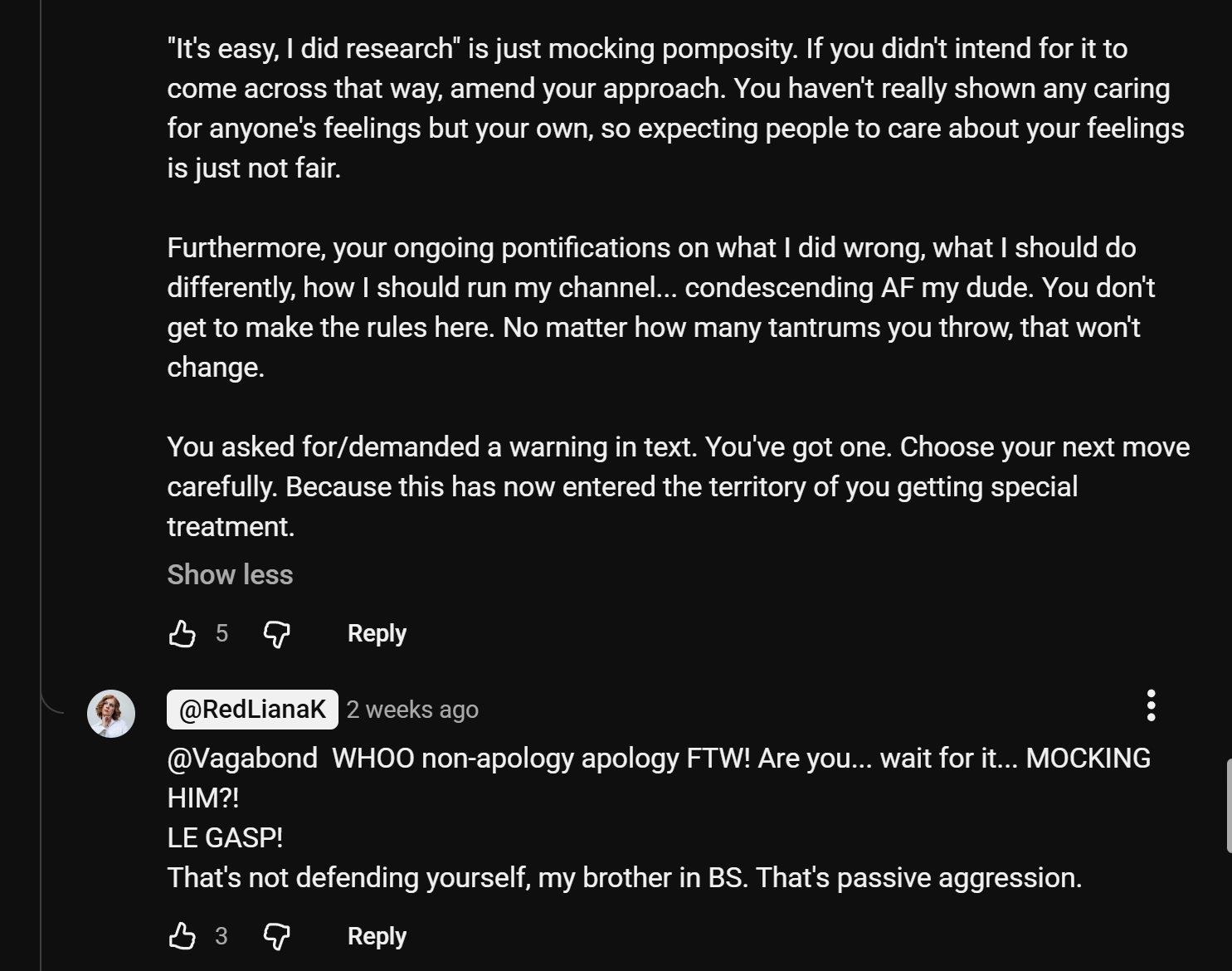
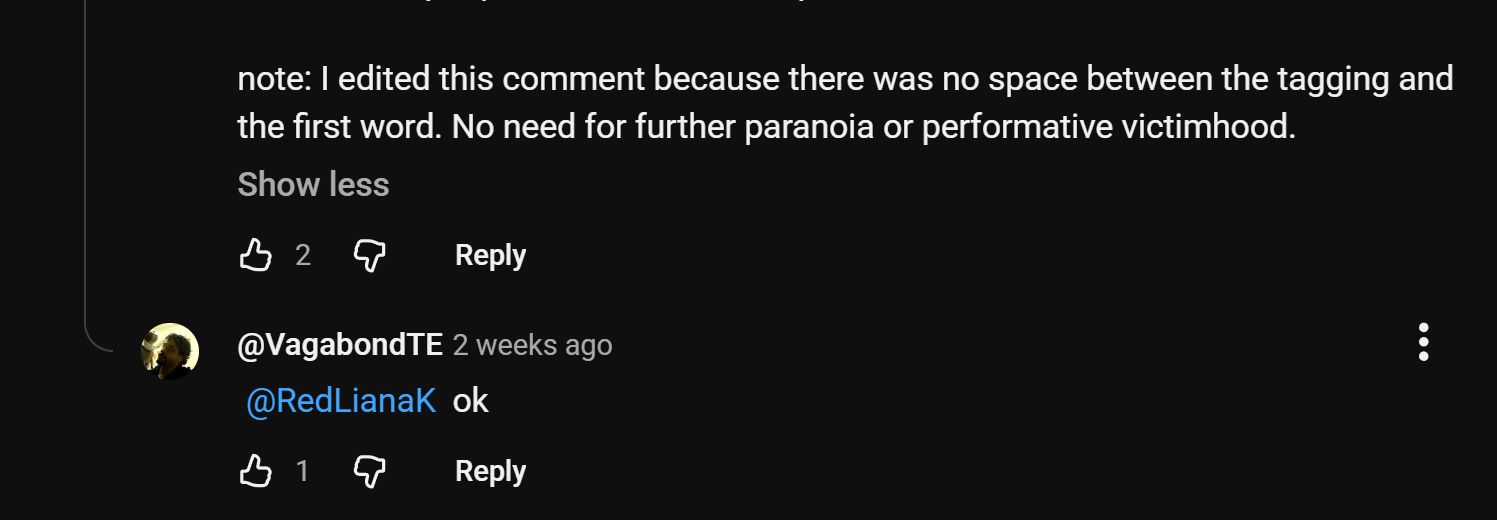
Kerzner’s phrasing here is notable because it echoes a well-known rhetorical pattern often summarized in the following sequence:
That didn't happen.
And if it did, it wasn't that bad.
And if it was, that's not a big deal.
And if it is, that's not my fault.
And if it was, I didn't mean it.
And if I did, you deserved it.
Placed alongside the earlier exchanges, this thread appears to complete the pattern that had already begun to emerge.
First, Vagabond clarifies something specific: he was not objecting to “the snikt.” He explains that what he perceived as mocking was the tone Kerzner used when reading his comment, along with what he interpreted as derogatory assumptions about his motives. He also refers to Kerzner allegedly mocking him about something said on her server—an incident I could not independently verify. The responses from other participants quickly return to familiar refrains: “NO ONE is talking about you,” “let it go,” “manchild,” “stop talking,” and “let go of your ego.”
Vagabond’s emotional investment in correcting what he believes to be a misrepresentation is itself interpreted as evidence of ego or overreaction. Kerzner’s intervention shifts the frame further when she reframes the issue from “did I mock you?” to “where do I sign up for the club where someone can say something arrogant and wrong and not get roasted?” At that moment, the question of whether Vagabond felt misrepresented is obliterated, and instead it is focused toward the premise that his comment was arrogant and therefore deserving of ridicule. Even when she says, “Even if I did intentionally make fun of this guy (I DID NOT)…,” the hypothetical introduces the possibility that mockery would be socially acceptable under the circumstances.
Kerzner continues with a series of assertions about Vagabond’s conduct: that he has “proved” he does not practice what he preaches, that his opinions are now “worth less,” that he is projecting, that he has shown concern only for his own feelings, that his commentary on her behavior is “condescending AF,” that he “doesn’t get to make the rules,” and that his responses amount to “tantrums” and demands for “special treatment.”
This is a public delegitimization. At the same time, there is an escalation in asymmetry in how mockery is addressed. When Vagabond says he felt mocked, Kerzner interprets that claim as projection; yet in another comment she playfully accuses him of mocking someone else—“Are you… wait for it… MOCKING HIM?! LE GASP!”—in an overtly sarcastic tone, echoing the rhetorical style she had previously rejected. Meanwhile, Vagabond’s tone narrows and does not escalate. He attempts to clarify that he accepts her feelings and that he no longer wishes to participate in the discussion beyond correcting statements he believes to be inaccurate. Whether one agrees with him or not, the contrast is visible: while Vagabond attempts to withdraw while preserving his stated position, Kerzner continues to respond with increasingly authoritative assertions.
A consistent leitmotif throughout the exchange is the question of interpretive authority. Kerzner maintains that how the comment “landed” on her justifies the tone of her response, and she treats that reaction as dispositive instead of her subjective experience. She also insists that she alone can know her own intent while simultaneously attributing motives to Vagabond. When she suggests that if he does not like the feeling of being mocked, he should recognize that he caused it, the responsibility for the dynamic shifts away from her actions and onto his behavior. His responses are interpreted as arrogance, ego, projection, or tantrum-like conduct, while her own position is presented as authoritative. The exchange evolves into a series of hierarchical assertions by Kerzner about whose interpretation of events carries legitimacy.
Viewed alongside the Patreon remarks and the later archetype episode, the framing of the dispute appears to shift over time. The initial question raised by Vagabond—whether his comment had been mischaracterized—is forgotten, and the entirety of the discourse is replaced by Kerzner’s reframing of the issue as a question of why he could not tolerate being “roasted.” By that point, the original question and the objections were no longer in anyone's mind.
This leads into the next series of significant exchanges in February of 2026:
In a video published on February 6, 2026, Kerzner discusses her desire to create more positive content while also addressing the negative and contentious comments that often accompany her more controversial opinions.
She describes the difficulty of dealing with online negativity and the exhaustion it can produce, particularly when she feels that people mischaracterize her work or continue to revisit earlier disputes. Read alongside the earlier exchanges with Vagabond, there is something disquieting about this statement. Throughout that exchange, Vagabond repeatedly stated that he believed his position had been misrepresented and attempted to clarify what he meant. From his perspective, the same dynamics Kerzner describes—mischaracterization of her and the persistence of past grievances—were occurring— in reverse. Kerzner also emphasizes the importance of authentic conversations and maintaining what she calls the “maximum reasonable benefit of the doubt.”
In the interaction described above, however, that presumption does not appear to have been extended to Vagabond. The observable pattern in those exchanges shows his attempts at clarification being interpreted as anything but a good-faith disagreement. Despite the trajectory of the prior discussion, Vagabond nonetheless attempted to extend an olive branch in the comment section:
Kerzner’s response was notably disproportionate in comparison to the conciliatory tone of Vagabond’s comment:
You will recall that one of Kerzner’s central complaints in the February 6 video was that people mischaracterize her work and hold onto past grievances. That concern is worth highlighting here, because the exchange with Vagabond provides a point of contrast. Vagabond’s comment reads as an attempt at repair. He opens with an apology and is quick to affirm that he appreciates Kerzner’s positive content, he acknowledges that his earlier phrasing may have landed poorly and explicitly states that he is hesitant to speak because he fears further escalation: “I’m scared to talk here.”
He concedes that the phrase “it’s easy” may have sounded dismissive, and suggests that a brief clarifying outreach from Kerzner might have prevented the dispute from expanding. instead of an assumption of intention (which Kerzner's response certainly was). His tone is deferential and self-monitoring. Rather than advancing accusations, he attempts to explain his intent and frames his critique in terms of communication process rather than personal character.
Kerzner’s very aggressive reply shifts the structure of the exchange in several ways. First, the conflict moves from a question of miscommunication to a series of accusations about Vagabond’s behavior. Her response is organized around repeated “Why did you…” questions that accumulate into a list of alleged actions: lying, demanding censorship, spamming comments, exploding emotionally, projecting motives, attacking her character, inventing conspiracies, and attempting to control her content. Secondly, she reverses the dynamic of characterization: Vagabond’s claim that his position had been misrepresented becomes, in her framing, evidence that he had attacked her and his fear is interpreted as an expectation that she provide comfort. A desire to not have his words distorted further is then taken as an attempt to restrict her speech. Finally, Kerzner asserts interpretive authority over the exchange: Vagabond is criticized for speculating about her intent even as she attributes motives and psychological states to his behavior— and as she has been doing throughout the entire exchange under the guise of describing how something 'lands', while reacting as if it were a given instead of a question.
The exchange ultimately shifts away from discussion of the original issue and into Kerzner cementing her hierarchical authority: she emphasizes her control over the channel, raises the possibility of blocking him, describes his prior reactions as “explosions,” and anticipates that any further response will constitute another meltdown. This creates a situation in which the range of responses available to Vagabond narrows considerably to almost nothing at all. A continued reply risks being interpreted as further escalation, while a withdrawal would come across as tacit confirmation of the framing. Within that structure, a setup that is called a double-bind communication, attempts at clarification or apology can themselves be reinterpreted as additional evidence against him.
Vagabond is, essentially, trapped.
A SERIOUS RED FLAG MOMENT
There is a recognizable communication pattern in Vagabond’s comments that is often associated with autistic or autistic-adjacent social processing. This is not an attempt to diagnose Vagabond; it would be irresponsible to do so. However, the structure of a communication pattern can still be analyzed independently of any medical label, and it is important to address the form of his communications because it is deeply significant.
The hallmarks of this style of communication include hyper-literal clarification, over-explaining to prevent misinterpretation, visible anxiety about tone, repeated self-correction, explicit naming of intent, and difficulty compressing thoughts into short, socially “normal” comments. Vagabond rewrites sentences multiple times and anticipates how phrases might be misread. He apologizes for length. He explicitly says he is scared to talk. He tries to reconcile perceived inconsistency through logic rather than social maneuvering.
It is important to once again note that none of that proves autism. Nevertheless, all of those trademarks closely mirror how many autistic adults describe navigating high-context social spaces like YouTube comment sections— interactions marked by conscious effort, verbosity as a safeguard against ambiguity, and distress when intent and reception diverge.
What is ethically alarming is not whether or not Vagabond could be diagnosed with autism. It is how that pattern pro se is handled.
When someone communicates in the manner in which Vagabond has, escalation through accusation, sarcasm, and moral indictment will inevitably magnify distress. Autistic communicators often double down on clarification when misunderstood as a means of self-correction. If that repair attempt is reframed as “spamming,” “exploding,” “projecting,” or demanding censorship, then what happens is that result becomes a feedback loop: The more they try to clarify, the more they are pathologized, and the more they are pathologized, the more urgently they try to clarify.
From the outside, this can look like obsession or instability. From the inside, it is often panic at reputational distortion. Panic is often followed by indignation, and when pressure continues beyond that point, collapse becomes a real risk.
When a media personality positions herself as conversant in mental health dynamics, and then responds to this style of communication with public prosecutorial rhetoric, sarcasm, power signaling, and pre-emptive framing of future responses as meltdowns, it is socially dangerous. Especially if the audience includes neurodivergent individuals who already struggle with tone policing, rejection sensitivity, and public misinterpretation. The dynamic visible here — and reportedly echoed in other cases you have already seen in this document — is predictable: a literal, anxious communicator is interpreted as hostile and any repair attempts are unquestionably treated as escalation and the individual is publicly framed as unstable or manipulative.
Once again, the core issue is not whether Vagabond is autistic. The communication style on display is one that any mental-health-aware community should recognize as requiring de-escalation, clarification without resorting to humiliation. What Vagabond received, however, was adversarial amplification. If this pattern repeats — as it has in other interactions — then everything points towards a systemic mishandling of vulnerable communicators in high-visibility spaces.
When someone claims to foster psychologically informed discourse, the bar is set higher, not lower, for how they manage exactly this type of interaction in the interactions they invite as public figures.
What makes this especially insidious is not just the exchange itself, but the modeling effect it has on a neurodivergent audience that looks to the perceived expert for social cues. When a high-status figure frames anxious clarification as “explosion,” repeated defense as “spamming,” a vulnerable admission of fear is treated with suspicion and dissent chastised like a failure of character or moral fiber (and done so sarcastically and dismissively), it becomes template for how “healthy” people are supposed to respond to perceived disruption. Viewers and community members will then mirror the behavior that was signaled. We see it immediately: Aileyn repeatedly dismisses things that are readily observable, Per resorts to mocking and Baconlazer adopts a policing position in which he demands silence. The majority of Kerzner's community members are not independently analyzing the situation, but instead they are acting in alignment with the markers set out by her behavior, and it feels justified because it has been authorized from above.
In that structure, containment of the “problem person” becomes the predominant communitarian virtue, and — despite the terminology employed— the practice of it is far less the act of moderation than it is a form of social enforcement through humiliation. For neurodivergent viewers trying to learn how to navigate conflict, the lesson that will be absorbed is chilling: overwhelm, accuse, delegitimize, and crowd out. That is how "healthy" people neutralize threats. That is how you prove loyalty to "healthy" standards of acceptable behavior.
And that is how a psychologically branded space metastasizes into a mob without ever calling itself one.
And I suspect that is why Liana Kerzner was deemed unqualified, as per licensed therapists
according to her own words, to deal with autistic individuals and those on similar spectrums.
The reason this case is being highlighted is not because Vagabond's is a unique case — it happens over, and over, and over with Kerzner. It is only especially egregious because of it is currently happening as of this writing, and the ending of it is very predictable, as per all the other cases with Kerzner.
The final act is already playing out. In Kerzner's video Warhammer 40K Is A Rorschach Blot (Feedback Friday), Vagabond simply left the following comment:
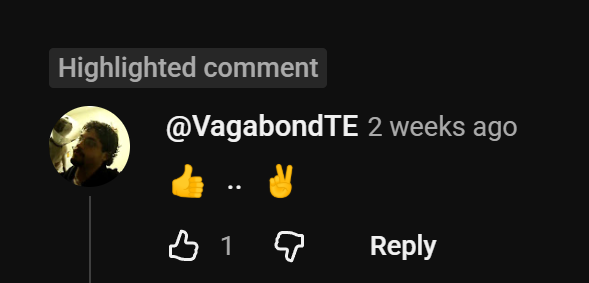
If the broader context of the confrontation is taken into account, Vagabond's response becomes easier to understand. After everything that had occurred up to that point, the space has effectively collapsed. There was no longer a safe way to use words.
When someone is repeatedly criticized for verbosity, they may attempt to shrink their output. If every interaction is mined for intention and reframed into a conflictive stance while also being exposed to public humiliation, most forms of engagement tend to cease. In conflict psychology, this dynamic is often associated with what is sometimes described as learned futility. In this instance, the visible pattern suggests an acknowledgement that verbal participation will likely be weaponized. Minimal signaling becomes one of the few remaining forms of interaction that might appear resistant to reinterpretation.
There is also a neurodivergent dimension worth considering. If a person who already struggles with tone interpretation experiences intense public hyper-scrutiny and taking apart of their words, they may come to view language itself as unsafe. What is left is the behavior of someone who has been publicly dismantled and is attempting to leave the smallest possible footprint in order to avoid further harm while still remaining socially connected rather than withdrawing entirely.
In the exchange that follows, however, even that reduced participation does not appear to be tolerated.
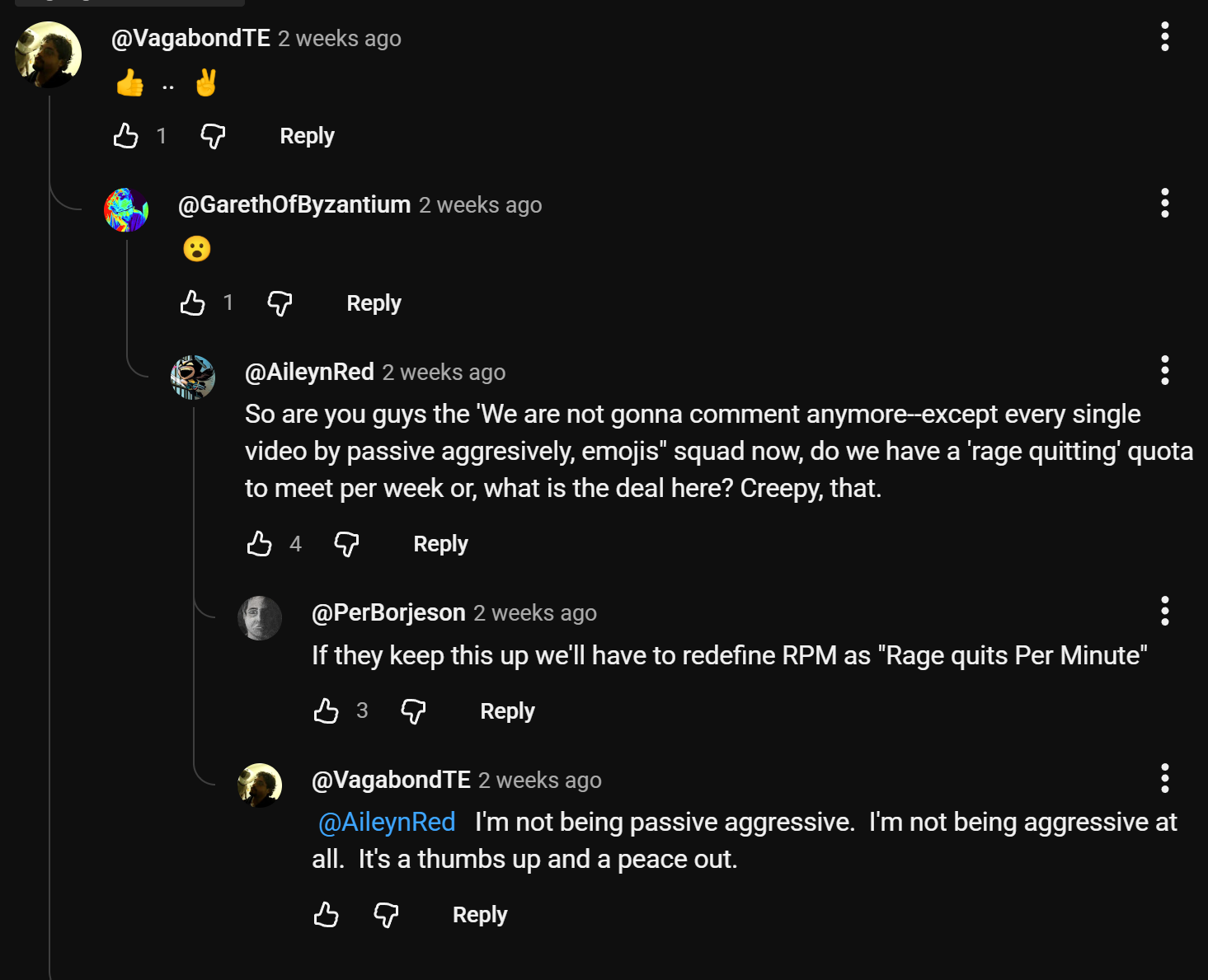
Aileyn immediately implies that the emojis are a demonstration of passive aggression, describing them as “rage quitting” and “creepy.” The question “Do we have a rage quitting quota?” keeps the prior framing alive and applicable: Vagabond, in Aileyn’s telling, is unstable and dramatic.
Per follows by turning the moment into a joke: “Rage quits Per Minute.” In doing so, he signals to the in-group that this person remains a spectacle, a source of entertainment — as Kerzner would put it— “for the needs of the many.”
From this point forward, there are several ways Vagabond could react, and none of them appear likely to resolve the situation in his favor except complete withdrawal. Disappearing entirely would place him outside the reach of the hostility, but at the cost of further isolation and the loss of any remaining social connection within that environment.
Some individuals, particularly those who struggle with navigating complex social cues, may remain engaged despite hostility, because hostility can feel preferable to total silence.
Liana Kerzner herself articulated a version of this dynamic during her disagreement with Gail Simone, when she remarked that the choice can feel like being “tortured by noise” or “tortured by silence.” Within that framework, Vagabond may continue attempting to find a way to interact “correctly” with Kerzner, hoping to avoid further humiliation or punishment.
Prolonged pressure can eventually produce a more extreme reaction — frustration, anger, or visible emotional distress. In other conflicts surrounding Kerzner, similar trajectories have appeared in different forms: some individuals have responded by posting extensively about her (Jura), while others have withdrawn almost entirely from public participation with her (Simone, Song).
The narrative frame surrounding the individual is often already affixed by that point. The person may be recast as a “stalker,” a “hater,” a "bully" or “unhinged,” joining the catalogue of adversaries Kerzner collects and references in her videos. Their names and voices recede into the background of her narrative, replaced by anecdotal descriptions detailed enough for her audience to recognize the target without formal identification.
They become one of the illustrative examples — the kind whose level of detail Vagabond himself once protested.
Kerzner’s style of conflict management does not produce resolutions when it truly matters. Instead, the pattern documented across these exchanges suggests a habitual pattern in which conflicts are continually re-absorbed and incorporated into the narrative rather than conclusively settled.
My observations about the possible trajectory of Vagabond’s situation are not idle speculation or unfounded conclusions. They arise from patterns visible in how Kerzner has handled other conflicts in which the opposing party held significantly less social power or public standing.
And insofar as the toxicity she fosters within her community? The results can be seen in the comment sections of her videos still, perfectly exemplified by Aileyn, Per, and others. This can be seen here in a recent exchange, which shows a community and moderators who have lost all sense of proportion— thanks to the leadership that models acceptable behavior: Liana Kerzner.
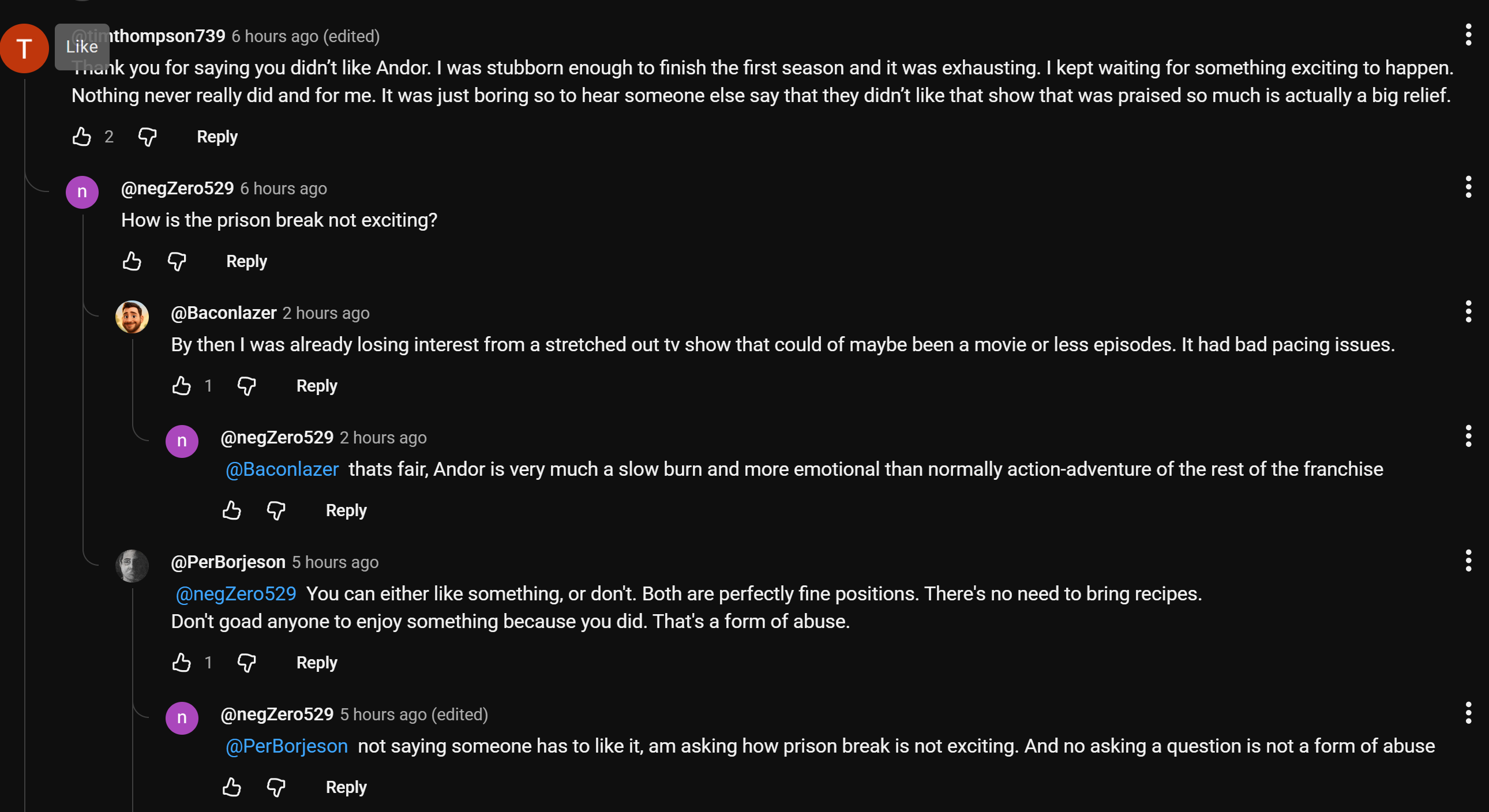
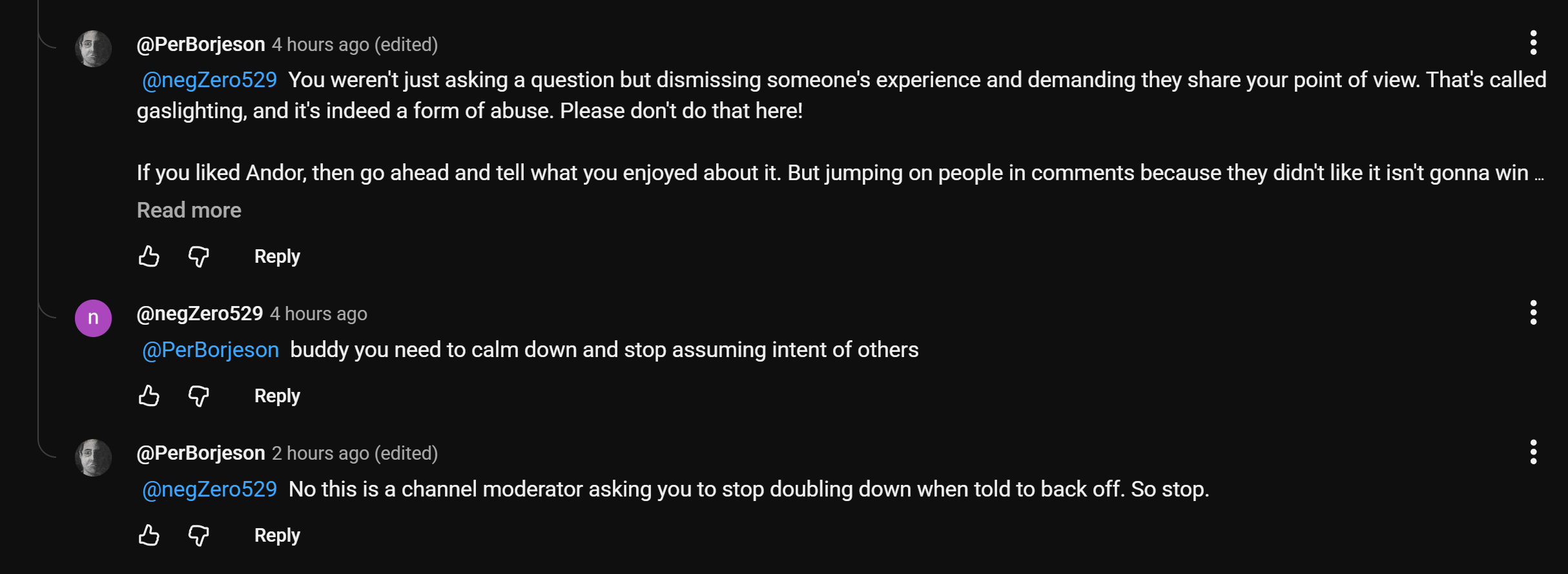
The way in which Kerzner portrayed this incident in one of her later videos (Don't Be Afraid Of Being Weird) is also incredibly telling in how little her account of events resembles observable reality:
"And ___. it it happened when I mentioned I don't like Andor. I didn't say Andor is a bad show. I just don't like it. And I found it boring. And somebody agreed with me and they said, 'Oh my god, I feel so much better that I'm not alone.' And some guy jumped on him in the comments. So, you're saying the heist wasn't exciting. The heist happened in the last damn episode, sir. Like, what? That, but also just let the person say they didn't like it. Holy ___, Calm down. And it's, you know, but that's normal on the internet. It's not good, but it's normal. And a, you know, a moderator stepped in and go, 'Hey, cool it.' And that's the way I do things around here." — Liana Kerzner
Kerzner constantly describes the actions of her critics and, really, anyone with a dissenting opinion with very violent terms. They 'blow up' at her, 'rage' at her ( but when applied to her, she responds "how does someone rage over text?"), and 'jump on' other people when, observably, they are asking a very innoffensive question and devoid of any hostile language. I believe this is intentional . Once again, I must point out that Kerzner constantly prides herself on her communication studies and ferquently expounds on her credentials as a public communicator, so we cannot consider her ignorant of the impact of the specific words that she chooses . Kerzner couches the actions of the target in inherently violent language in order to reinforce her image as the besieged victim, all the while building up a bravado of doing the right thing in the face of mobs of 'harassers', 'stalkers' and 'haters.'
All the while her admins such as Per—trained on Kerzner's rhetoric— treat the asking of a question as abuse.
Similar dynamics appear in prior incidents: how D was handled, how Mitchell Jura and Song were transformed into cautionary figures within the community narrative — individuals discussed as sources of ridicule, scorn, or reputational condemnation.
A comparable pattern also appears in the way Kerzner ultimately has spoken about my husband, Asher.
 The 'Very ugly fight'