Introduction
This section must, by necessity, include screenshots of the claims
Kerzner has made about the production cycle, and my qualities as a
professional, to her community of Patreons on Discord, which is also
comprised, in part, by backers of the game.
Kerzner will argue that this is a violation of privacy.
I must point out that Kerzner's server can be easily accessed through
Patreon by anyone willing to pay $1 and verify their identity. This server is not an intimate space of close friends, but a professional forum with approximately 100 members — including clients, Patreon supporters, gamers, developers, and other creatives. My usage of this material is in the public interest to correct harmful falsehoods. It is also necessary to observe that she has made statements I believe are false and misleading, and I will present evidence to that effect. I also believe that her statements meet the criteria for professional defamation under U.S. law, and therefore must be included here because Mrs. Kerzner's own actions have made their inclusion necessary. I also must be able to show that she said what she actually said, the medium in which she said it, her pattern of behavior, and my refutation to the claims.
It is also necessary to showcase how her audience receives and amplifies
the stories imparted by Kerzner, as they are likely to be repeated as fact beyond the paid Discord, anytime her audience encounters my moniker or future creative projects.
Mrs. Kerzner and her lawyer may wish to argue that my 'online identity' has no value
that could be damaged, but in this she is wrong, as several of my albums
are published under my moniker, which is also tied and registered to my
real life name. It is also the nom de plume under which I am developing
my own projects. If Kerzner wishes to imply that the falsehoods and
inaccuracies that she is spreading about my professional qualities do
not affect how I will be perceived in the different indie industries in
which I am publishing, and intend to publish— I must observe that this is not reflective of the reality of the fandom spaces and the modern independent creative sphere on the internet, where long-term-monikers are as identifiable as a creator's given name.
A Definition of Defamation
Under U.S. law, defamation involves a false statement presented as fact, which:
1.Is communicated or published to someone other than the subject (i.e., it is not entirely private);
2.Causes harm to the subject’s reputation; and
3.Is made with at least negligence, if not actual malice.
Importantly, even semi-private spaces — such as Discord servers — can qualify as “published” environments under defamation law. Courts have recognized that statements made to small groups may still meet the standard of publication. You cannot defame someone “in private” if the content is accessible to a group of third parties, especially one of significant size, such as one hundred people (or more).
In Thelen v. Evening News Ass’n, 89 Mich. App. 718 (1979), the court held that publication occurs when a defamatory statement is communicated to anyone other than the plaintiff — regardless of whether it is formally printed or broadcast. The court further clarified that publication is actionable when the statement is made in a manner likely to damage the plaintiff’s reputation.
Statements such as “They breached contract” or “They refused to communicate with other team members” are examples of factual assertions — not opinions — and are subject to defamation analysis. These are claims that can be proven true or false.
Kerzner has made statements of this nature, and I will address and refute them in the following sections.
Identifiability
Kerzner has repeatedly claimed that she did not name me or Asher in her video content. However, this defense is insufficient under U.S. defamation law, which recognizes identifiability by inference. The “of and concerning” requirement is satisfied when reasonable people familiar with the context can recognize who the statements refer to — even without the use of a legal name or handle.
There are multiple contextual indicators that point directly to me and, by association, my husband:
1.The Kickstarter page for the project lists only two team members.
2.The video references one team member’s spouse.
3.My Kickstarter bio explicitly names my spouse and our company.
4.Within 24 hours of Kerzner’s cancellation video being published (October 4), online users publicly identified both me and my spouse.
These facts demonstrate that third parties — without prompting from us, as we made no public statements immediately after the cancellation (and Asher wouldn't until 15 days after) — could and did recognize us as the subjects of Kerzner’s statements.
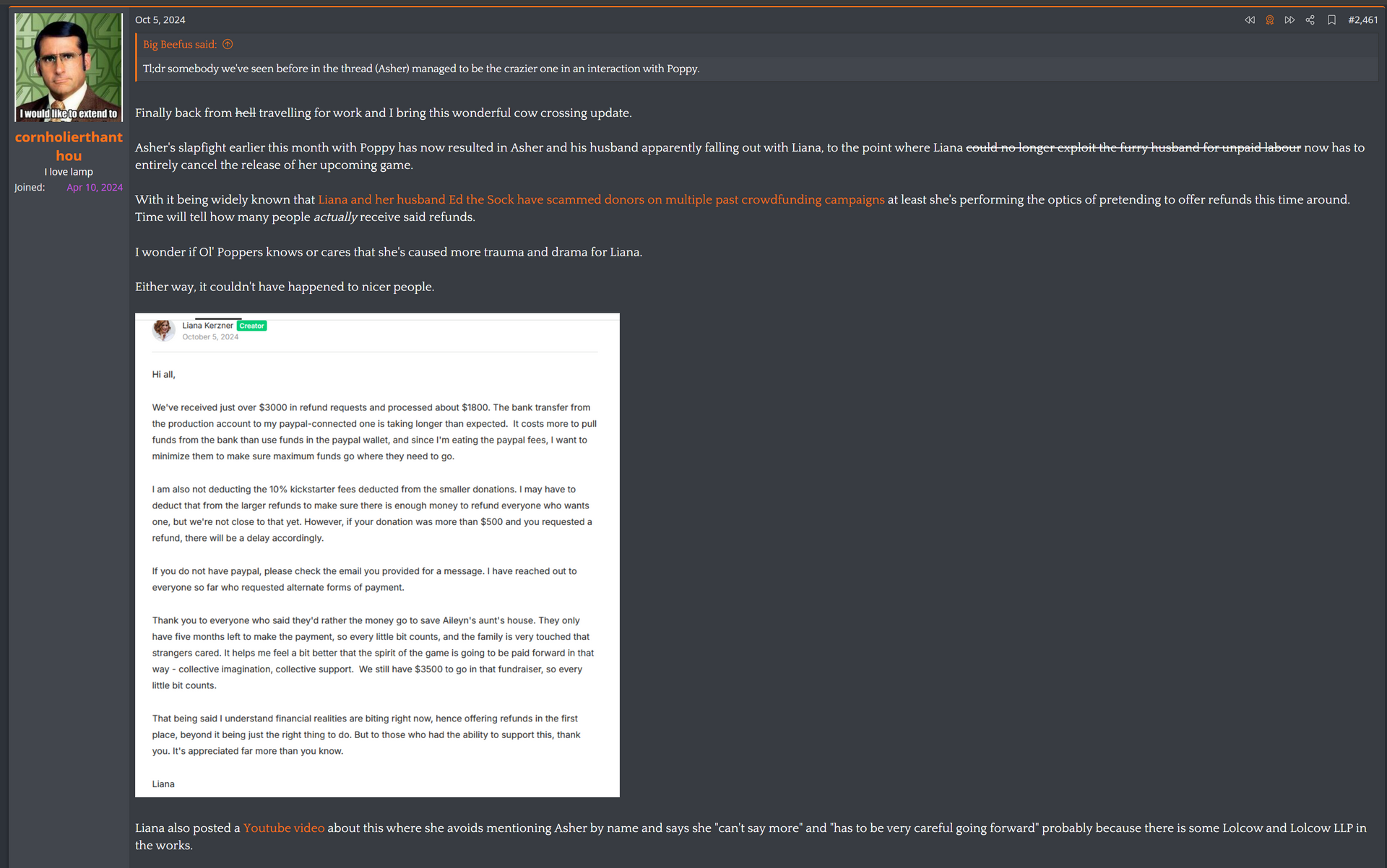
I have preserved evidence of this identification. Two social media accounts tagged me directly the day after the video aired, referring to “Liana’s furry henchmen,” clearly signaling that they connected us to the comments made in the video:
These posts are
now archived for evidence should the need to prove their existence ever arise.
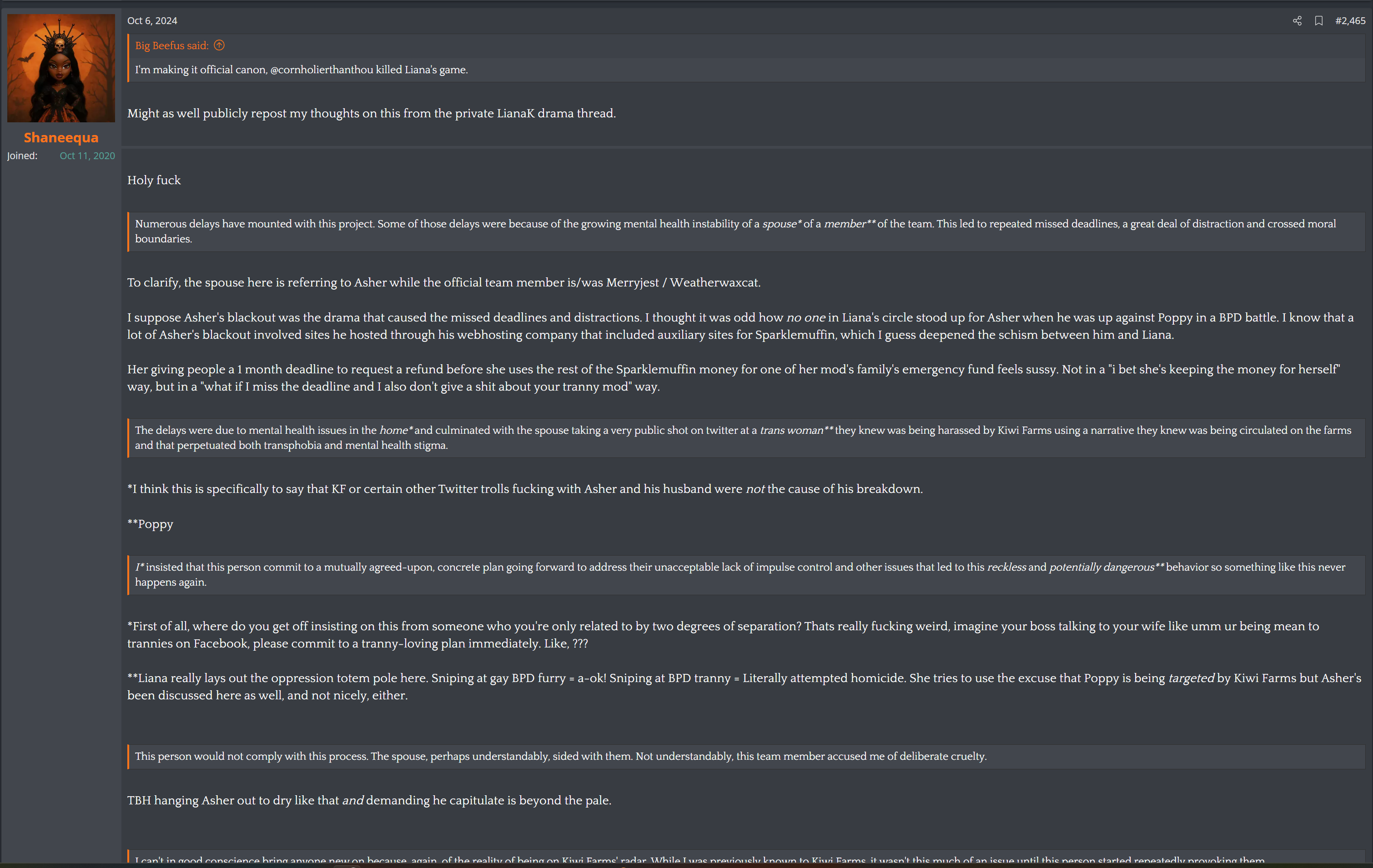
In addition, prior to the video’s release, two separate users on Kiwi Farms — a notorious internet forum known for coordinated harassment — immediately identified both me and my spouse in relation to Kerzner. This refutes any claim that our identities were protected or obscured.
Note: Kiwi Farms is a forum associated with campaigns of harassment and doxing, and has been linked to multiple high-profile online abuse cases (source: Wikipedia). I do not endorse the site or its content in any way. My spouse and I were forced to monitor activity there only due to safety concerns arising from our prior association with Kerzner.
Venue of Publication
While Kerzner’s statements were made inside a Discord server accessible via a $1 Patreon subscription, this still constitutes a public or semi-public forum under defamation law. Courts have held that statements shared with a community broader than personal friends, or with a shared professional or commercial interest, can qualify as published.
Kerzner’s server includes approximately 100 members — many of whom are patrons, gamers, and creatives — including individuals with direct ties to my own professional spheres. This increases the potential reputational impact and supports the conclusion that the audience was sufficiently public for defamation analysis.
Vagueness as Defense
Kerzner has, at times, claimed she does not name individuals in her commentary. However, a pattern emerges in which she relies on rhetorical cues, nicknames, and contextual details to signal identities to her audience — who, in turn, appear to recognize exactly whom she means. In a 2023 tweet, Kerzner stated:
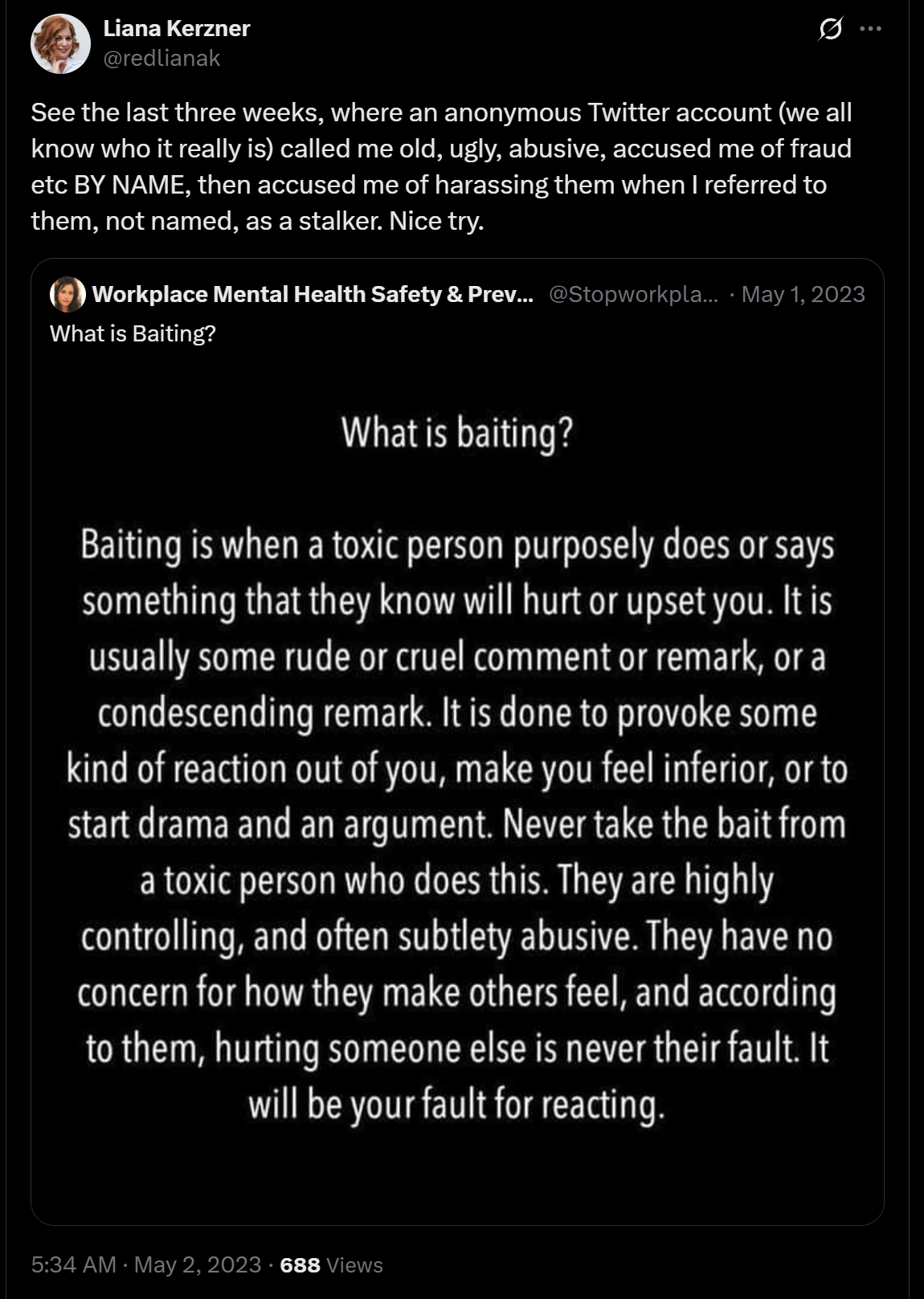
This comment was retweeted in conjunction with a post about “baiting” — behavior associated with toxic individuals seeking to provoke emotional responses. Taken together, the implication is clear: her audience is meant to “know” who is being discussed, without the need for formal naming
In the same video, Kerzner suggests that Schooley submitted multiple emails through an unprotected contact form, but later speculates it might have been the “Gruesome Twosome” who "can be just as unhinged"— her nickname for me and my spouse. She uses this name elsewhere in her Discord server, including a post where she identifies Asher, my husband, by name, in conjunction with the nickname.
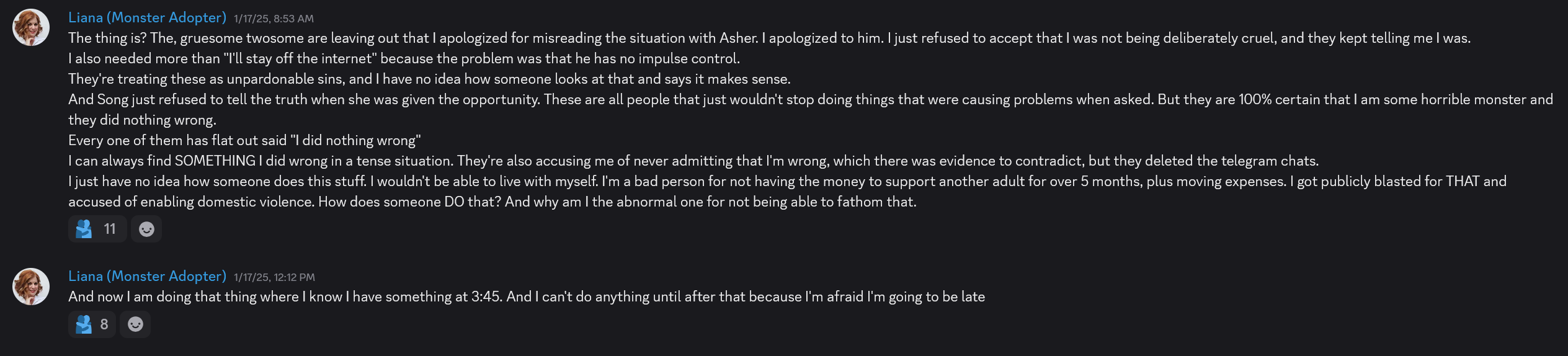
This layered use of inside jokes, nicknames, and private references creates a “wink-to-the-audience” dynamic, where she maintains plausible deniability while effectively identifying people to those familiar with her content. The effect is to bypass explicit naming while still making targets clearly identifiable — especially to those with context or access to related information (e.g., the game project, Discord discussions, and prior social media exchanges).
Further evidence of this rhetorical pattern includes her use of the nickname “Princess Grifter” to refer to Song Eretson. In a December 2024 post, Kerzner wrote:
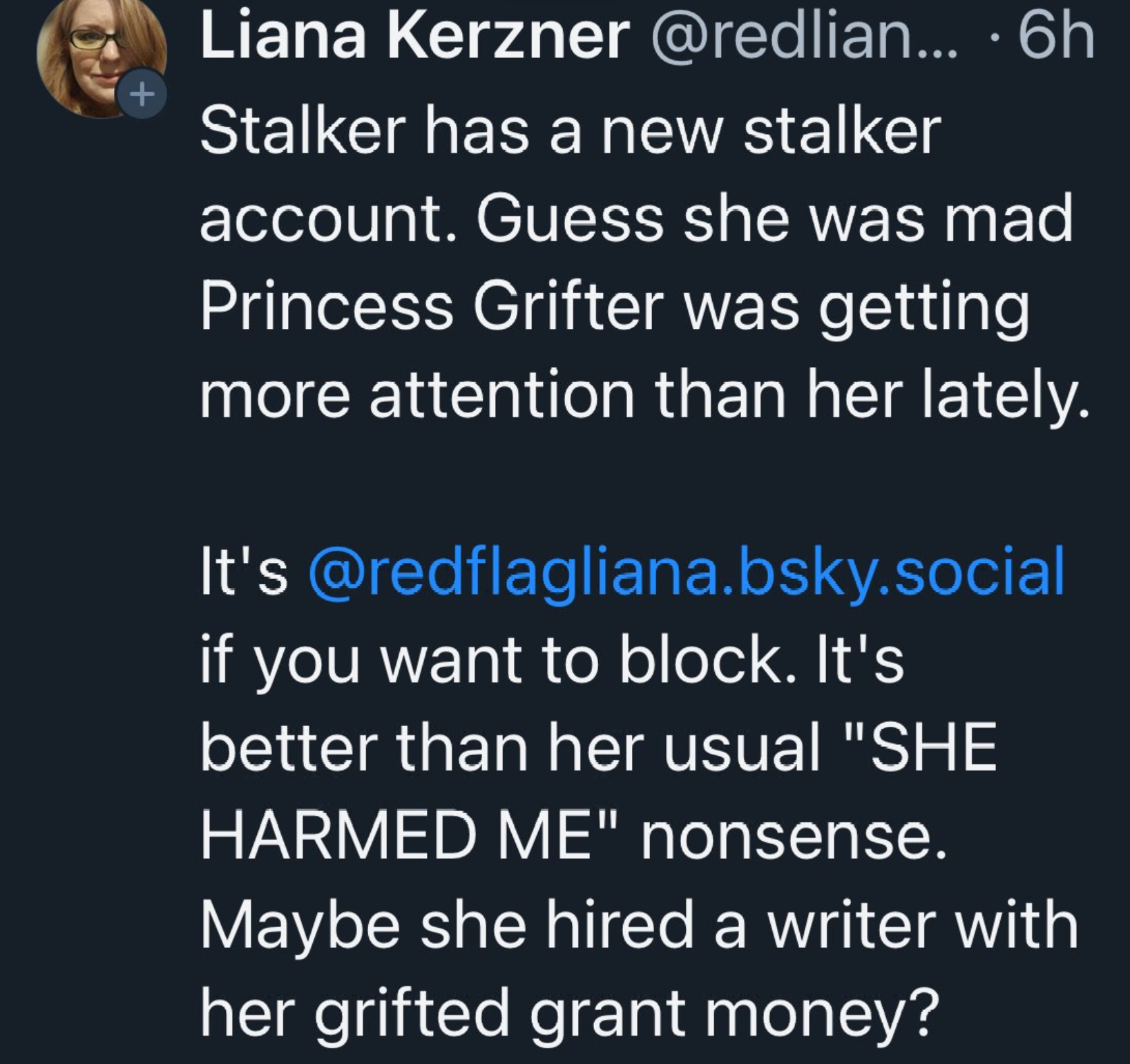
At the time, Emily Schooley’s company had publicly received arts funding and was recognized by Meridian Credit Union — making the target of that comment readily inferable.
This ongoing pattern — invoking “Stalker-Chan,” “Gruesome Twosome,” and other identity-linked phrases — establishes a narrative structure that invites the audience to decode who is being targeted. The omission of names does not shield the speaker from liability when identification is plainly possible.
Courts have repeatedly affirmed that defamation can occur even without direct naming when the subject is reasonably identifiable.
This dynamic directly supports the legal conclusion that Kerzner’s statements meet the “of and concerning” standard in defamation law. When audience members are able to, and in fact do, identify the individuals being discussed, omission of names does not negate responsibility.
Moreover, as the following section will demonstrate, Kerzner’s subsequent statements include a litany of false or misleading claims that are clearly directed at me — further confirming her intent and her audience’s understanding.