SONG ERETSON
Song Eretson was Liana Kerzner's collaborator on their joint Youtube series, 'Two Women Talking.' Song Eretson was, also, a LianaKares client of Liana's, and we have already covered her involvement in the game as a sprite-making volunteer.
Eretson was, as expected, a member of Kerzner's Discord community and remained there until December of 2024, when Kerzner published the following video:
Kerzner opens her video by saying she is making the video because she believes in “transparency” and public honesty, and because, according to her, Song Eretson does not share those values.
According to Kerzner, the lie concerned an audiobook for Song's book, an audiobook that was never released for which Kerzner and others worked for free, or were compensated through services Kerzner herself bartered on Song's behalf. Song ultimately decided not to go forward with the voice work as recorded, and Kerzner alleges that Song blamed her boyfriend for the decision. Kerzner then claims there was a later conflict involving Song’s boyfriend that involved a racist remark, and Song protested Kerzner's calling him out in that Discord server. Kerzner insists this was not a public attack because the server was private and invite-only, but we have already established that anyone who can pay the one dollar Patreon charge can get access to the server.
Kerzner frames this confrontation was the immediate event that led to the larger lie being exposed. In her telling, Song scolded her for behavior that had resulted from a false story Song herself had been maintaining.
After the truth allegedly came out, Kerzner asked Song to write a statement for approval and distribution to make up for the long-running lie. Song produced a draft, but Kerzner found it insufficient because she claimed it made it seem like a small lie told once out of fear instead of a lie repeated and reinforced over many months. Kerzner refused Song's rationale, claiming there was nothing for Song to fear.
This glosses over the fact that Song has claimed that she lived in a highly-controlling environment, administered by a mother who was emotionally abusive and controlling. It is strange that a Peer Counselor who has spoken to her client about these issues would suddenly be unfamiliar with her emotional and psychological context simply because the incident involved her. People living in abusive and controlling environments often develop hyper-vigilance and a heightened fear response, and often end up resorting to subterfuge in order to head off any potential confrontation— even if, in the long term, it tends to catch up to them and cause even larger problems. Subterfuge is a survival mechanism that is learned fairly early in these situations and it is a behavior that extends into other spheres. Liana Kerzner, a mental health advocate and a survivor of abuse at home by her own account, should be familiar with this and should have recognized that, although there may have been no rational basis for Song's fear of what Kerzner's reaction might be, it was still nevertheless a reaction grounded in trauma.
And in a display of self-sabotage, Kerzner's subsequent actions have done nothing but reinforce the notion that, perhaps, Song did have somethin to fear.
Kerzner demanded for Song to write something “for approval and distribution,” and later says outright that when Song said she wanted a “public confession,” Kerzner responds affirmatively with "Yes, yes I did." This course of action is a much more controlling and performative demand than simply asking someone to admit the truth or apologize. It is a humiliation tactic.
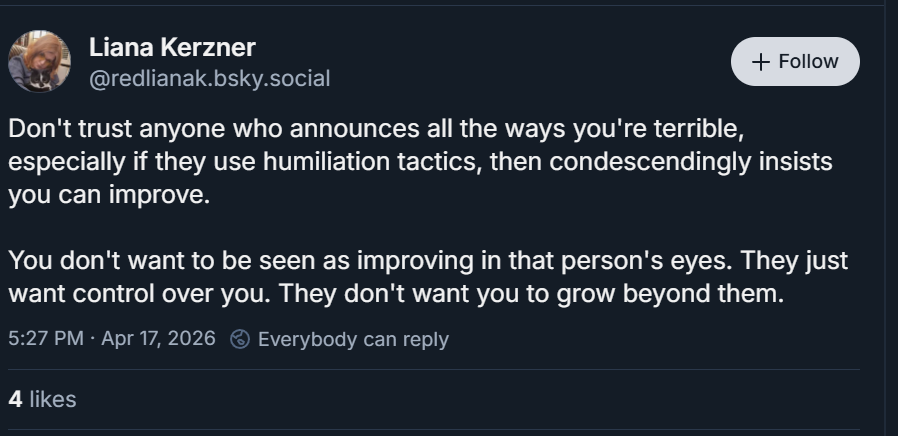
When Song did not comply, Kerzner says Song “tried to shame me into not doing this" —meaning the public video. Song objected to a “public call out” and Kerzner presents that as an attempt to pressure her into staying quiet.
Kerzner claimed to be recording the video after Song did that, and that she had originally intended to be more discreet but got angrier because “she went there.” Kerzner treats moral criticism of her conduct as the same as coercive silencing, and those are not the same thing. This is an established pattern with Kerzner, as she has claimed that Asher and I speaking up and criticizing her is us trying to take her freedom of speech away, an inability to separate moral criticism from persecution. Song's objection, based on her background and her stated traumatic experience, was very likely an objection to public escalation of a private dispute. Kerzner claims there is a difference between name-calling and what she believes she did, which was confronting someone over behavior and hypocrisy.
By those standards, Liana Kerzner should have no objection to the content of this website. We anticipate her endorsement fairly soon.
Kerzner claims that by the time of recording, her last message to Song had essentially asked why Song was still lying to her boyfriend and did not want him to find out the truth. She says communication then went silent for hours. This is another instance in which Kerzner brings a private matter 'not meant for public consumption' (as she will say much later in a Patreon video) into the public sphere. She also says she showed receipts to Discord moderators.
The liberty with which Kerzner likely shares information with her Discord moderators will become even more troubling as we continue.
Kerzner then claims that after she 'set a boundary' with Song over a separate personal matter—something Song wanted pushed five months early and that would have cost Kerzner money—Song stopped speaking to her for a week. Kerzner says Song later returned with a brief apology, which Kerzner accepted, only for Song less than a day later to revive the accusation that Kerzner had publicly attacked her boyfriend. At this point Kerzner broke off officially with Song and terminated their partnership, and their collaboration on Two Women Talking.
Kerzner refuses to go into detail about the separate private matter because discussing it would involve personal information, and claimed that it featured “someone’s living situation” as an example of the kind of thing she was not willing to expose.
She then exposes it in a video four months later:
Kerzner discusses Song’s living situation explicitly. She says Song’s mother had said Song had to be out by March, that Song was talking about moving in with her boyfriend, and that the boyfriend supposedly could not take her until around May. Kerzner had offered Song a place to stay as a last-ditch, emergency measure, she claims, and that in October Song asked to move the date up to December, which is something Kerzner could not do for various reasons.
She also characterizes the home situation in her own terms, claiming that Song’s mother “seems kind of controlling or very controlling,” while adding that she only knew this through Song and had not witnessed it directly. Later on, as we will see in the Aftermath section, Kerzner will directly claim that Song's account of being in an abusive home —the account of a LianaKares client— was a con.
The thrust of the issue itself is that the video is unnecessary. What Kerzner describes in the first video is a private dispute about a collaborator allegedly lying to her over an audiobook decision, blaming someone else, then making objections when Kerzner confronted her in private over Discord. Even if we take Kerzner's version at full value and good faith, the core problem is interpersonal and business related. There is nothig in the timeline that Kerzner portrays that could be construed as an urgent public danger, a necessary fraud warning to an audience, or even some fact of public interest that could only be addressed by broadcasting it to her viewers. There was no evidence of any professional reputational damage that could be incurred by Kerzner from this, either. Not only does the video come across as an unnecessary measure, but it also comes across as a humiliation tactic. One that you've seen at work already in Kerzner's demands to "D" back in the PAX incident.
Song published her own account on her channel:
Song’s account is that the breakup with Kerzner grew out of a badly handled audiobook project, and states that the dispute blurred personal and professional boundaries. Song claims that the long-term lie was due to confusion, fear, poor communication, and a power imbalance.
On the audiobook project, Song says her boyfriend did comment that Kerzner did not sound like the character, one he had helped create and cared about deeply as part of their long-running shared project. Song claims that the real problem was that she herself was unhappy with the result and did not know how to direct voice actors and found herself inadequate in articulating what she wanted. Song explains that she was too afraid of upsetting Kerzner to say it in so many words, which she ascribes to cowardice on her end and poor communication.
Song discloses that she comes from an abusive and unstable home and is therefore used to authority figures becoming dangerous when angered, and grew fearful of rejection. She says Kerzner knew this context but omitted it from her public account— this is something I have observed, since song was a LianaKares patient and had discussed her background with Kerzner extensively.
Eretson says that she also felt dependent on Kerzner, because Kerzner promoted her book, had served in a mentor-like role, and sometimes even described herself as Song’s manager. Kerzner was also someone Song turned to for peer counseling and advice. This made the relationship confused and asymmetrical from the start.
Eretson then proceeds to state that the situation worsened because Kerzner quickly turned hostile toward Song’s boyfriend. She claims that after the audiobook issue, Kerzner dismissed his role in the creative project and treated his contributions as lesser, would insult him privately, and carried a grudge against him. This situation has very strong echoes of Kerzner's attitude not only to Corey Cole, but other projects such as the one in which she broke NDA. Over time I am beginning to suspect that Kerzner has deeply-rooted misandrist tendencies that get triggered when a man poses an obstacle of some sort in her path. To this date, her usage of the verb 'pontificate' is reserved exclusively for men. When the confrontation happened on Discord over remarks he made about Cynthia Erivo and the Wicked poster controversy, Song says Kerzner’s response felt less like moderation and more like a personal attack against him shaped by the existing resentment Kerzner already had. Once again, this fits the pattern you will also see with Asher in the Very Ugly Fight section.
Song speaks about how her relationship with her mother had been deteriorating for years and how by October things had come to a head. Kerzner had previously offered that, if things became dire, Song might be able to stay with her in Canada temporarily. When Song later asked whether this could happen by the end of the year instead of later, Kerzner refused. Song says she understood why due to Song's limited assets and lack of employment. She explains her week-long silence happening due to embarrassment and stress.
Kerzner took Song's silence as an act of personal aggression. Upon Song's return, she claims that Kerzner came at her aggressively, accused her of silence and punishment, attacked her boyfriend’s character and turned the whole situation into a moral indictment of Song herself. Song claims that Kerzner escalated everything into a view that Song was not merely mistaken but fundamentally deceitful and vile.
This is, frighteningly, the same pattern you will observe with Asher, with variations allowed for the differences in each unique situation. And I am certain that this is not the only time this has happened. Or will happen.
In regards to the apology, Song says she did apologize and acknowledged her fault, but that Kerzner was not satisfied and found her apology insufficient (again, a pattern that will repeat with Asher.) When Song complied with the written statement for rlease, Kerzner kept pressing for more detail and more exact language. It was Song's impression that Kerzner didn't want an apology but a confession and public humiliation. Song walked away and expected Kerzner would go public.
Song disputes Kerzner’s financial framing. She says she did receive a small amount of money from sponsored episodes of Two Women Talking but that it didn't amount to a significant sum, and also says that she did unpaid work for Kerzner, including multiple pieces of promotional art for a friend’s book launch. However, she observed that Kerzner’s account makes it sound as though only Song benefited from the relationship, whereas Eretson states that the relationship was more complicated than that, and reciprocal. This is a pattern that will now be familiar to the reader, as Kerzner has also attempted to cast the same narrative on me.
Eretson states that the conflict never needed to become a giant public video. A short public statement that trust had broken down and that Kerzner no longer wanted to associate with her, Song states. would have sufficed— which is the same thing Asher and I have stated about our situation. Instead, however, she states that she believes Kerzner publicly dragged her before a much larger audience, framed her as malicious scum in a way that was designed to destroy her standing while casting Kerzner as the innocent party.
Once again, a repetition of the pattern.
Song's video reads as far more sincere than Kerzner's video. Eretson admits weakness repeatedly, that she was cowardly and handled things badly and admits that that she may have been self-serving. None of these are things Liana Kerzner has ever admitted to, in any of her videos.
The strongest mark of sincerity is that Song’s story doesn't hinge upon portraying herself as spotless as Kerzner's videos do. She also observes that Kerzner has a tendency to blur the boundaries between professional and personal spheres and that she was never entirely sure which Liana she was speaking to at any one time. Kerzner's porous or nonexistent boundaries, I believe, are the reason for which she is so quick to betray client confidentialities to friends and her server alike —as will be seen in the Aftermath section.
A year later, Song released a follow-up video:
Song begins by summarizing the last fifteen months for her. She explains that she has lived in absolute terror, consumed by fear, paranoia, self-consciousness, self-loathing, and self-doubt. She frames the entire period after the earlier conflict as one of psychological collapse, where she struggled to get any creative endeavors started. A situation that is frighteningly similar to the effect Kerzner has had on Asher's psyche. Song deleted her Twitter, removed her art and withdrew from much of the public creative presence she had previously built.
She relates how the effects of Kerzner's attack on her have continued with repercussions in her life, such as the fact that she kept encountering fresh examples of people twisting her words or lying to her, and that this reinforced the damage rather than allowing it to fade. Frighteningly, this is also a common experience Asher has had. Eretson does not want to go into much detail or talk about “Kerzner because she does not want her attention and wants mutual distance. But she immediately says she also cannot ignore the reality that she has been living in fear of Kerzner and of what they say about her for nearly a year and a half.
Needless to say, this is an all-pervasive pattern. This manifests at regular intervals with people Kerzner has burned out of her life, and the fact that it keeps occurring — people dreading, fearing and reacting to what she says about them — indicates that it is not the delusions of 'stalkers' but an actual phenomenon caused by how Liana Kerzner handles interpersonal conflict... which is, not at all. It demonstrates how Kerzner uses her audience and reach as a weapon against those who do not have it. How Liana Kerzner punches down.
Eretson explains that she contemplated returning by changing her identity, returning to another channel, using a different pen name in order to escape what happened. It was then that she realized she was living in abject terror of one individual. She had to ask herself why she was letting fear of one person control her life so thoroughly. Part of her wishes that she had become angry enough to defend herself forcefully instead of gone quiet for months and allowed someone else to control the narrative, twisting her words and defining the situation publicly. Having been devastated by her mother and losing her entire community was a blow that left her without the emotional strength to fight back. The last year has taught her a very important lesson, and it is that living in fear of someone else means giving them your power and letting them win. Song is tired of that.
Eretson points out Kerzner's propensity for double-bind traps: Once Kerzner publicly brands you a liar and insists you are still lying, it creates a trap: anything you say in response can simply be folded back into the accusation unless you have hard evidence for every point. The situations Kerzner designs are set up to make every defense look like further dishonesty.
This reinforces a great deal of observations that we have seen happen over and over throughout this document. Liana Kerzner's pattern is a cycle that has been at work for years , and it manages to succeed thanks to a very important mechanism that will be seen in the section dedicated to her critics.
But we will now examine the worrying case of Vagabond:
