MICTHELL JURA
Mitchell Jura was a client of Liana Kerzner through her “LianaKares” sessions.
Other individuals mentioned previously in this document, including Song and Mara, also participated in those sessions during the same general period. Jura is a Canadian man who has publicly described himself as living with autism and who sought Kerzner’s guidance.
Kerzner operates what she describes as a “peer counseling” service.
As discussed elsewhere in this report and summarized more fully in the ethics section, the structure of this service raises several concerns. Although Kerzner is not a licensed therapist and does not present herself as one, the methods she describes and the way she interacts with clients frequently resemble therapeutic practice.
In several public episodes in which she describes her peer-counseling process, her explanations closely resemble the structure and language of therapy sessions.
This resemblance is notable because Kerzner has also stated that, as a peer counselor, she does not maintain the professional distance typically expected of licensed therapists.
The following exchange between Kerzner and Jura illustrates this dynamic.

In this exchange—later shared publicly by Jura after Kerzner dismissed him as a client—Kerzner characterizes Jura as a victim of abuse. Kerzner made this assessment despite not presenting herself as having clinical training or certification in mental-health diagnosis.
Kerzner has also addressed criticisms of her qualifications publicly. In a Patreon video she stated that licensed professionals had told her she was “completely unqualified to deal with people with autism,” a criticism she dismissed as professionals “throwing their weight around.”
— Liana Kerzner, "Another week, more jaw pain", June 26, 2025
As is often the case with Kerzner’s public accounts, the audience receives only her description of the exchange and not the full context of the conversation that preceded it. Kerzner does not identify the professional involved. However, her description contains contextual clues that suggest the criticism came from a licensed professional. For example, she recounts saying the following:
"And then I told them, that is crossing the line in acting like, using your credentials and you're not supposed to do that with somebody that you're not treating. And that was the last I heard from them. So good riddance."
Kerzner’s framing suggests she believed the professional had acted improperly by expressing concerns about her conduct with someone they were not directly treating. Aside from the fact that this interpretation is wrong (therapists may not diagnose someone they are not treating, but they can give expert opinion on the suitability of a mental heath caretaker for a specific condition), the exchange indicates that concerns about her qualifications had been raised by credentialed professionals.
Based on my own interactions with Kerzner and her public statements, she appears to hold strongly negative views toward credentialed mental-health professionals, particularly therapists. Kerzner herself has stated that she does not hold a completed academic degree to her knowledge, and she frequently criticizes the authority of licensed professionals.
Peer counseling, as commonly understood, is typically designed to function as a supplementary support mechanism alongside professional therapy rather than a substitute for it. Kerzner, however, has often framed her service as a direct and affordable alternative to therapy. Her dismissal of professional criticism regarding her approach may therefore raise legitimate concerns for observers.
Jura later posted additional exchanges from his LianaKares sessions on social media after being dismissed as a client. Jura indicated in one post that he preferred communicating through text rather than voice sessions. One particular exchange from these materials is especially notable.
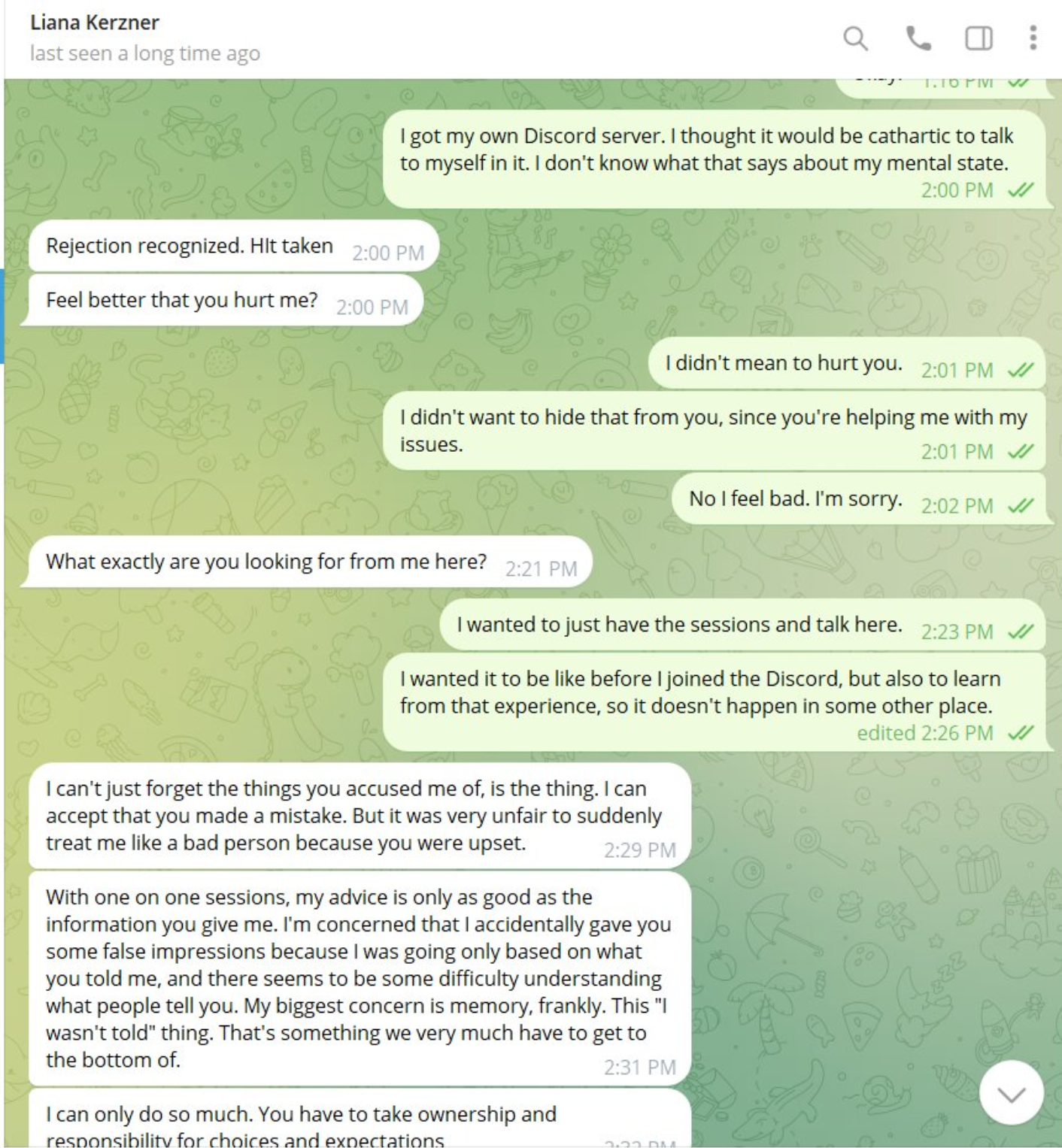
In this conversation, Jura told Kerzner that after being removed from her Discord server—following a dispute over his use of the term “tomboy”—he had created a Discord server where he spoke primarily to himself. He framed this in a way that suggested concern about his mental well-being.
Kerzner responded by interpreting the comment personally, replying: “Rejection recognized. Hit taken.” She then proceeded to criticize Jura’s behavior in terms that observers might consider confrontational or dismissive. In a conventional therapeutic context, such responses would generally be considered unusual or unprofessional. Although Kerzner does not operate within that regulatory framework, she does nevertheless operate as a facilitator for mental health.
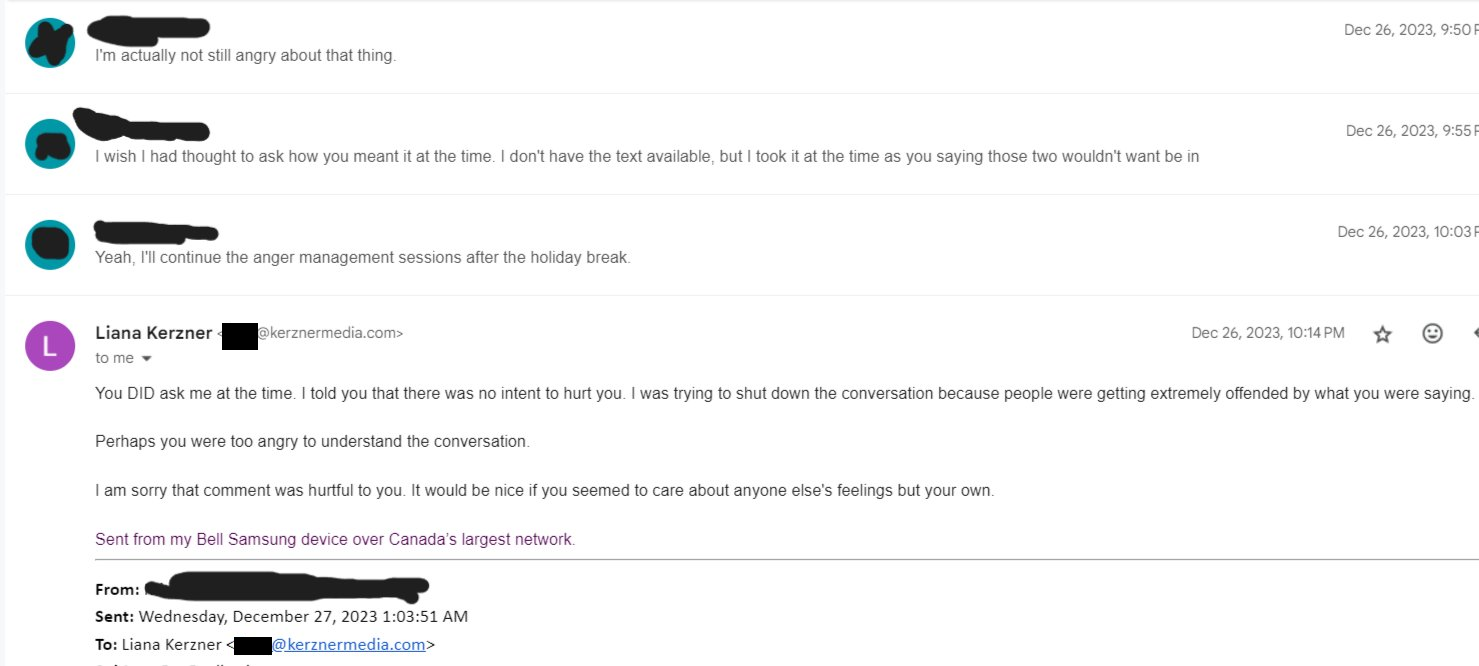
Kerzner’s tone in this exchange is scolding. Whether this approach is effective or appropriate when dealing with individuals who have publicly stated they struggle with autism is a matter readers may wish to evaluate themselves, but it is my personal opinion that it is catastrophic.
Eventually, Jura emailed Kerzner in February expressing concerns. According to Jura’s own account, he had spoken with a therapist and a college counselor, and they expressed concern that Kerzner’s interactions with him might be exerting undue influence or control.
Kerzner’s response to Jura was brief: "Your counselor is wrong. Don't contact me again."
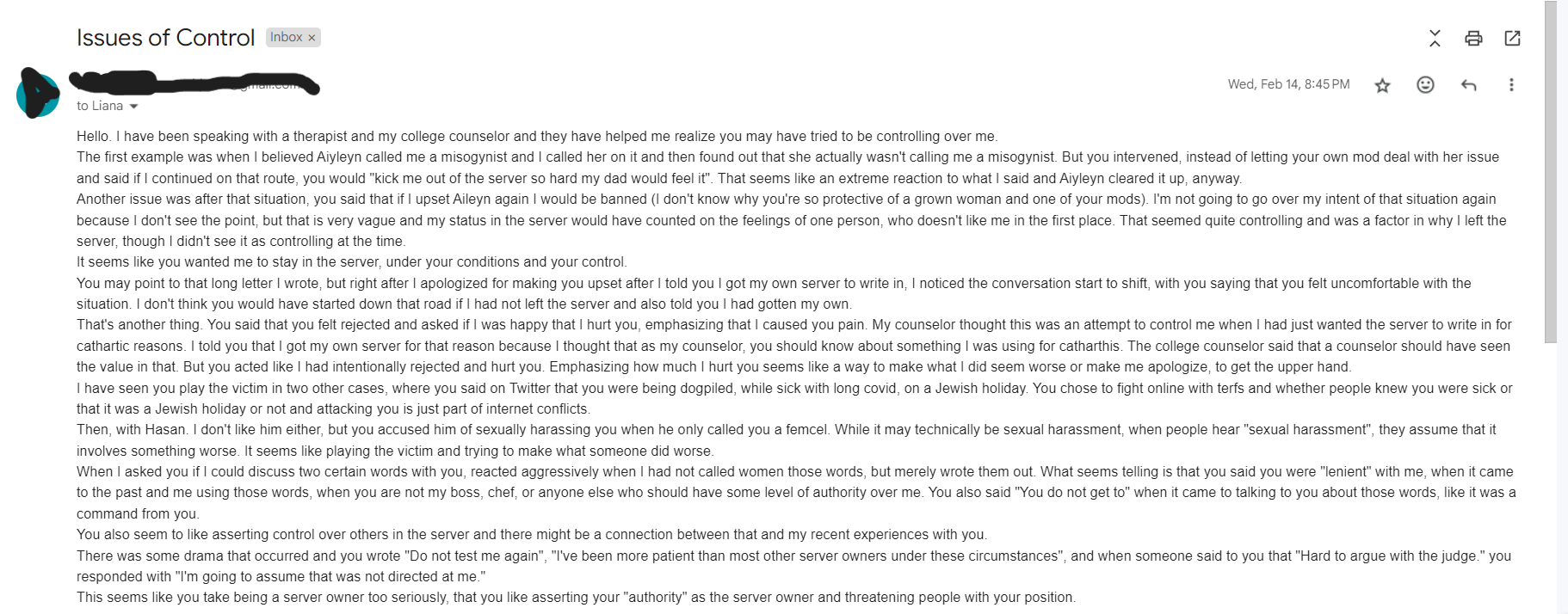
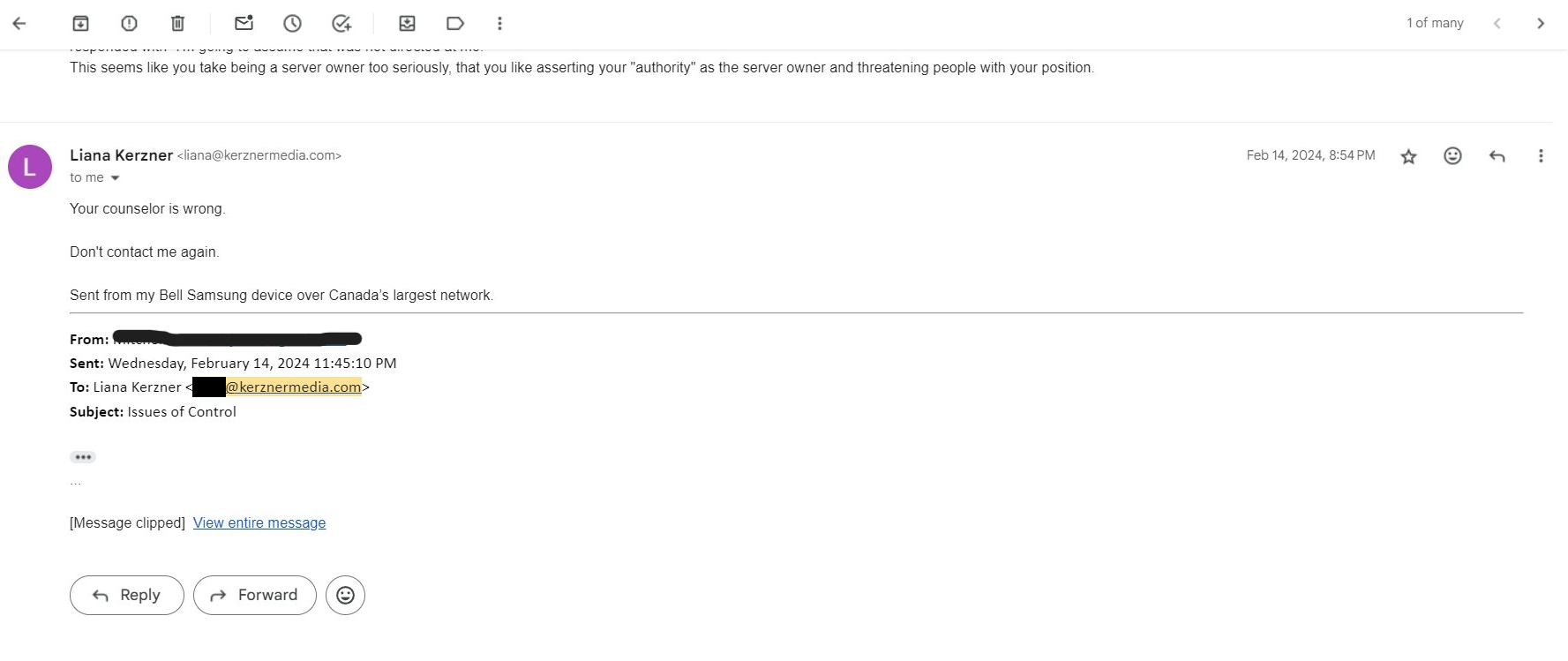
In my view, this exchange demonstrates Kerzner dismissing the assessment of a licensed mental-health professional when it conflicted with her own view of the situation.
For comparison, Asher once had a disagreement with a therapist that ended a professional relationship. Even in that case, the therapist responded by offering one final session to discuss the matter before closing the professional relationship. When Asher declined, the therapist ended the relationship without further commentary.
The contrast illustrates the difference between trained therapeutic practice and the informal structure of Kerzner’s peer-counseling service.
The contrast illustrates the difference between trained therapeutic practice and the informal structure of Kerzner’s peer-counseling service.
This conversation shows Kerzner and Asher discussing Jura’s behavior and criticizing it. Jura’s online posts at the time were frequently provocative and confrontational:
(15.07.2024 16:12:37 UTC-07:00)
Asher Wolfstein: I mean, I'm being honest.
Liana Kerzner: This was part of the problem. He is, legit, very stupid. It's impossible to get him to see that the things he likes doing are terribleAsher Wolfstein: Yeah, I've gathered that.
Liana Kerzner: And if Schooley had any brains she'd block this motehrfucker
Asher Wolfstein: He's not going to use his autistic condition to play the victim, even though he has.
Liana Kerzner: The way he's talking, he's clearly either copying her or she told him what to say
Liana Kerzner: Which... went poorly
Asher Wolfstein: You'll notice I just stopped replying, no matter how tempting.
Liana Kerzner: Oh mission accomplished. There was too much for me to even screen cap
Asher Wolfstein: He can't copy her. He's not smart enough, which is sad.
Liana Kerzner: Because she herself isn't that smart
Asher Wolfstein: Yes
Liana Kerzner It's funny though, in her rush to just find anyone who hates me, she caught herself a real loser, and now she's responsible for what he says
Liana Kerzner: Because by her definition, he's a flying monkey
Asher Wolfstein: This phrase "force a conversation" is really strange.
Liana Kerzner: He's upset I won't talk to him anymore
Asher Wolfstein: Like, he could, and as if that would change anything
Liana Kerzner: He's trying to get attention
Asher Wolfstein: He keeps using it to refer to, I guess, convincing people that his narrow views are right.
Asher Wolfstein: I called him a flying monkey already.
Liana Kerzner: He's not convincing anyone he's in the right with that mouth
Asher Wolfstein: Nice
Liana Kerzner: Now she either cuts him and he goes off on her, or she doesn't and it's obvious she's full of shit
Asher Wolfstein: OMG
Asher Wolfstein: Troll Patrol has *2* followers: Hugo and TTT
Asher Wolfstein: That's it
Liana Kerzner: And yet he keeps saying "Emily"
Asher Wolfstein: I noticed that too
Asher Wolfstein: I did as well
Liana Kerzner: She never screens ANYONE. They hate me? They're in. And it's starting to blow up on her because she's attracting some people who are too disturbed even for me
Liana Kerzner: https://facebook.com/[ LINK REDACTED BY MERRYJEST] - his facebook
Asher Wolfstein: "After some toxic Twitter fighting, I wanted to exercise a little more, today, to make up for it. It's gooey and delicious, but SOOO bad for you.
Asher Wolfstein: Whaaaaaaaaat?
Liana Kerzner: Yeah he's a weirdo
Liana Kerzner: Just repeats shit over and over
Asher Wolfstein: Did he actualy get through college?
Liana Kerzner: I don't know, he was struggling when I cut him off and still had some courses to go
Liana Kerzner: It's commercial food prep
Asher Wolfstein: I can't waste anymore space in my brain for this person.
Liana Kerzner: I feel zero ethical reason to not share this, because he started posting out of context telegram shit, and... yeah short version, he is extremely stupid.
After Jura posted screenshots of their communications online and began insulting Asher on Twitter, Kerzner shared additional personal information about Jura with Asher during private conversations. These details reportedly included aspects of Jura’s mental-health history and past hospitalizations.
Those details will not be reproduced here for obvious reasons.
In my view, sharing that information with a third party raised serious ethical concerns. Licensed mental-health professionals operate under strict confidentiality obligations regarding client information. Kerzner’s peer-counseling work is not subject to the same regulatory framework, but the ethical expectations surrounding client confidentiality are widely understood even outside formal licensing regimes.
Rather than advising Asher to avoid engagement with Jura due to his mental-health struggles, Kerzner provided information that could have been used in an online conflict. Asher declined to use that information and instead criticized Jura only for his behavior and language without disclosing any mental health history details. Records documenting this exchange exist and were preserved by Asher.
Kerzner has stated publicly that one reason she prefers operating as a peer counselor rather than a licensed professional is that licensing requirements would restrict how she conducts her work.
It must also be acknowledged that Mitchell Jura’s online behavior has often been erratic, crude, and at times unacceptable. His social-media presence frequently reflects someone struggling with interpersonal boundaries and communication—issues that are not uncommon for individuals managing autism.
Jura, Asher, and I have had significant online conflicts over his behavior. I do not personally like him, and we will likely never agree with one another. However, personal disagreement does not justify dehumanizing treatment toward someone who sought guidance in a mental-health support context.
My conclusions in this section are based not only on personal impressions but on documented written exchanges.
It is also worth mentioning that Kerzner had betrayed Jura's information prior to the formal ending of their professional relationship. In December of 2023, following one of Jura's contentious communications in Kerzner's Discord server, Liana Kerzner shared details of Jura's mental health history with Asher, as documented in his Telegram archive, which shows this was not a one-time occurrence.
Readers may also have noticed Kerzner referring in the Telegram conversation to “Schooley.” Shortly after his dismissal from Kerzner’s server, Jura subscribed to the Patreon of Emily Schooley.
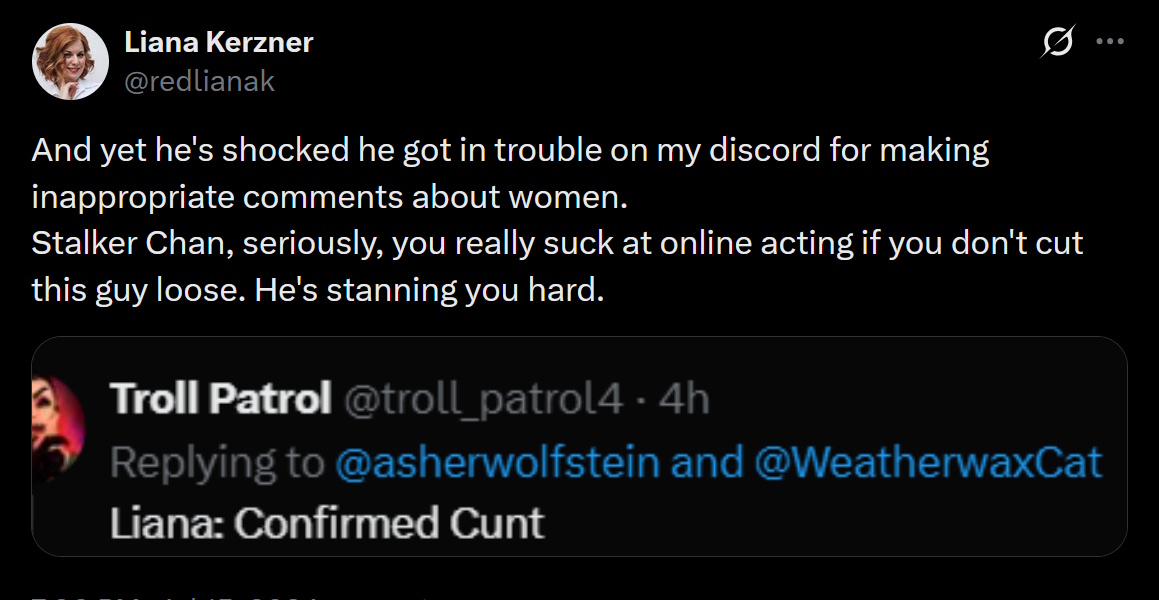
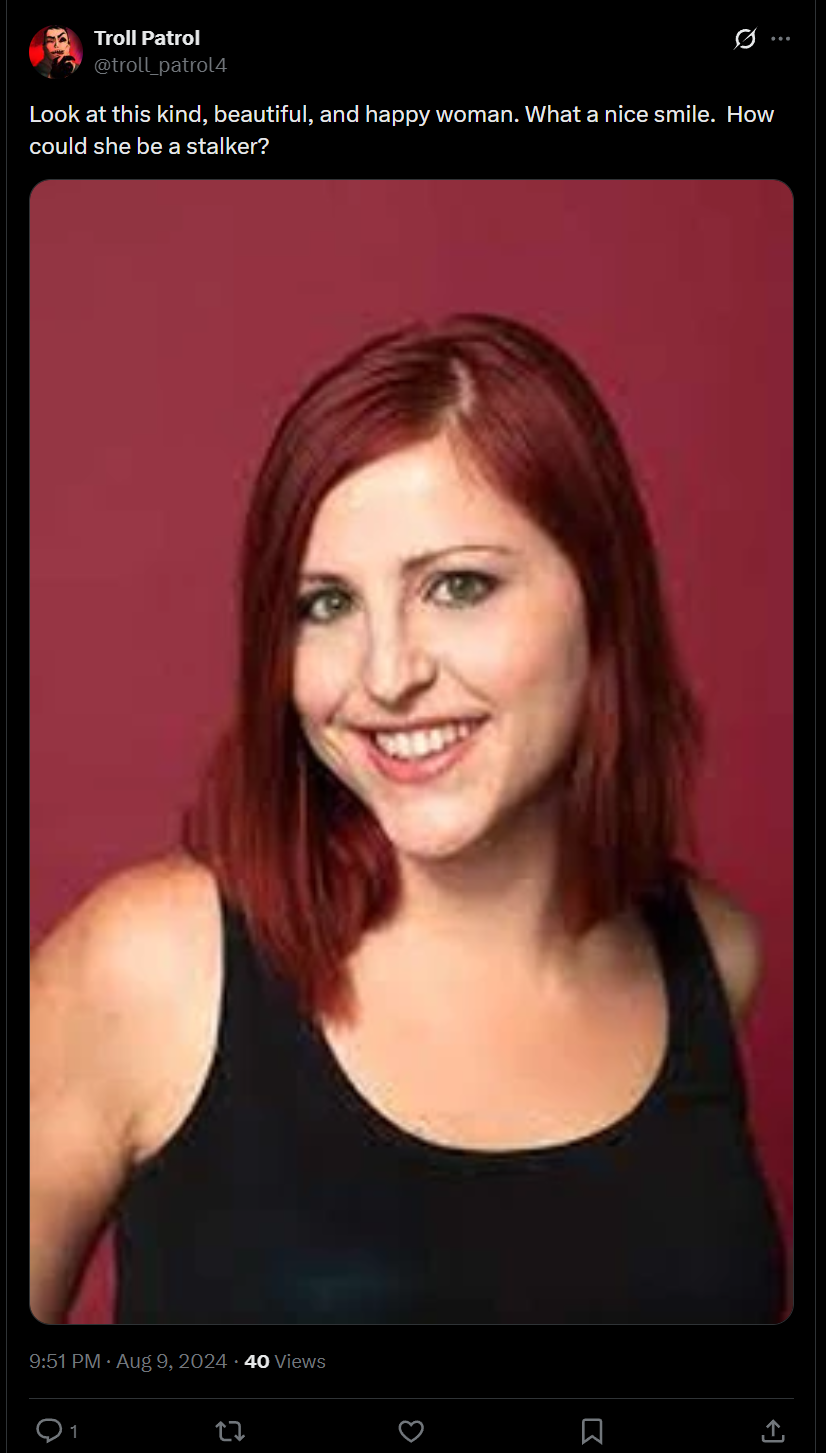
Emily Schooley has publicly accused Kerzner of abusive behavior and positioned herself as one of Kerzner’s critics. Kerzner, in turn, has repeatedly described Schooley as a stalker and often refers to her using the nickname “Stalker-Chan.”
Kerzner has at times suggested that she avoids naming Schooley directly to reduce potential defamation exposure. However, in private communications with followers—and occasionally in public discussions—Kerzner has provided enough contextual information that observers could readily infer the identity of the person she is referring to.
Which brings us to the next section.