Claim 2: I Complained Of 'Too Much Work'
On January 18th, Kerzner said the following about my professional work ethic in her server, in regards to the work I was doing:

This quote attributes a “too much work” complaint to me and suggests that the involvement of another artist was a direct response to that complaint. However, the archived documentation tells a different story:
On March 19, 2022, Kerzner approached me about involving one of her Liana Kares clients, Song Eretson, as a volunteer and discussed how Song might help with art tasks. I did not raise a complaint about workload at that time, nor did I suggest that any task was burdensome to the point of being refused. The relevant message thread shows that the topic of volunteer assistance was introduced by Kerzner following a discussion I initiated about an unrelated system feature (calendar/seasonal events).

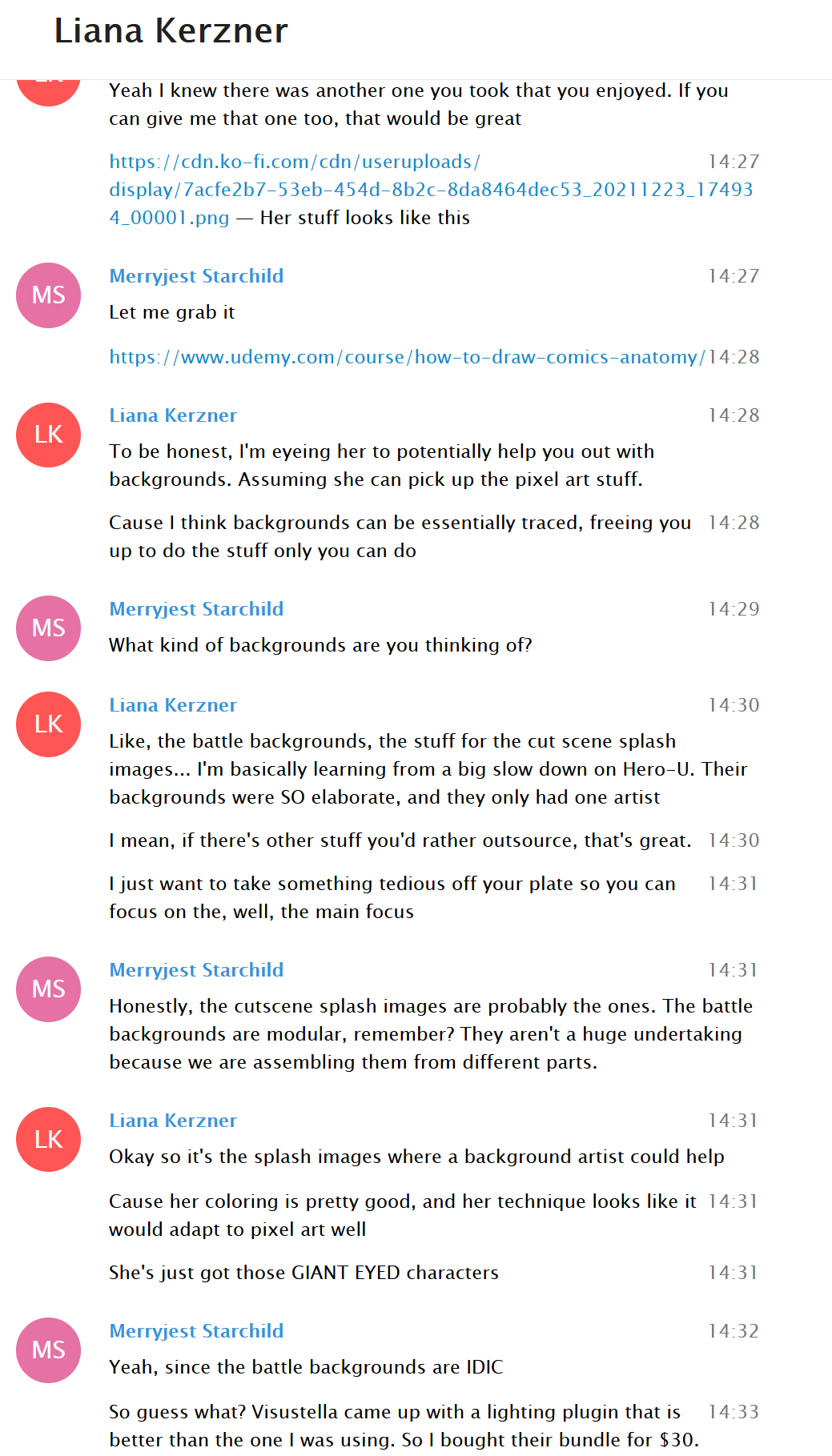
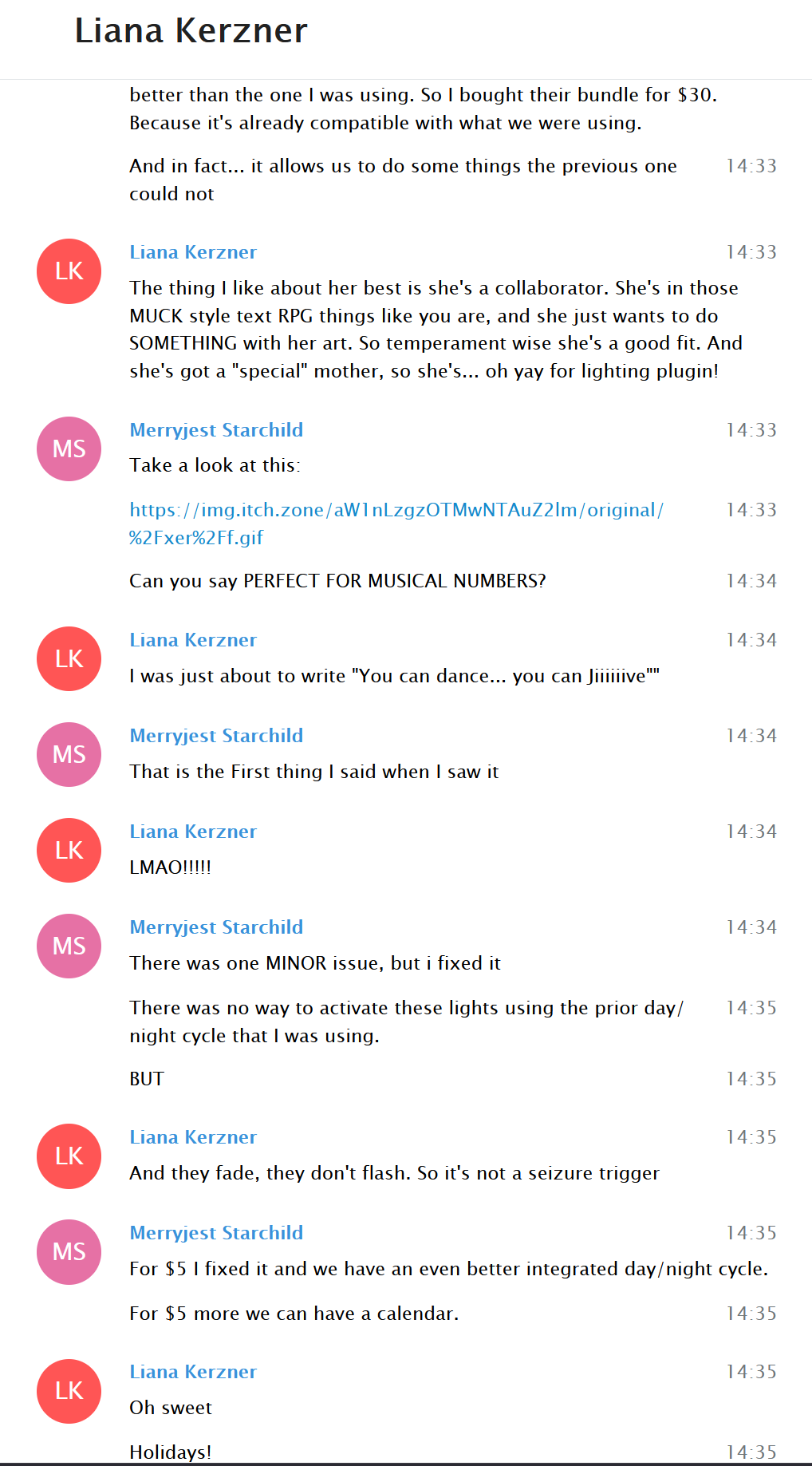
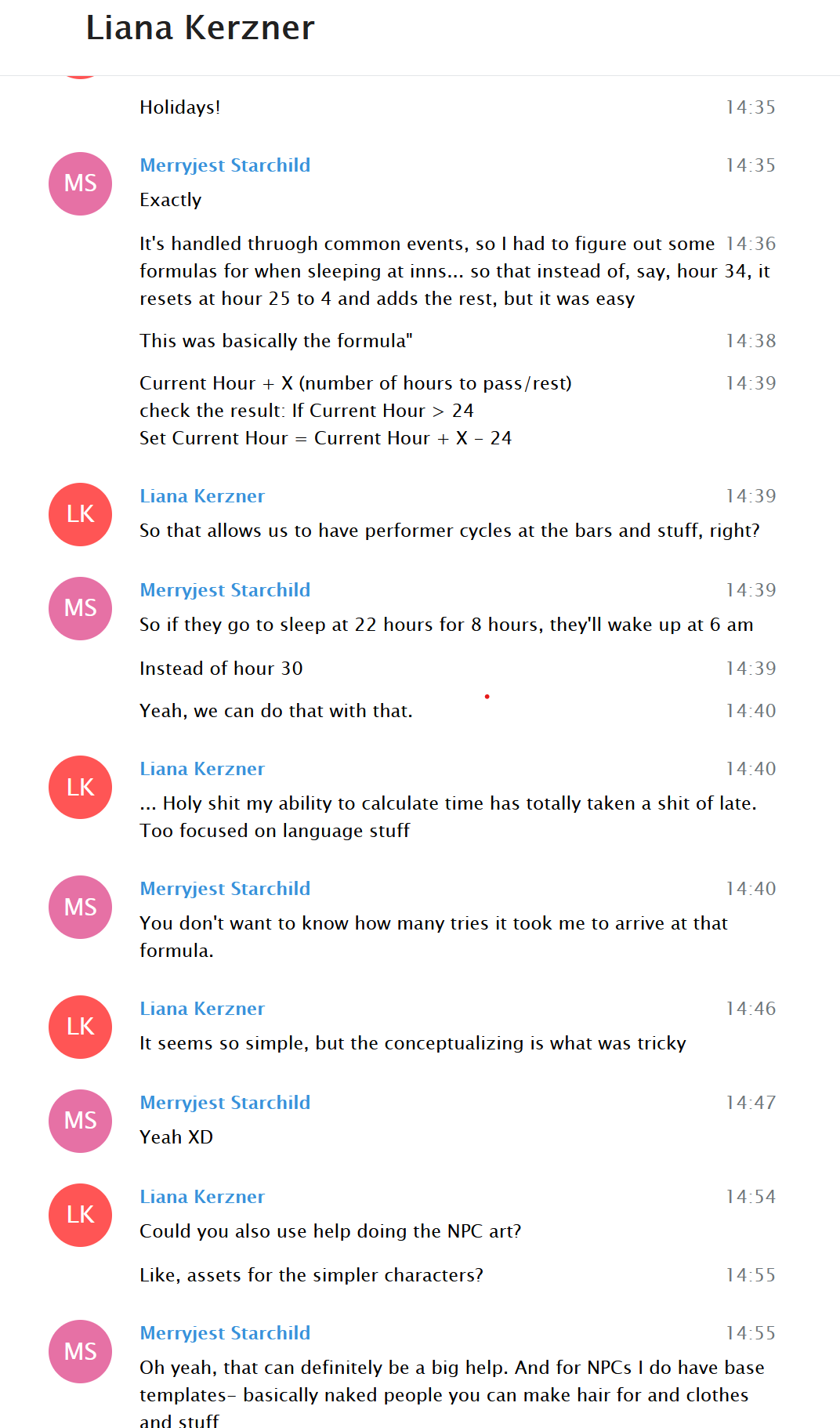
At no point during development did I communicate that one task or another was “too much work” in the sense implied by Kerzner’s statement. I continued to perform development work across multiple areas without refusing or stepping back due to workload. When I expressed concerns, they tended to relate to technical issues — for example, when engine updates caused plugin features to break, requiring additional investigation and mitigation — but those comments were about technical constraints, not about unwillingness to do the work.
Kerzner’s phrasing in her Discord post suggests that she “had to get another artist” in response to a complaint I never made. The message history shows that she brought up the idea of Song volunteering, not that I refused responsibilities or stated that the scope was excessive.
This instance is one of at least two cases where Kerzner involved her own clients in the game’s development: Song and later Mara, another volunteer who worked on backer NPCs. Both Song and Mara eventually ceased participation in the project. Song was later the subject of a public video by Kerzner in which Kerzner distanced herself from her, accused her of lying, and has subsequently addressed her by the nickname "Princess Grifter"; Mara, according to Kerzner, stopped communicating (“ghosted” her).
If Kerzner objects to this conversation being published or to the screenshots of the exchange, it is important to recall that she has repeatedly raised concerns in the past about “removal of context.” Restoring full context here is necessary to accurately represent what was said — and when that context is included, the record does not align with the characterization in Kerzner’s Discord statement.
Despite my reservations about adopting an unprofessional tone, this situation requires me to firmly stat that when the contextual evidence contradicts a claim, presenting that evidence in full is essential to correct the record. If Kerzner wishes to contest the accuracy of this account, I have archived copies of our 76 pages of exported Telegram conversations, including the development channel logs (which also involved Captain Coloratura) and the joint pixel art discussions with Song and Mara. These records support the timeline and interactions described here. I could not find a single record of the complaints Kerzner claims I issued.
It also bears noting that someone who considered creating a hundred or so NPCs as "too much work" would be unlikely to produce a character creation tool involving 300+ distinct assets (body parts, clothing, hair, accessories, etc.) — a tool I developed specifically to facilitate NPC creation. The existence of that tool and its output directly enabled volunteers like Mara to create backer NPCs in a short period, which contradicts the notion that NPC creation was inherently unmanageable or that I declined to make progress on it.
Kerzner’s statement about workload makes logical sense only if all detailed context — dates, message threads, and archived conversations — is ignored. That selective framing is consistent with a broader pattern in which broad or vague language obscures specific details that would contradict the claim.
The 300+ assets I created for the character builder were a direct response to an identified need: Song had limited experience with pixel art and was struggling with certain tasks, and Mara likewise benefitted from structured tools. The volume of work I put into that system directly contributed to the productivity that followed — a contribution that contradicts the narrative implied in Kerzner’s statement.