Claim 5: Liana Didn't Know The Combat Demo's Script Was Different
On January 15th, 2025, Liana made the following claim:

The implication is that Kerzner was unaware of the differences between the final demo and her original script, that she was blindsided by a rewritten version, and that she chose not to raise objections solely to avoid further delay. This framing paints her as a cooperative but sidelined contributor — a narrative directly contradicted by documented evidence.


Screenshots from May 14, 2024, clearly show that I proposed an alternative, temporary scenario for the combat demo due to delays in script completion. Kerzner responded in the development chat with a simple approval: "Sounds good." This exchange occurred in full view of Captain Coloratura and others who were also part of the project. At no point did Kerzner object, nor did she express that she felt excluded from the process. To the contrary, she endorsed the pivot.
This is not a matter of differing interpretations — it is a matter of record. Kerzner had been urging us to release the demo, while also failing to complete the required script. With only 171 new words added to the combat demo script as of May 11 — nine days from the proposed May 20 release — I made the decision to design a stopgap scenario. The goal was to present players with a complete and functional experience that showcased the core combat mechanics and elicited feedback.
While I was responsible for development and systems implementation, I was not originally tasked with narrative design. Taking on this responsibility was a collaborative compromise, not a unilateral deviation. Kerzner’s claim that I “went rogue” — as she later characterized it — does not reflect the nature of the development process as it occurred. She was aware of the proposed changes, approved them, and continued to observe the demo’s progress through our shared channels.
Kerzner also criticized the inclusion of a vegan character (Solomon) consuming ice cream in the demo. However, the script clearly identifies the product as a non-dairy snow-based dessert, part of a larger environmental plotline involving the mountaintop monastery. These critiques appear less as genuine objections and more as rhetorical devices used to undermine the scenario's validity post-release.

It is also necessary to address the assertion that Princess Sparklemuffin was excluded from the demo. Screenshots show that she was scheduled for inclusion in the second phase of the demo, following user feedback and polish — not omitted altogether.
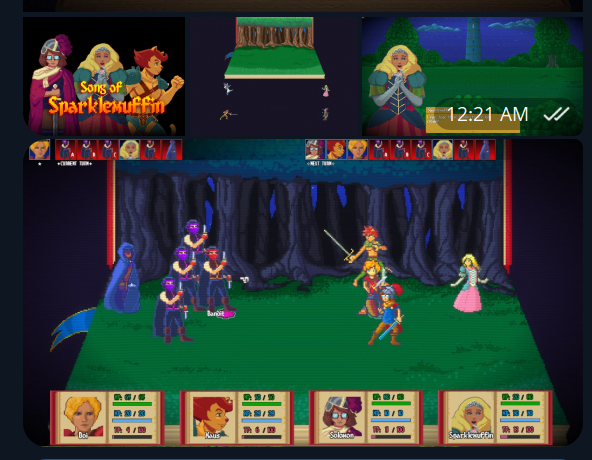
After training for my new position, I resumed work on the demo in early April. Kerzner requested a delivery date, and I proposed May 20. Despite having had ample time to complete the script, Kerzner only made minor additions by May 11. When I proposed the enclosed demo scenario on May 14, she accepted it.
Her claim that she remained silent because I had unilaterally taken control contradicts the collaborative history of the project and the evidence. The narrative she presents — one where she is a passive observer overridden by a domineering teammate — is not consistent with the project timeline, chat logs, or team dynamics.
Rather than two developers jointly navigating the complexities of indie game production, Kerzner’s version casts herself as a victim and others as antagonists. That version is deeply reductive and obscures the actual events and working relationship that defined the development process.
This pattern of selective omission and reinterpretation, as seen in prior claims, supports the conclusion that Kerzner’s narrative has been constructed to preserve her personal reputation at the cost of distorting collaborative realities.