Claim 8: Kerzner Was Cut Off From Development
Liana Kerzner has publicly stated that she was excluded from the development process of our collaborative game project. In her characterization, she references a “they,” referring to both Asher and me, and alleges:
a) that there were multiple pauses in development while we considered making a pornographic game;
b) that we planned to remove her entirely from the development process after having been “paid in advance”; and
c) that these changes were justified on the grounds of mental health and distraction.
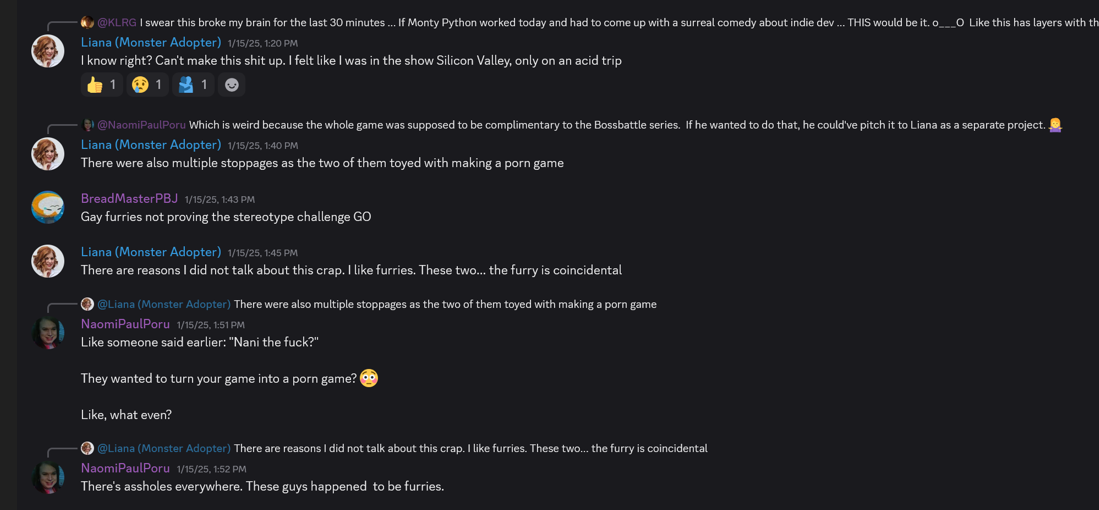

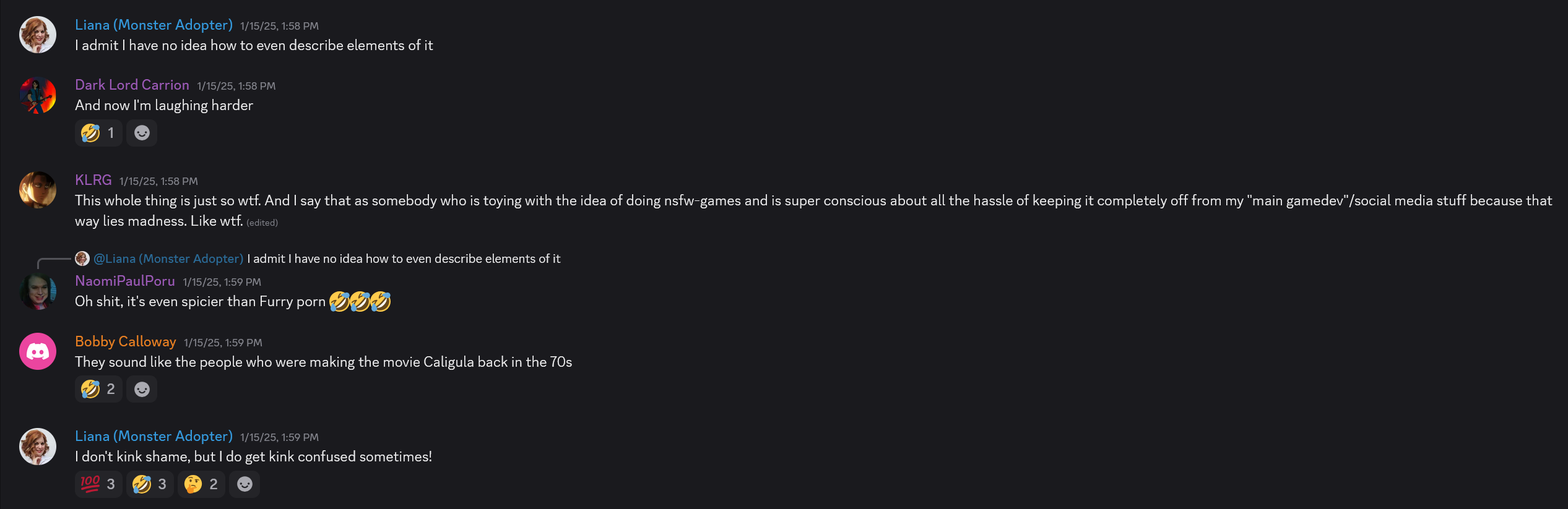
These assertions are inconsistent with both documented evidence and previous communications. Most notably, Liana’s legal counsel, Dr. Mark Bourrie, explicitly stated in a letter (reproduced in full in the Legal Intimidation section) that Liana has never portrayed Asher as involved in development. This contradicts the implication in her Discord post that both Asher and I were jointly planning to continue development without her.
Asher was not involved in the development of Song of Sparklemuffin. He was, at that time, independently exploring ideas for an erotic visual novel project as a personal creative outlet during a difficult period of depression. His project was entirely separate from the development of Song of Sparklemuffin. I was not actively involved in his project beyond limited moral support and occasional feedback—roles that Liana herself also briefly took on at the time.
Liana previously praised Asher’s writing, describing it in vivid terms including “Salinger meets Dear Penthouse Letters meets anime,” and adding, “Whenever I call something Salinger, it’s high praise.” While she may now express different views about the work, this initial endorsement is well-documented.
It’s worth examining the contrast between these early interactions and Liana’s later Discord comments, where she expresses confusion or distance from the stories Asher wrote. This discrepancy may be explained by changes in personal relationships or the natural evolution of opinion, but the difference remains notable.
At no point did I indicate to Liana that development of Song of Sparklemuffin would be paused or abandoned in favor of Asher’s project. The timeline clearly shows that the most significant delays were due to external factors, including my loss of employment and job search. During that time, I continued working on Song of Sparklemuffin, including creating a Sierra-style animated cutscene for the opening sequence—efforts that contradict the idea of a full stop in development.
At the time referenced by Kerzner, Asher was dealing with severe depression. He felt creatively isolated and feared that his work—regardless of its quality—would go unnoticed. In an effort to reconnect with purpose and regain a sense of self-worth, he turned to a solo creative exercise: writing a series of erotic visual novels. This was an attempt to create something meaningful during a time when he was struggling to stay afloat emotionally. Asher built his own visual novel engine, wrote the scripts, and developed the concept entirely on his own.
I did not collaborate on this work beyond casual encouragement. Occasionally, over meals, we discussed his progress, and during one dinner, I produced a single page of rough sketches as a conceptual gesture. That was the full extent of my creative involvement. The idea that his personal project somehow interrupted or replaced development of our joint game is inaccurate.
Equally important, I never told Liana that she was being “cut off” from development or that we were planning to take over the project without her. Nor did I state—or imply—that this abandonment was “necessary for mental health.” These are statements attributed to me (and Asher) in Kerzner’s Discord messages, but they do not reflect what was actually said or done.
When placed against the documented timeline of events—including periods of unemployment, ongoing work on Song of Sparklemuffin, and the absence of any formal handoff or redirection of the project—these claims do not align with the facts.
This disconnect becomes even more apparent when comparing Kerzner’s private legal correspondence with her public-facing statements on Discord.
In his third letter, her lawyer, Dr. Mark Bourrie, stated:

This statement is significant because it directly contradicts the version of events presented by Kerzner in her own Discord server, where she said:

This framing clearly suggests that two individuals—Asher and me—deliberately excluded her from her own project, for which she had paid both of us. The plural “they” is consistent throughout the message. Considering Kerzner’s known background in communication, editing, and writing consultancy, this choice of language appears deliberate. If her intent had been to anonymize a single party, she could have easily done so using neutral phrasing.
Kerzner’s audience, familiar with the individuals involved and the context of prior exchanges—including a public interaction on Bluesky—would have understood “they” to refer to Asher and me. This is reinforced by her server’s reactions, which reflect shared knowledge of these events.
While it is not unlawful to express personal frustrations, portraying a narrative in one forum that directly contradicts a formal legal position raises important questions—especially when one version may influence public perception, while the other is intended for legal insulation
What emerges from these contradictions is a broader pattern. Publicly, particularly to her paying Discord and Patreon audience, Kerzner has presented a version of events that departs significantly from the one articulated by her legal representative. The distinction may seem technical, but its implications are substantial—especially when one narrative serves to generate sympathy or reinforce a perception of betrayal, while the other denies any significant involvement from the very individual she implicates.
It is important to emphasize that this is not simply about one instance of disagreement. Across multiple exchanges—some of which will be detailed in later chapters—Kerzner’s communication style appears to rely heavily on implication through omission. This rhetorical approach, known in classical oratory as paraleipsis, encourages the audience to draw their own (often negative) conclusions from what is left unsaid. It's a form of narrative control that avoids direct statements while still planting a clear interpretive path.
Kerzner often emphasizes her expertise in communication and presentation. Given that background, it is difficult to argue that such ambiguities are unintentional. She is not an inexperienced speaker. Her audience is often primed to read between the lines—and, in many cases, that is exactly what they do. The claim that development was abandoned in favor of a different project—especially one built entirely by Asher in a separate context—does not hold up under scrutiny.
As for Asher, his work was never meant to replace Kerzner's game. It was a private creative endeavor undertaken during a time of serious emotional struggle. He did not seek credit, compensation, or control. He simply asked for someone to listen. In no way did he ever suggest that he and I should finish Kerzner's game for her.
As this chapter illustrates, when claims are weighed against the actual timeline and documented communications, significant inconsistencies emerge. These inconsistencies matter—not because any single contradiction is damning on its own, but because they suggest a recurrent strategy of narrative reframing in response to criticism or conflict, as has been the pattern so far.
Before forming conclusions, I would encourage readers to consider a simple question:
When was the last time Liana Kerzner publicly acknowledged fault or shared responsibility in a professional dispute—without qualifying it as trauma-related, or reframing it as evidence of being mistreated?
This is a claim for which I don't have relevant screenshots because... I never told Kerzner that we were taking over Song of Spaklemuffin and kicking her out of development. Nor that Sparklemuffin would be shelved for another project.
I understand if that may have been how she felt , for some reason, but if it was so then it was never actually verbalized to me. I cannot prove a non-event.