BREAKING NDA
In the period between PAX and the beginning of the Song of Sparklemuffin project, Kerzner and I worked together on a game project for a third party. The project ultimately did not reach completion.
Both Kerzner and I signed a non-disclosure agreement in connection with that work. Because of that agreement, I am not at liberty to identify the project, the developer, or the company involved.
To this day, I have maintained the integrity of that NDA by not discussing the project’s details with anyone who was not directly involved in its development.
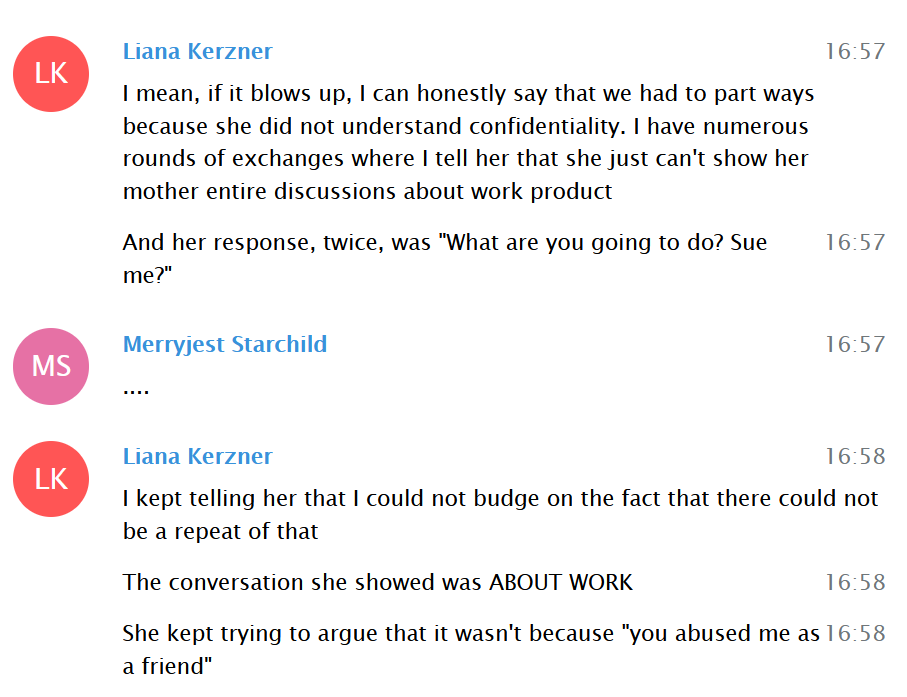
It is therefore notable that Kerzner herself previously dismissed a volunteer—Jess—for breaking an NDA. The offense in question, according to Kerzner, was that Jess had shown work-related conversations to her mother.
Jess later publicly disclosed a diagnosis that made her reliance on her mother understandable.
Against that background, it was surprising to see the following exchange take place in Kerzner’s Discord server.
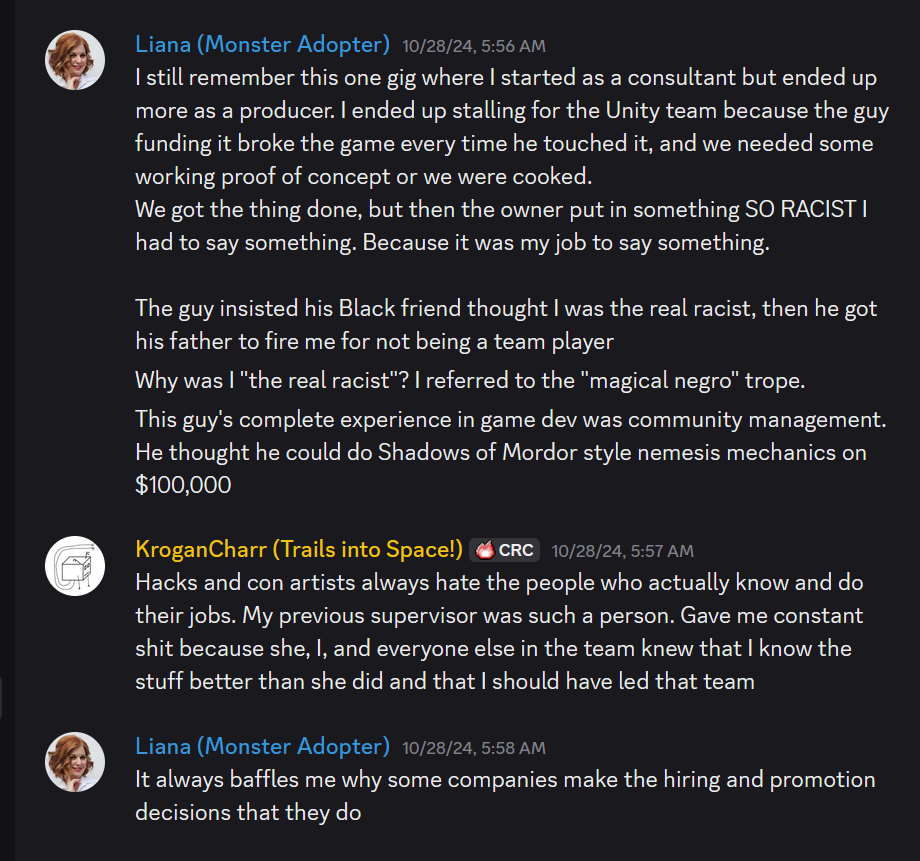
In that exchange, which occurred in a Discord server that has been observed to contain roughly one hundred members, Kerzner disclosed several details about the project, including:
-development information relating to the company.
-the existence of an investor or founder involved in development decisions.
-that a proof of concept was urgently required.
-an approximate development budget of around $100,000.
-statements regarding the founder’s lack of prior game-development experience.
-references to specific design goals, including an attempt to build a feature similar to the Nemesis system from Shadow of Mordor.
These statements describe internal project conditions such as budget, organizational structure, development goals, and internal disputes. Depending on the wording of the confidentiality clause in the NDA, such disclosures could reasonably be interpreted as falling within categories typically considered confidential business information.
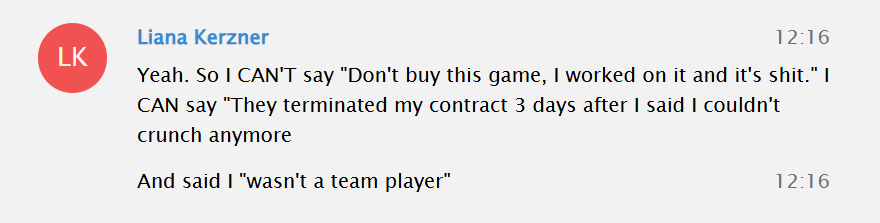
At the time Kerzner made these statements, she had already left the project but led me to believe that she remained bound by the NDA’s confidentiality provisions. The following screenshot demonstrates that she understood the continuing obligations imposed by the agreement.
A pattern observed in earlier sections appears again here. Because of the NDA, I cannot reproduce certain screenshots that would risk identifying the developer or company involved. However, the NDA does not prevent me from documenting statements Kerzner made publicly in her own server regarding the project.
Kerzner stated in that discussion that she had faced significant pushback from a male developer involved in the project. In later statements, she characterized that developer’s conduct as abusive and stated that he had yelled at her during meetings. I did not personally witness these events and therefore cannot independently confirm them.
Kerzner also alleged that the developer behaved abusively toward his spouse in a similar manner and speculated about the developer’s mental health.

This section must necessarily remain concise because the NDA limits the amount of supporting documentation I can present without identifying the parties involved. Nevertheless, the asymmetry present in Kerzner’s conduct is noteworthy.
Earlier, when Kerzner believed Jess had violated an NDA, she demanded that Jess sign a statement affirming that she had not been pressured into resigning—even after Jess had asked Kerzner to stop contacting her.

By this point, several recurring themes in Kerzner’s conduct are likely becoming visible to the reader. These include:
- Reframing other people’s narratives and motivations.
- Characterizing conflicts as abuse or abusive behavior.
- Sharing or speculating about individuals’ mental health in conversations with third parties.
In several cases documented in this report, these disclosures involve mental-health details that the subject did not publicly share themselves and may not have consented to be discussed.
The next example will make these patterns even more relevant.