GAIL SIMONE
Liana Kerzner’s association with Gail Simone predates my friendship with her by several years. When I met Kerzner, I was not aware of the nature or extent of that association. As a DC Comics reader, my interests had historically gravitated toward The Titans, Young Justice, and Wonder Woman, with little engagement with Secret Six. I was also not deeply involved in fandom culture or the cosplay community, and much of what I later learned about Simone’s reputation and her relationship with Kerzner came only after the fact.
At some point prior to my involvement, the relationship between Kerzner and Simone was sufficiently close that Simone wrote Kerzner into Secret Six canon as an official character—Scandal Savage’s girlfriend and later co-fiancée, Liana Kerzner.


Kerzner also appeared to value Simone professionally and personally enough to include cameo appearances of Simone in one-off comics Kerzner produced with her husband and distributed at certain conventions. Kerzner gifted us copies of these comics the second time we saw her in person, in Arkansas. On one or two occasions, I joked that Kerzner should apply to play a DC character in a role-play environment I sometimes participated in, essentially playing a version of herself for novelty.
Aside from this, Kerzner and I spoke very little about Gail Simone. The first substantive mention occurred on July 14, 2019, when I pointed out that Simone had found a tweet by Mike Baron insulting her.
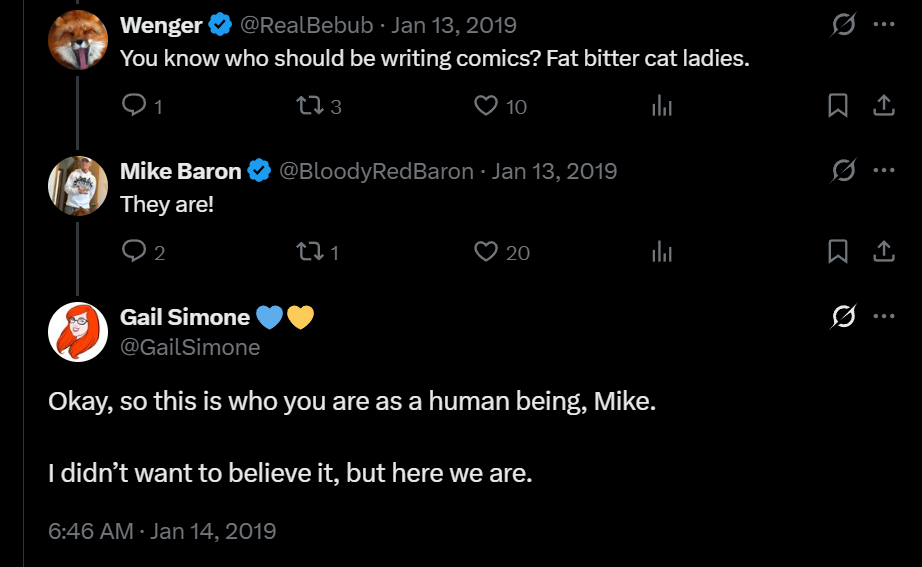
Baron is local to me, and for a period we were on friendly speaking terms as part of a local comics-creators group. That relationship ended when Baron publicly celebrated an elected official physically attacking a member of the press. When the group declined to distance itself from him over that incident, I left. Baron’s subsequent alignment with Comicsgate and participation in attacks against female creators occurred afterward and was publicly observable.
On other occasions, my references to Simone were limited to praise, particularly for her run on Wonder Woman, which I regarded as one of the strongest eras of the character following George Pérez’s reboot.
In August of 2019, Kerzner’s responses to mentions of Simone were neutral. In 2020, her reaction shifted noticeably. When I showed Kerzner the following Twitter thread—one of many threads I shared with her that I thought she might find interesting—her response differed sharply from previous interactions.

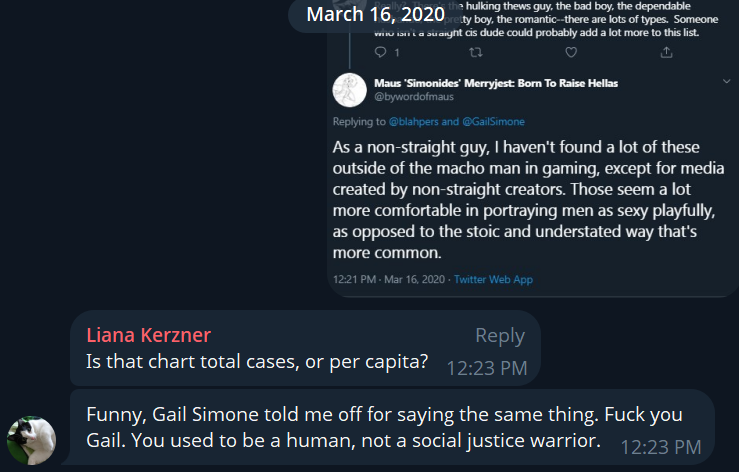
Kerzner stated that Simone had “told her off” over the comment. I did not ask where or how this exchange had occurred. It was not visible on Twitter at the time, and Kerzner had not mentioned such an interaction during earlier discussions of Simone, despite her usual tendency to recount conflicts close to when they occurred. I assumed, at the time, that this was a recent development.
In retrospect, and based on the evidentiary record available to me, I am uncertain whether the exchange occurred as described, or whether it occurred at all.
Following this statement, Kerzner speculated about Simone’s mental health. Over time, I observed a recurring rhetorical pattern in Kerzner’s private communications: when expressing hostility toward an individual, she frequently employed language framing that individual as mentally unstable, including phrases such as “profoundly mentally ill.” She used similar language in reference to Simone in a conversation involving a third party.
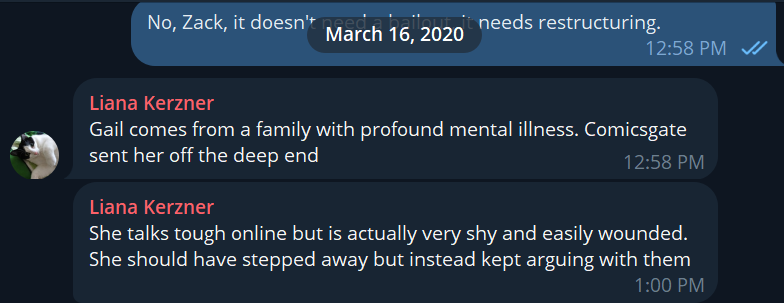
I was not an uninvolved observer in these conversations. At times, I agreed with Kerzner’s assessments, having extended her a level of trust that later proved misplaced.
Kerzner also expressed dissatisfaction regarding how her fictional namesake’s relationships developed within Secret Six.
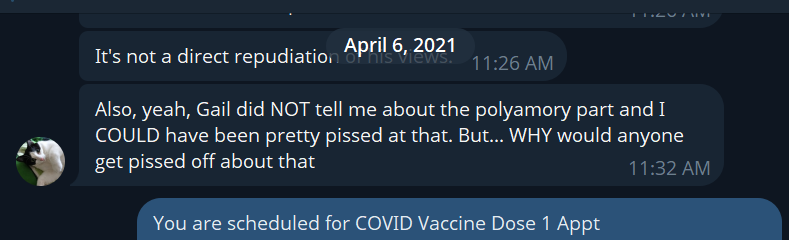
While this concerned a fictional character, it is relevant context. In videos following Kerzner’s later falling-out with Poppy Diabolique—an event that has remained largely unaddressed publicly—Kerzner repeatedly expressed disapproval of polyamorous relationships. She later attempted to publicly shame my husband and me for our non-monogamous relationship. Taken together, these statements suggest that Kerzner may hold more restrictive views regarding relationship structures than her public image would indicate. In that context, it is reasonable to consider whether Simone writing Kerzner’s namesake into a polyamorous relationship may have contributed to unspoken resentment.

Over time, I came to question Kerzner’s repeated claims that she speaks openly, directly, and promptly when conflicts arise. Based on my experiences, this appeared to occur primarily when the other individual held less social power or had limited professional utility to her. When that was not the case, Kerzner appeared to allow resentment to accumulate until an opportunity arose for a decisive rupture, which could then be narrated as entirely justified, and the other party always at fault.
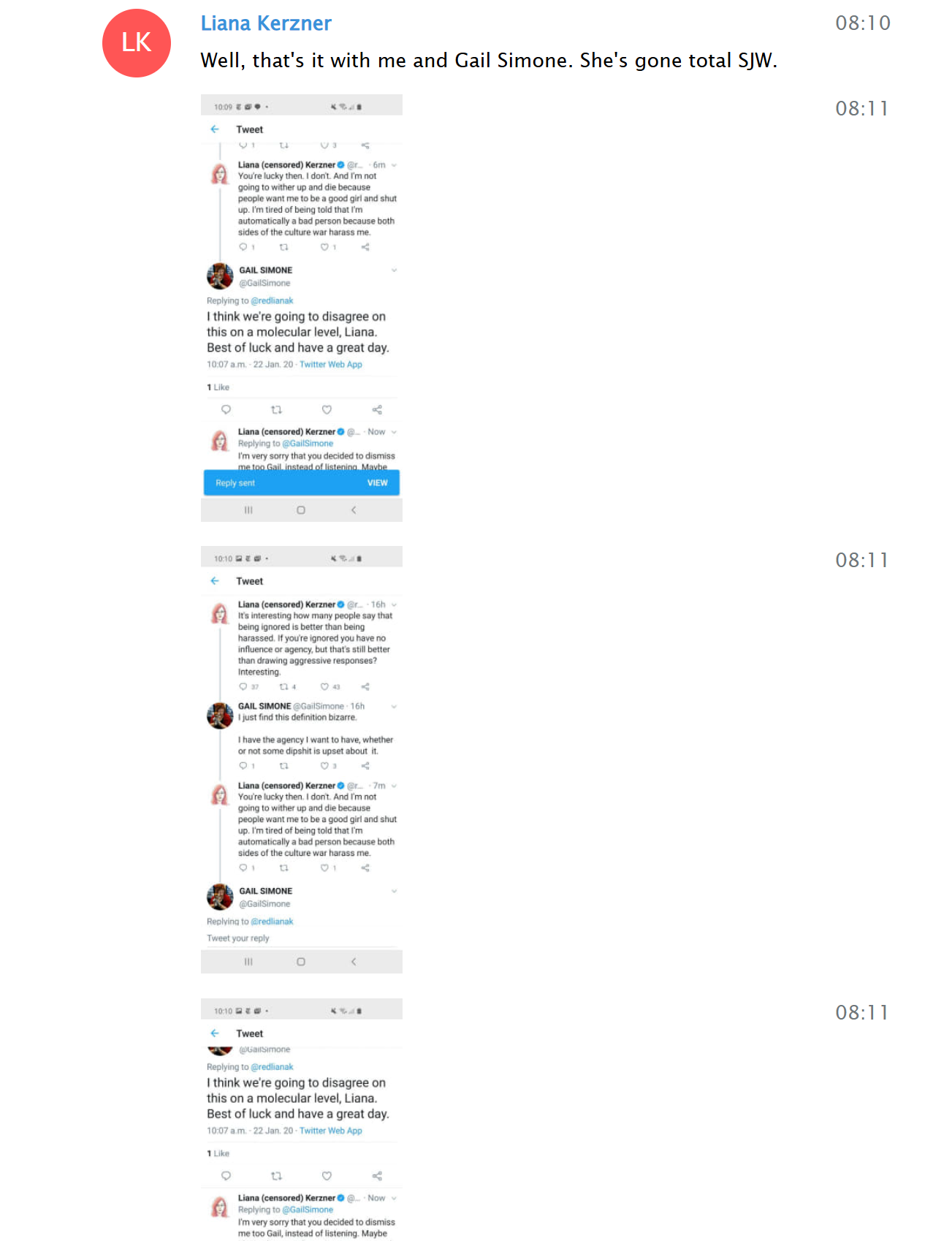
The exchange followed a public Twitter interaction in which Simone responded to one of Kerzner’s tweets.


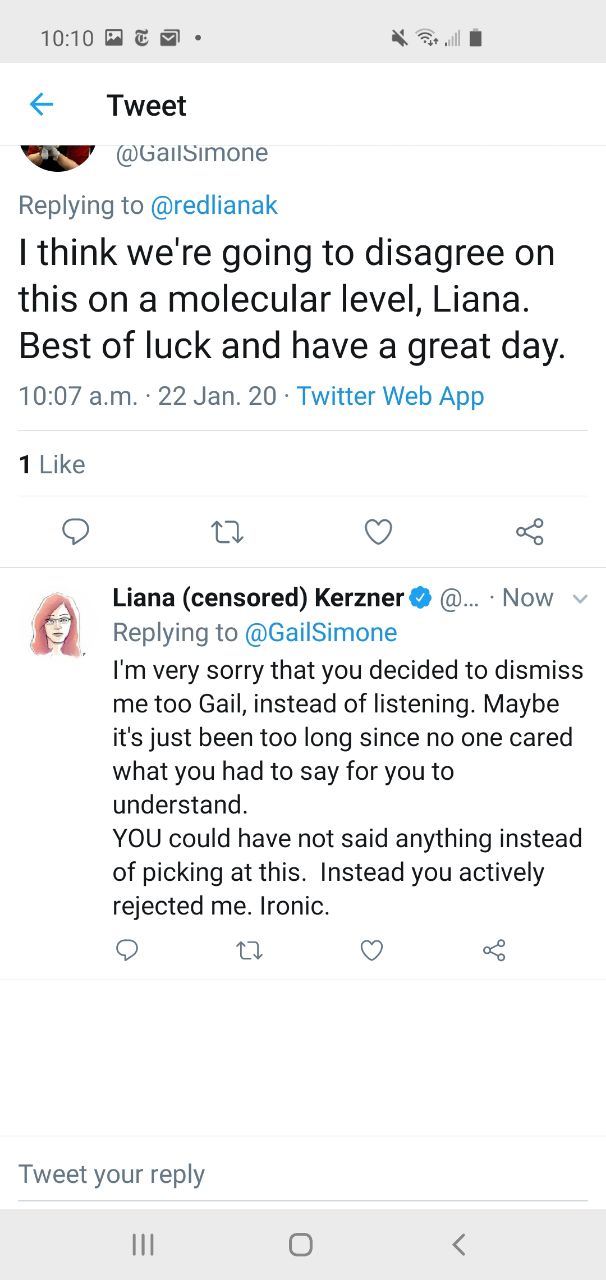
After Kerzner asserted that Simone had dismissed her, the conversation moved into direct messages. Kerzner sent me screenshots of the exchange as it progressed, accompanied by commentary that was largely negative in tone, at one point comparing Simone to a twelve-year-old.
I found the exchange confusing and noted this explicitly, asking whether there was an unspoken issue underlying the disagreement.
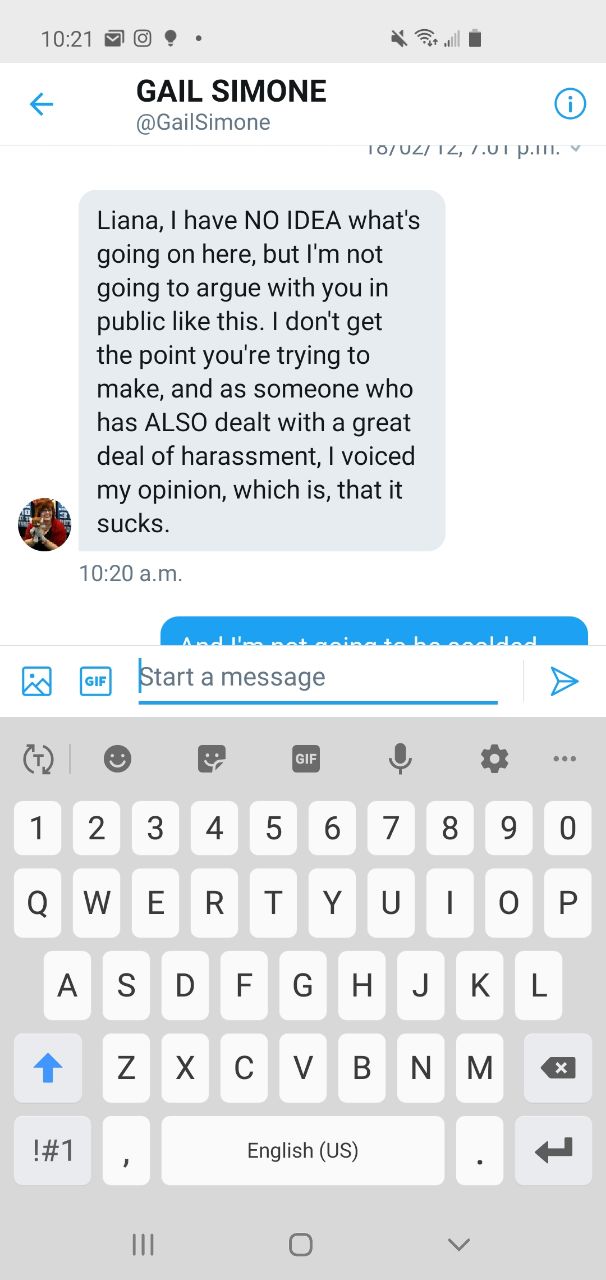


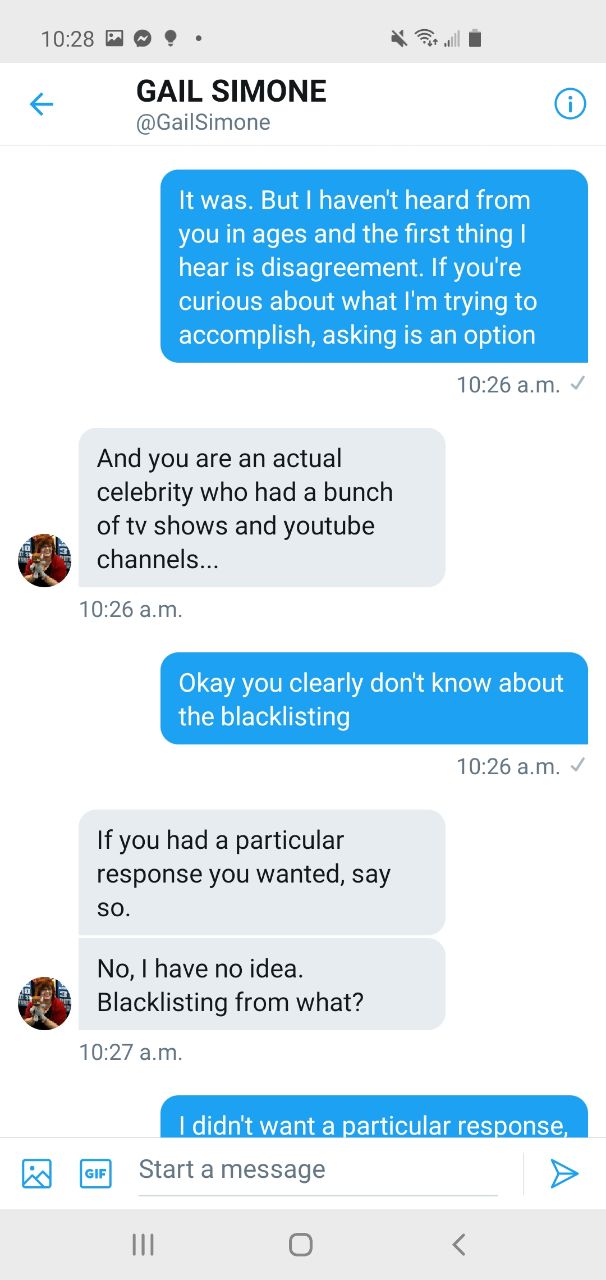

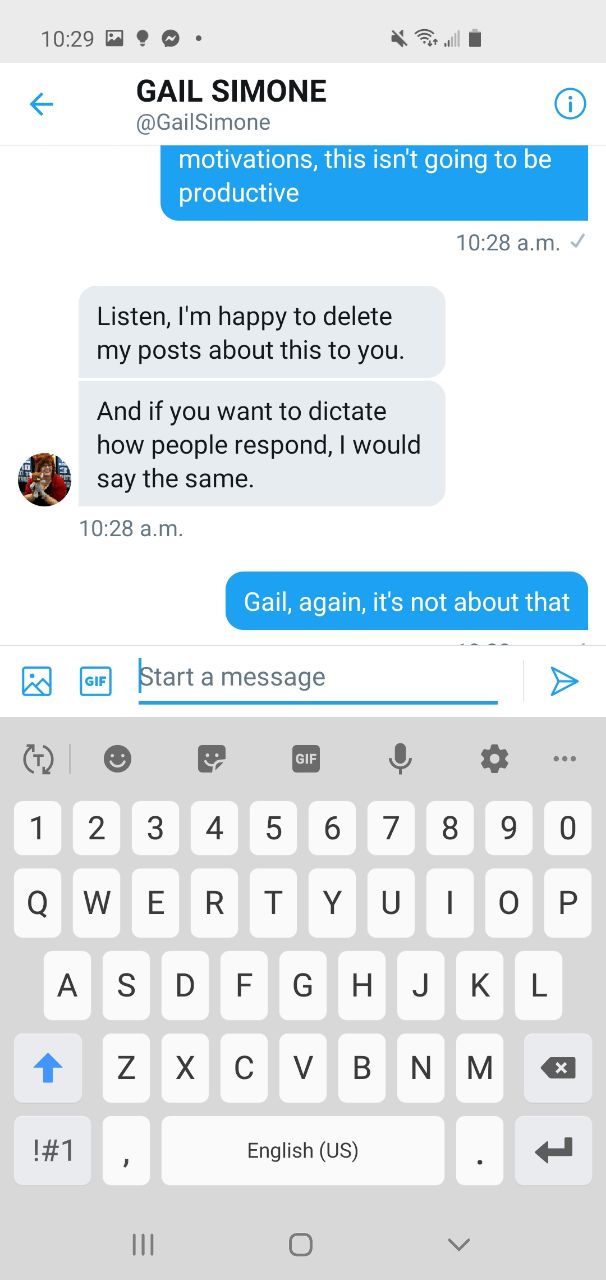
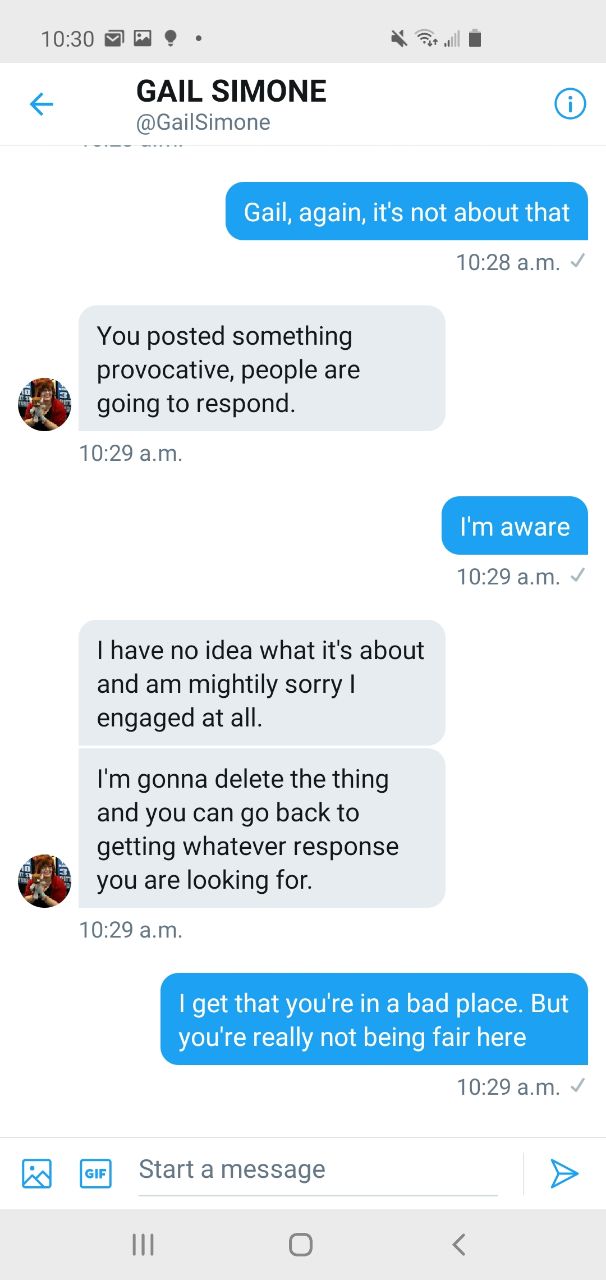
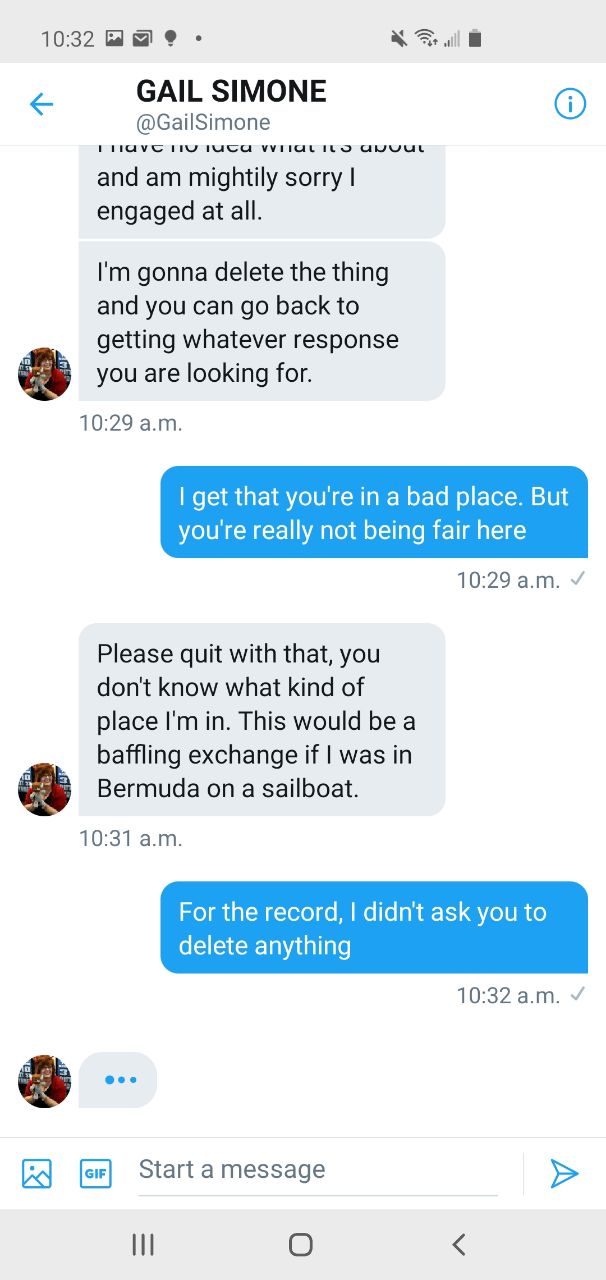
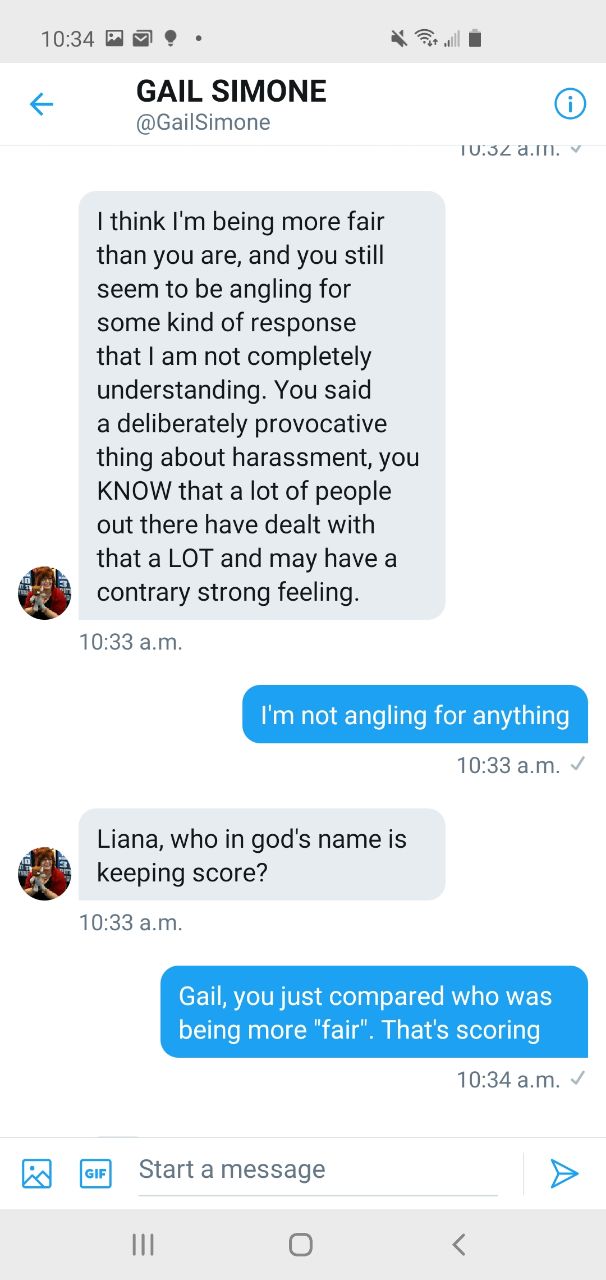
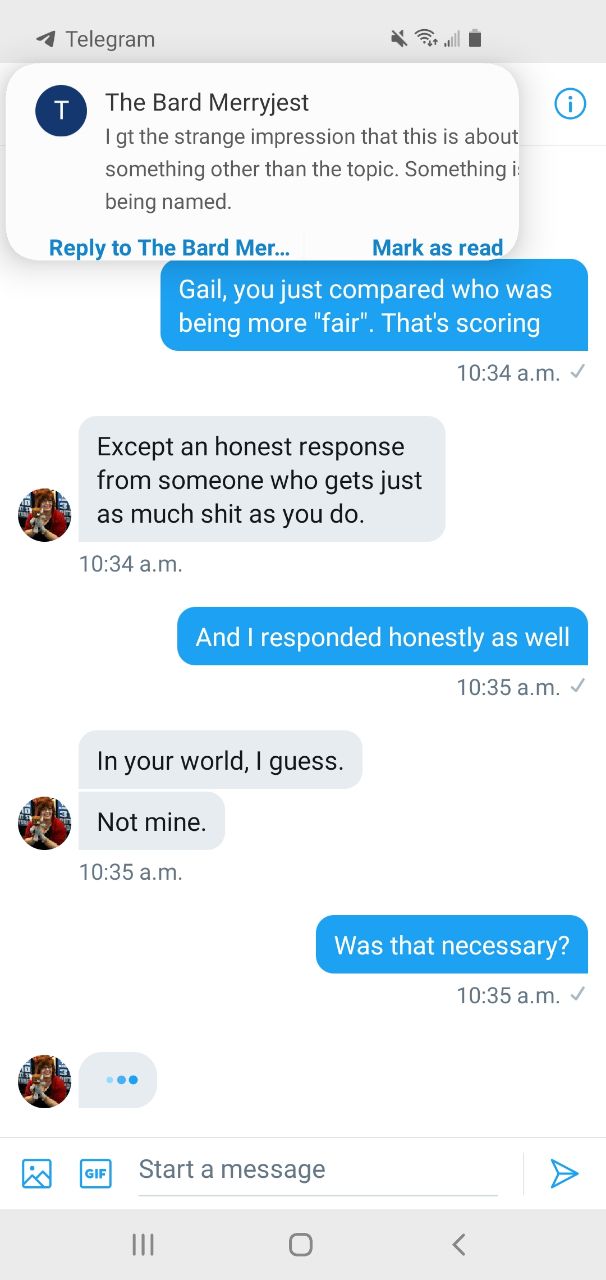


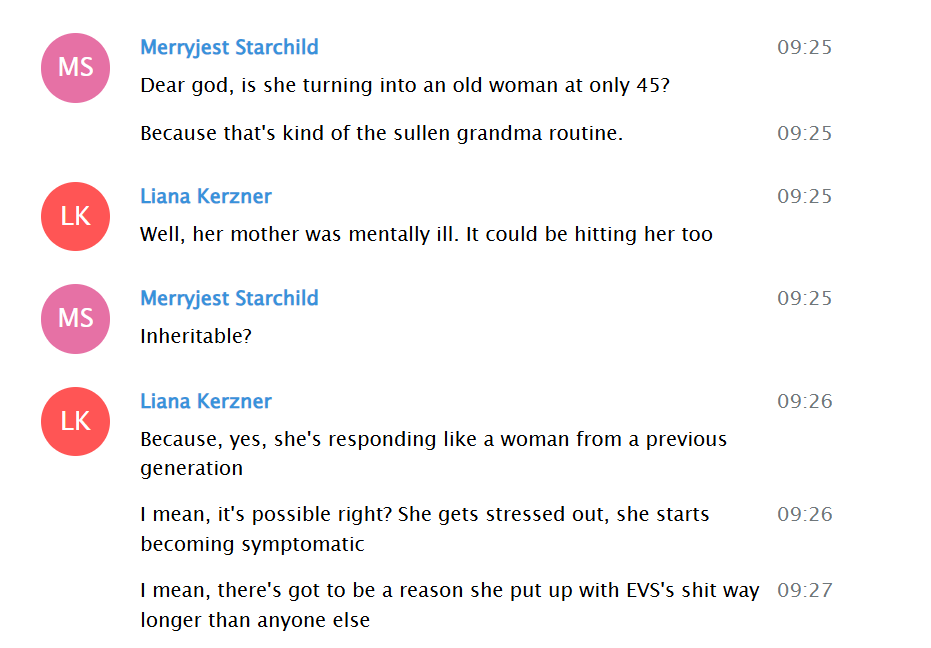
Kerzner did not address that question directly. Instead, she speculated about Simone’s motivations, raising possibilities ranging from professional dissatisfaction to references to Simone’s mother’s mental health.
Kerzner routinely states at the beginning of her show that she is not a therapist and is not qualified to diagnose mental health conditions. Nevertheless, in private and in public conversations, she frequently engages in speculative mental-health framing of individuals with whom she is in conflict.
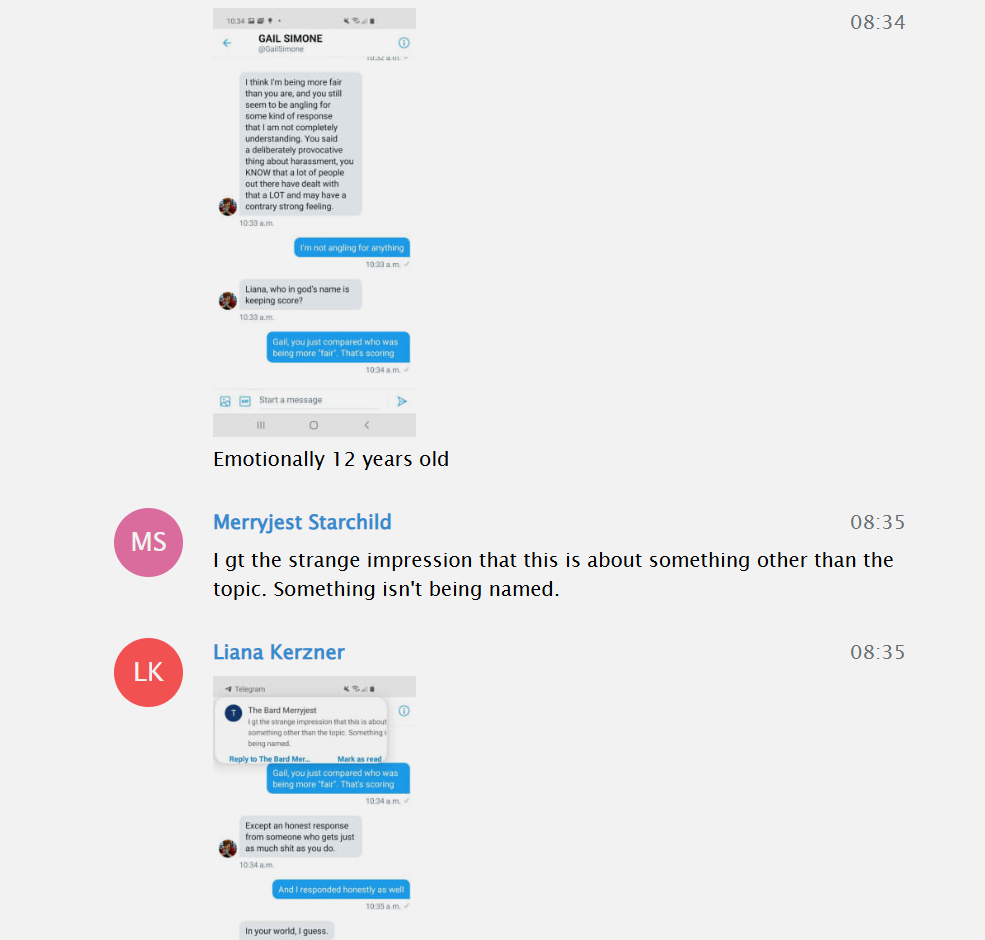
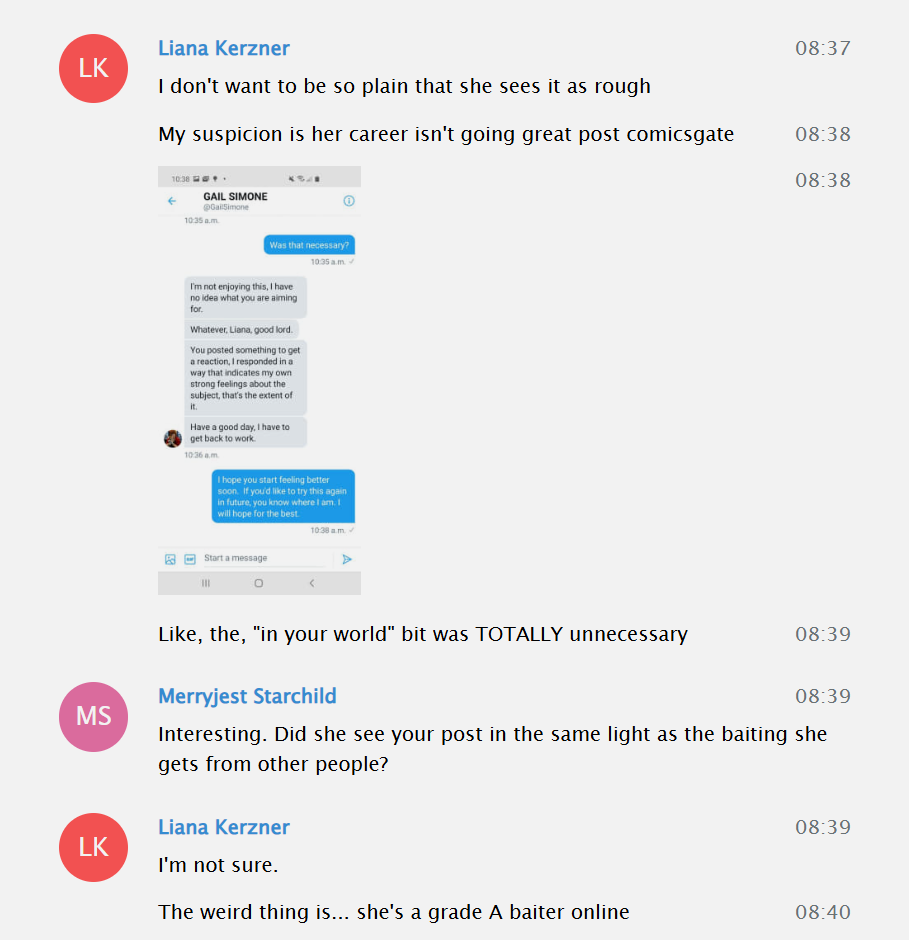


The exchange was unsettling, particularly because it appeared to escalate rapidly and left little room for resolution. From my perspective, Kerzner’s argumentative framing carried implications that were not explicitly stated but made disagreement functionally impossible. Short of full agreement, no response from Simone appeared likely to de-escalate the situation nor salvage the relationship. This, now I realize, was most likely by design.
Simone disengaged from the exchange.
At the time, I attributed much of my confusion to my limited knowledge of the prior relationship between Kerzner and Simone. In hindsight, it appears likely that unresolved grievances existed prior to this exchange. Despite Kerzner’s public assertions that she speaks plainly and promptly, the record suggests that objections may have gone unexpressed for an extended period.
As my husband Asher has often said: what Liana Kerzner does not say can be as consequential as what she does.
I later discovered additional context that materially alters the interpretation of the January 22 exchange. Two years earlier, on January 20, 2020, Kerzner had already raised the same issue publicly with Simone on Twitter. (EDIT: The original text had me making an error with 'days' instead of 'years', but the screenshotted evidence shows what my error was in typing, which is also evident when I bring up the two year gap in one of the paragraphs below.)

Notably, despite receiving fifty-three responses to the thread, Kerzner engaged in extended back-and-forth primarily with Simone.
On January 22nd 2022, Kerzner posted again using a rhetorical format that has since become familiar in her public communications, often relying on strategic vagueness. Of the fifty-three original responses, only seven indicated a desire to be ignored. Excluding the replies involving Kerzner, Simone, and the one other respondent, the majority of commenters did not support being ignored. Viewed in hindsight, it appears plausible that the later exchange functioned as an attempt to provoke a more definitive confrontation with Simone after her indicated opposition to the framing.
Two years later, Kerzner claimed that Simone had turned her into “public enemy number one,” despite the absence of any public denunciation, commentary, or further interaction by Simone. To my knowledge, Simone did not reference Kerzner publicly again after their twitter exchange.

I have not previously disclosed these materials. However, Kerzner herself discussed this matter in a semi-public venue.


In these messages to her Discord server of approximately one hundred paying patrons, Kerzner characterized Simone as having “gone nuts” and as facilitating bullying against her. This was not a private conversation among close friends, but a paid community under Kerzner’s control.
This aligns with a broader pattern I observed across multiple incidents: Kerzner would make reputationally damaging statements about individuals to semi-public audiences she controlled, while supplementing those statements through private communications that included additional personal or speculative information. There is no public record of Gail Simone discussing her mother’s mental health, just as there is no public record of other individuals Kerzner has discussed— such as Emily Schooley— disclosing similar information themselves.
Once animosity develops, Kerzner does not treat prior communications as confidential. In my assessment, the only effective way to counteract this pattern is to document it transparently and with primary evidence.
Kerzner’s audience appears to have received a materially incomplete or misleading account of events, which they appear to have accepted without challenge. Through these communications, a well-established comics creator was framed as a bully to an audience composed largely of fans and clients. Kerzner’s Discord server functions as a paid platform, not a private social circle.
Given Kerzner’s frequent references to legal action in other contexts, it is reasonable to assume she understands the potential risks associated with such conduct.
As an addendum, Kerzner may argue that she was referring to a different exchange with Gail Simone. Should she advance that claim, the evidentiary record does not support it.
In the screenshot in which Kerzner asserts that I “threw Gail Simone going nuts in her face,” the reference is to the final set of interactions Kerzner and I had while she was simultaneously engaged in what she herself characterized as the “Very Ugly Fight” with Asher.
At one point, I mentioned that what I saw reminded me precisely of her exchange with Gail Simone, for the aforementioned reasons. Kerzner has portrayed me to others as abusive and insulting to her during that exchange. This was not so. I was, in fact, greatly saddened by her behavior.


My comparison to her argument with Simone was made for a reason. In both instances, the same structural pattern was present: escalating hostility, attribution of mental instability to the other party, refusal to engage with the substance of the criticism, and an insistence on Kerzner’s interpretation of events as the only valid one.
The critical difference between the two situations is not the pattern of conduct, but the outcome. Gail Simone disengaged once it became clear that the interaction was no longer reciprocal or resolvable. Asher, by contrast, sought to preserve the relationship, and continued engaging in good faith. In doing so, he remained exposed to a level of emotional cruelty that I witnessed directly and found deeply disturbing.
That incident will be addressed in detail in the relevant section. This reference is included here solely to clarify the temporal and contextual meaning of Kerzner’s claim, and to preempt any suggestion that she was referring to some other, undocumented interaction.