YEAR ONE: 2022
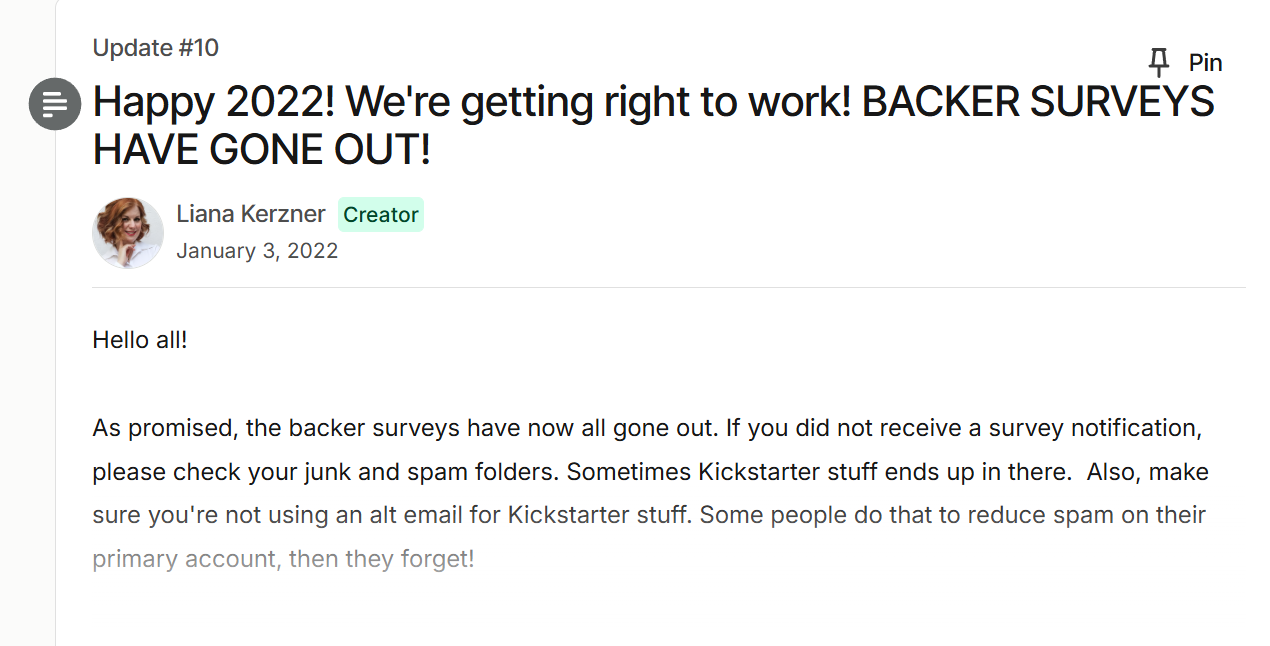
Our first priority after the campaign’s conclusion was to distribute and collect backer surveys. These were essential for gathering input from supporters across various tiers — from those contributing quest ideas to those who had pledged for custom character or pet NPCs.
Liana was responsible for coordinating with the backers at the quest-writing level. She scheduled and conducted meetings to discuss how their proposed characters and storylines could be integrated into the game’s lore and narrative framework. I participated in some of these sessions, particularly where implementation or integration questions arose. However, many of the meetings were conducted one-on-one between Liana and the individual backer.
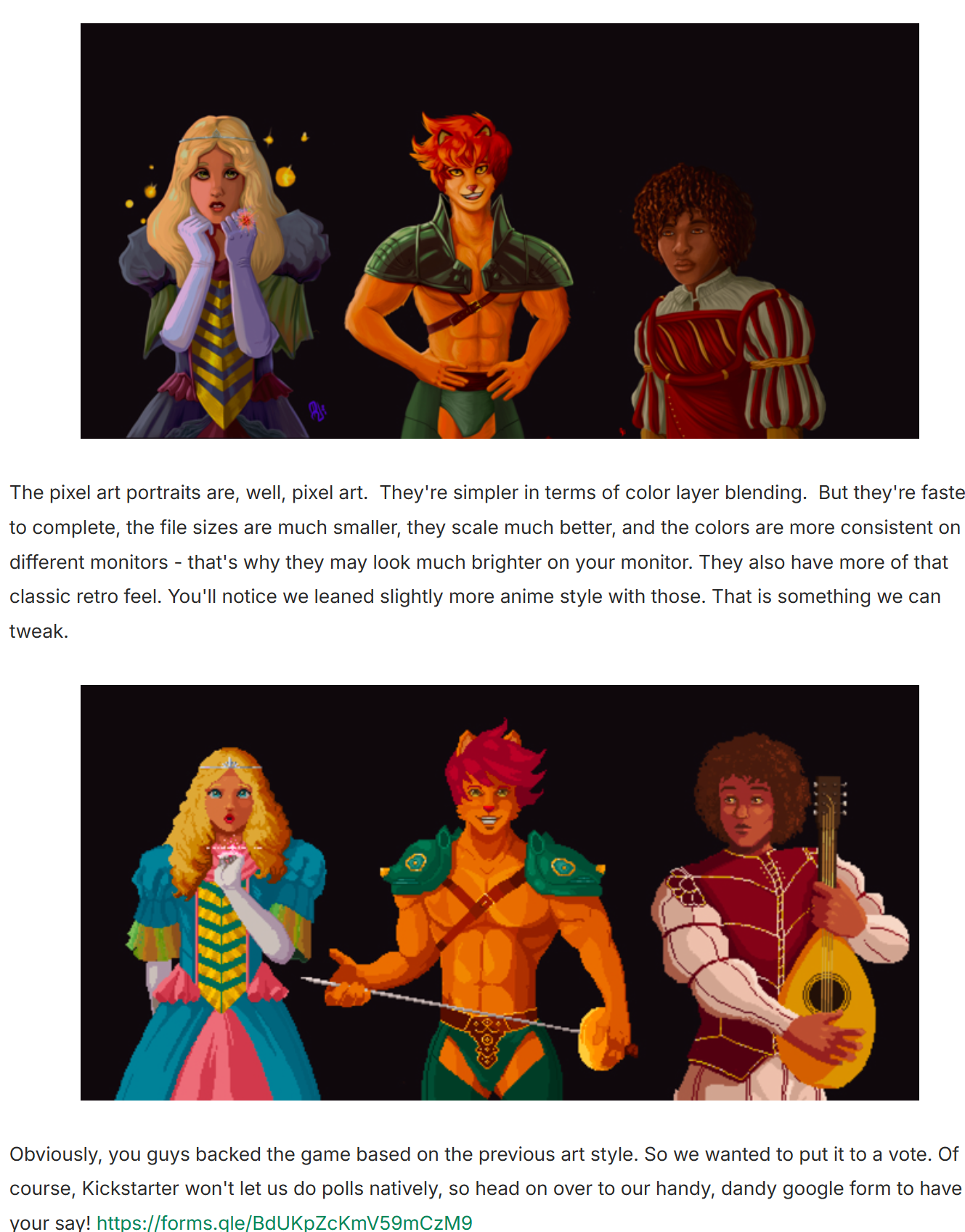
On the design front, our initial focus was establishing a unified aesthetic for the game. We adopted a pixel-art style as the foundation for all visual elements. A backer poll conducted in March confirmed this direction, with respondents expressing a clear preference for a fully pixel-art presentation over a hybrid approach that would have included raster portraits.

Around March 19, 2022, Liana introduced Song Eretson, one of her Liana Kares clients, as a potential volunteer to help create the backer NPCs. I will cover the full context and implications of this decision in the claims section later in this document.
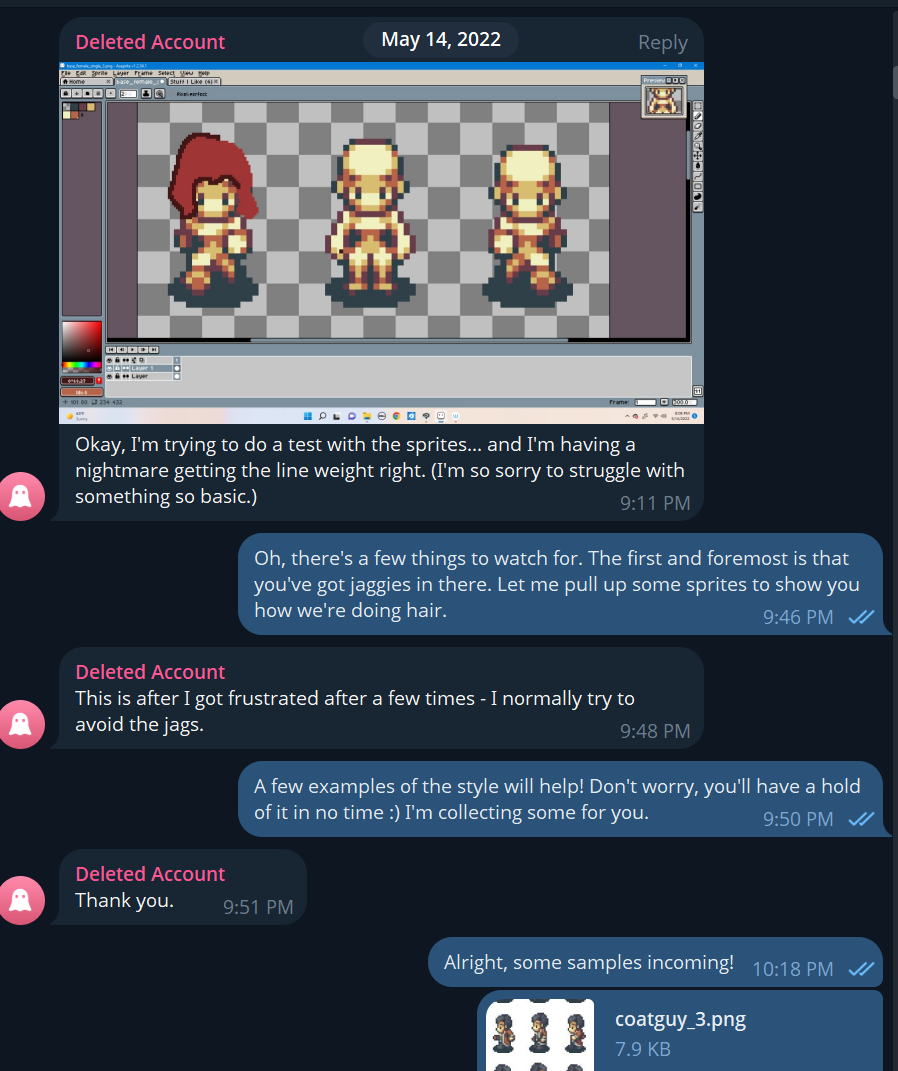
Understandably, Song felt overwhelmed by the size of the task and the idea of building each NPC from scratch.
While I looked for possible solutions to make the process easier, a workable method did not come up until later.
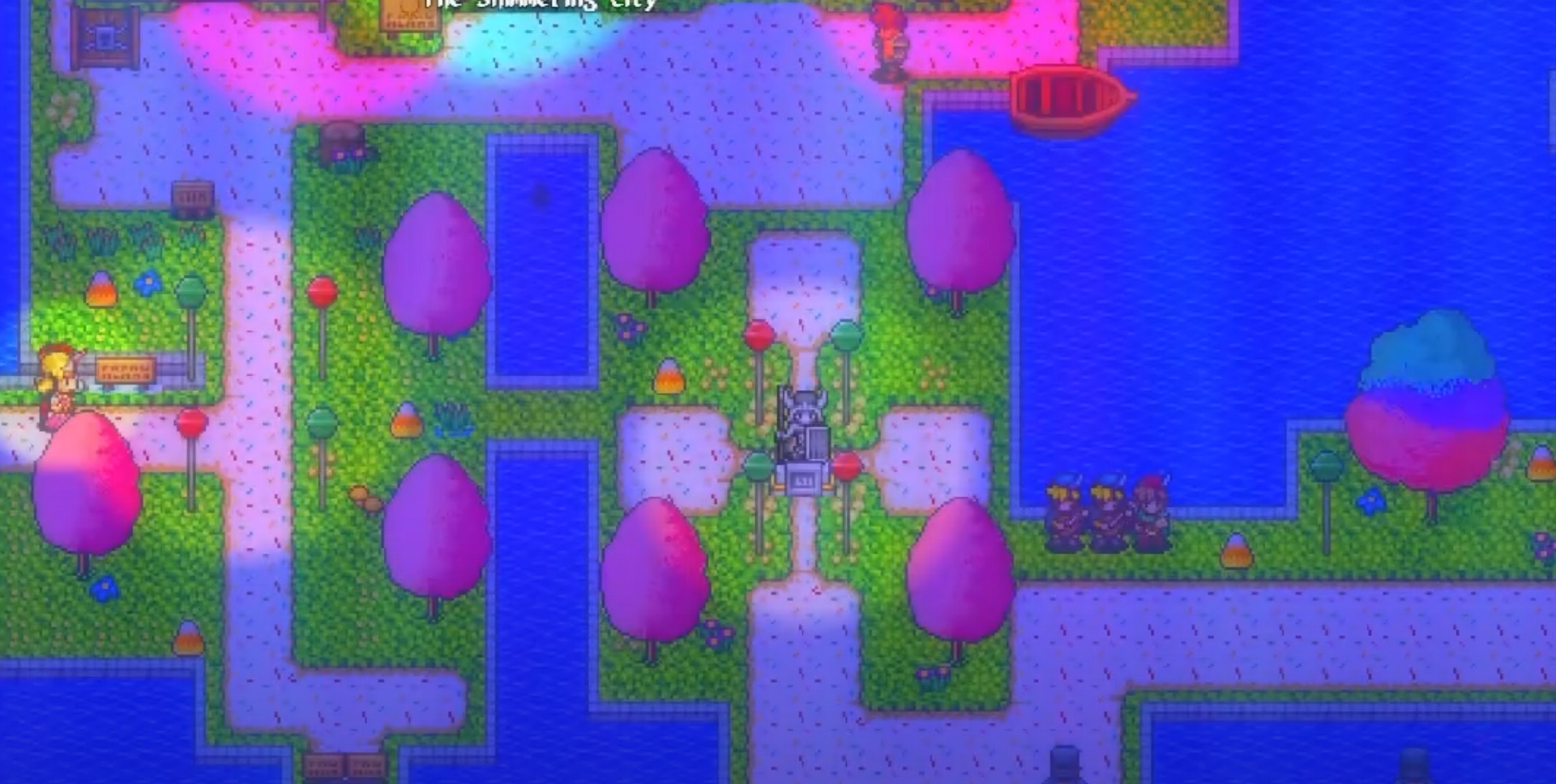
At that time, my immediate priorities included finishing the combat sprite sheets for Sparklepony and Boi, adding spell mechanics to the system, and continuing map development. The maps I finished by then included the introduction cutscenes, the Candy Apple Forest, the Hut by the River, and two key areas of the Shimmering City: Main Street and Other Street.
The overworld map was still a work in progress, slowly expanding as each major area was completed.
In the Shimmering City, I had finished the building layouts and started customizing their exteriors into various dessert-themed storefronts and façades to match the game’s playful style.
It's also important to mention that Song was the second volunteer on the project. The first was Jess, who joined earlier to assist with environmental design and map creation. Before she left, Jess completed one full map: the Troll Farm.
Jess was among the first volunteers to join the project, contributing to map design during the pre-development phase. She completed one map, known as the troll farm, before her participation concluded. According to Liana, this decision followed a conflict between them, which Liana attributed to Jess’s discomfort with certain communications. As I was not directly involved in these interactions and received only partial information from Liana, my understanding is limited to her perspective.
Liana reported that Jess had violated a non-disclosure agreement by sharing project details with her parents, particularly her mother. Jess resided with her mother and, according to Liana, relied on her for emotional support during team discussions. Liana also mentioned that Jess’s mother was a special education teacher and suggested that Jess might be neurodivergent. At that time, Liana speculated that Jess could be on the autism spectrum, though I did not pursue further details.
Subsequently, Jess publicly disclosed a formal diagnosis of autism. This information, if accurate, provides additional context for her behavior and her reliance on parental support. It also raises ethical considerations regarding the handling of her situation. Regardless of intent, I found Liana’s reported characterizations of Jess and her mother to be notably severe, particularly in light of her acknowledgment of possible neurodivergence.
In a June 2025 Patreon video, Kerzner said that a mental health professional advised her she was 'not qualified to work with autistic individuals' — a remark she disputed, suggesting the professional was simply asserting authority. While I am not privy to the full context of that exchange, the remark is noteworthy given her history of challenging interactions with individuals who later identified as autistic.
For legal clarity, it should also be noted that while Liana later accused Jess of breaching an NDA, a related issue arises from Liana’s own public comments. In her Discord server, she discussed a separate project in which both she and I were involved and for which we signed formal NDAs. As I remain bound by that agreement, I cannot confirm or deny the specifics she disclosed. However,based on my understanding of the NDA and the types of content typically governed by it, I believe her public comments may have involved information ordinarily understood as confidential.
These remarks were made in a paid-access server with over 100 members, including patrons and industry professionals. The inconsistency in handling confidentiality appears to be a recurring concern in Liana’s approach to boundaries and disclosure.
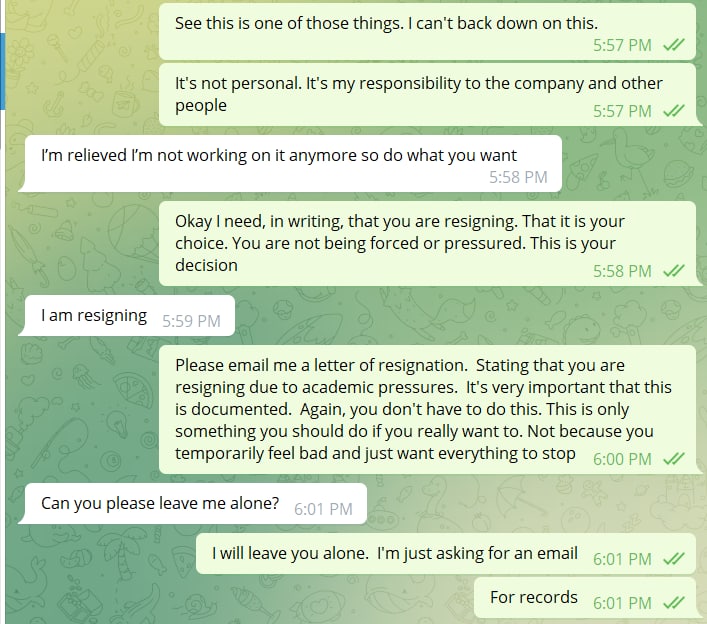
In the following screenshots, Kerzner's messages are in green, Jess' are in white.
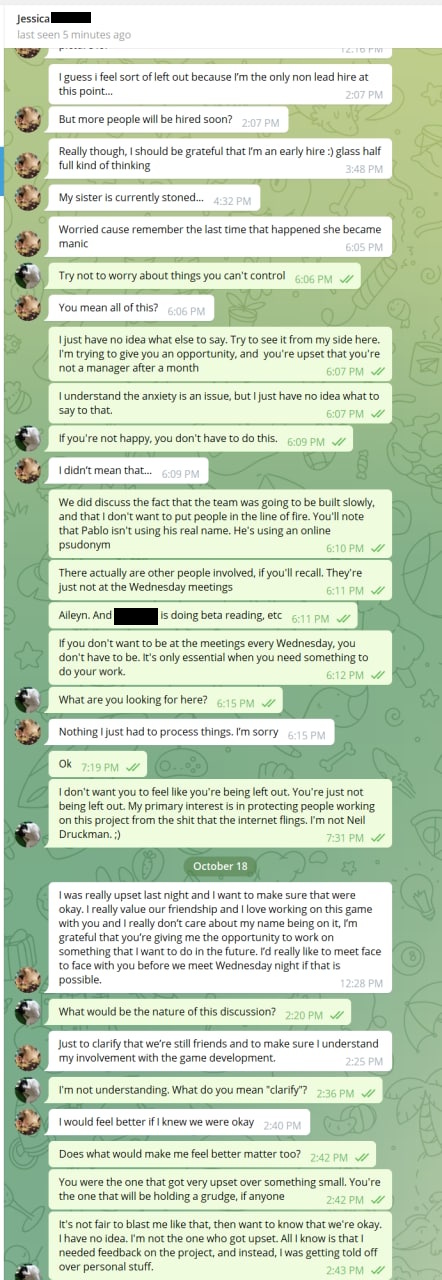
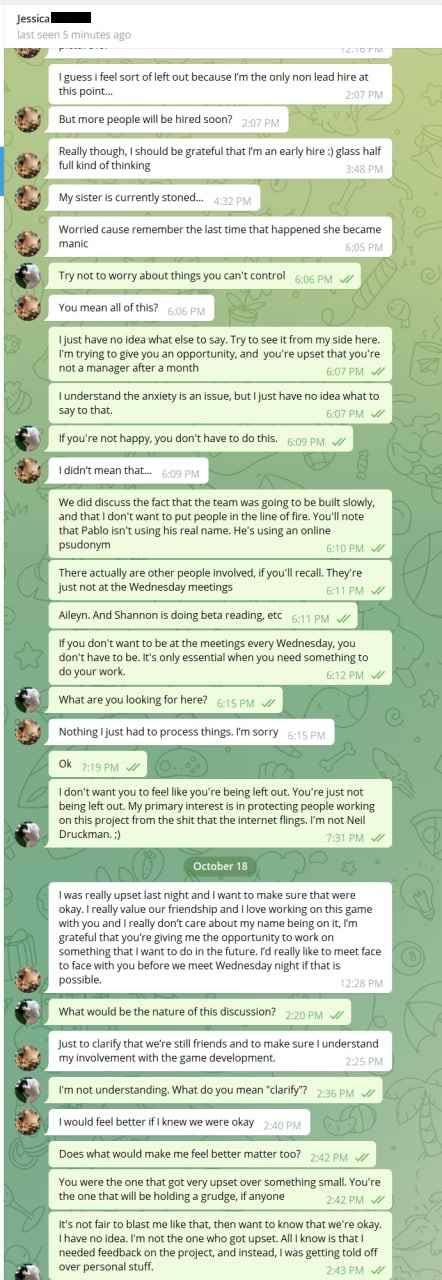


I contacted [Redacted] to verify whether they had engaged in any beta reading for the project beyond the materials provided in the demo or shared through the development chat. They confirmed that they had not participated further.
Regarding Aileyn, who has been an active member of Liana’s private server and appears to support the environment established there, I chose not to seek confirmation of her involvement. This decision was based on concerns about impartiality. Based on her subsequent behavior following the cancellation, which will be discussed in greater detail later in this dossier, I have reason to question the reliability of any confirmation that could be obtained from her.
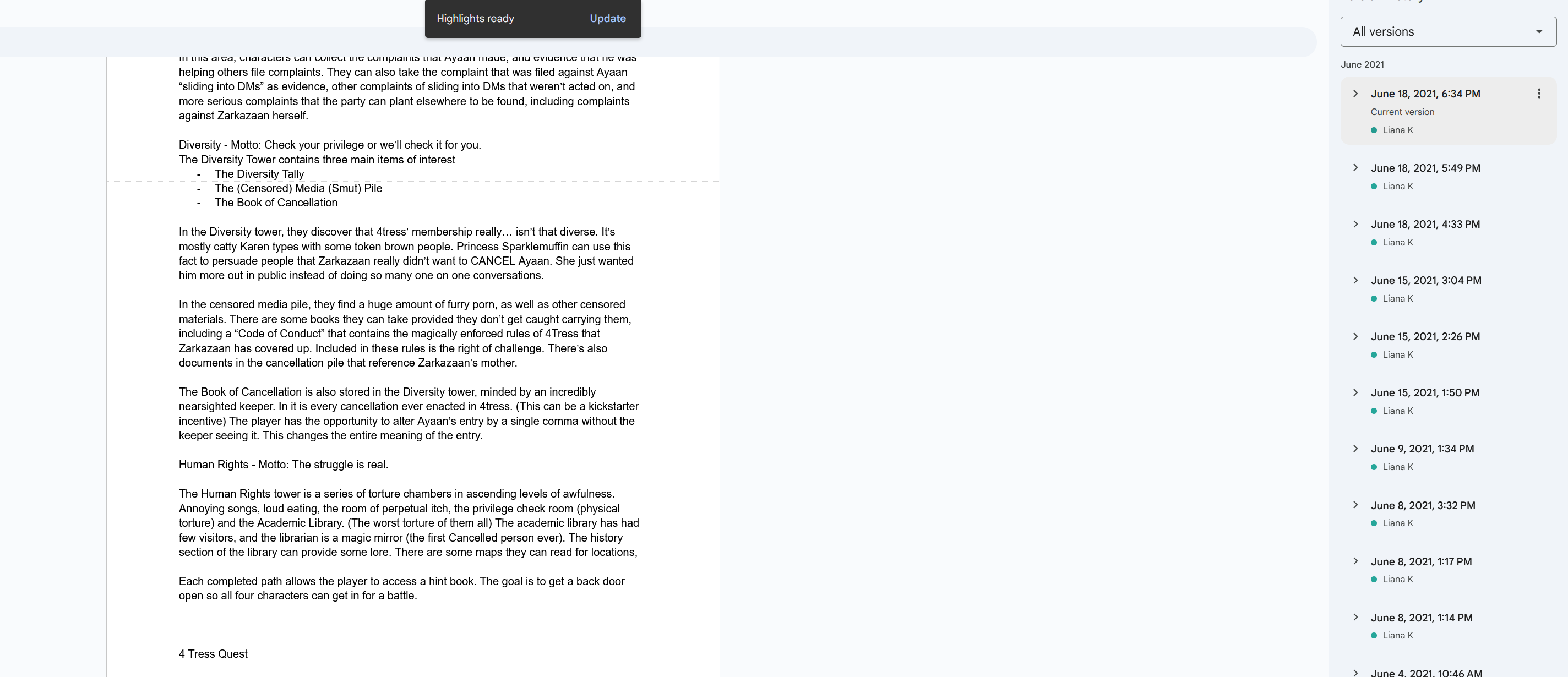
From a writing perspective, development of the main game script reached an impasse when the party arrived at 4Tress, the central quest location for the vertical slice demo. The most recent update to this section was completed by Liana on June 18, 2021.
It is important to note that Liana remained active during this period; her primary focus shifted to collaborating with backers who had submitted quest and NPC concepts, ensuring their ideas were incorporated into the broader game world.
Most of the quests contributed by backers were intended for the full release of the game rather than the demo. Only a limited number, specifically those set in the Shimmering City and its surrounding areas, were developed for inclusion in the vertical slice.
At that point in development, 4Tress was designed to function as the dramatic climax of the demo. Although Liana had established general concepts for each section of the location, she encountered difficulties in creating the corresponding puzzle mechanics.
As of that time, no finalized scripts or complete quest sequences for 4Tress had been produced by her.
Throughout May and June, I implemented a few more spells into the system, but turned my attention towards another system that would help flesh out the world and make it a more natural, living space. As noted in the update video, and independent from any plugins, I created a system that created day/night cycle, complete with hours, days of the weeks, months, and seasons. This system could speed up in the main map to symbolize traveling time, slow down in the main maps, or stop completely for specific scenes. On top of this, I layered a weather system that created appropriate weather depending on the season: Spring, had a mixture of light snow and sunshine, while Summer had sunshine and rain showers. Fall came with fog and showers, and winter was characterized by snow storms.
But that wasn't all- aside from creating the obvious terrain and map flags so that we didn't have weather patterns accidentally triggering indoors, I also created some zone-dependent flags, so that snow would never trigger if you were travelling in the South by Cat's Cradle, for example. And if you traveled all the way to the North, you'd get nothing but snow, snow, and snow.
At this point, there were also plans to include an NPC schedule feature that would let you see NPCs get around their day, to avoid the "Woman perpetually sweeping her front step" cliche. However, the pathfinding of characters as certain hours in the day hit created a perceptible slowdown and there was concern about the toll it could take in systems with lower specs when the player entered high-population areas, so it was abandoned for a simplified system. Shops still ran on schedules- except Ruchel's, because she never slept.
I finished Boy's combat animations, which were shown to the backers, and started working on Princess Sparklepony's. Leading up to August, I also turned my attention towards the game menus and tried to find a way to make them look more in-theme with the game. I leaned into the storybook format and created a storybook-style main menu for the game, and worked to incorporate the other menus following that design.
Following the comedic nature of the game, I gave each menu a title in the style of old compendiums, such as "Chapter Six: Being an accurate account of all the things people ask you to do. Constantly."
Which, of course, was the quest tracker. In retrospect this design, while having some amusement potential, ended up obfuscating things. No matter how clear I tried to be with the icons on each chapter, there would still be people who wouldn't quite grasp what each menu was- so I made a note to revisit this in a later update.
The reason there had been no activity in July was because work on the game was paused during that month, while I attended the Vocal Arts Festival in 2022. It was a month-long opera festival, where I took the roles of Gounod's Faust. Mozart's Idomeneo, and Fernand in Donizetti's La Favorita.
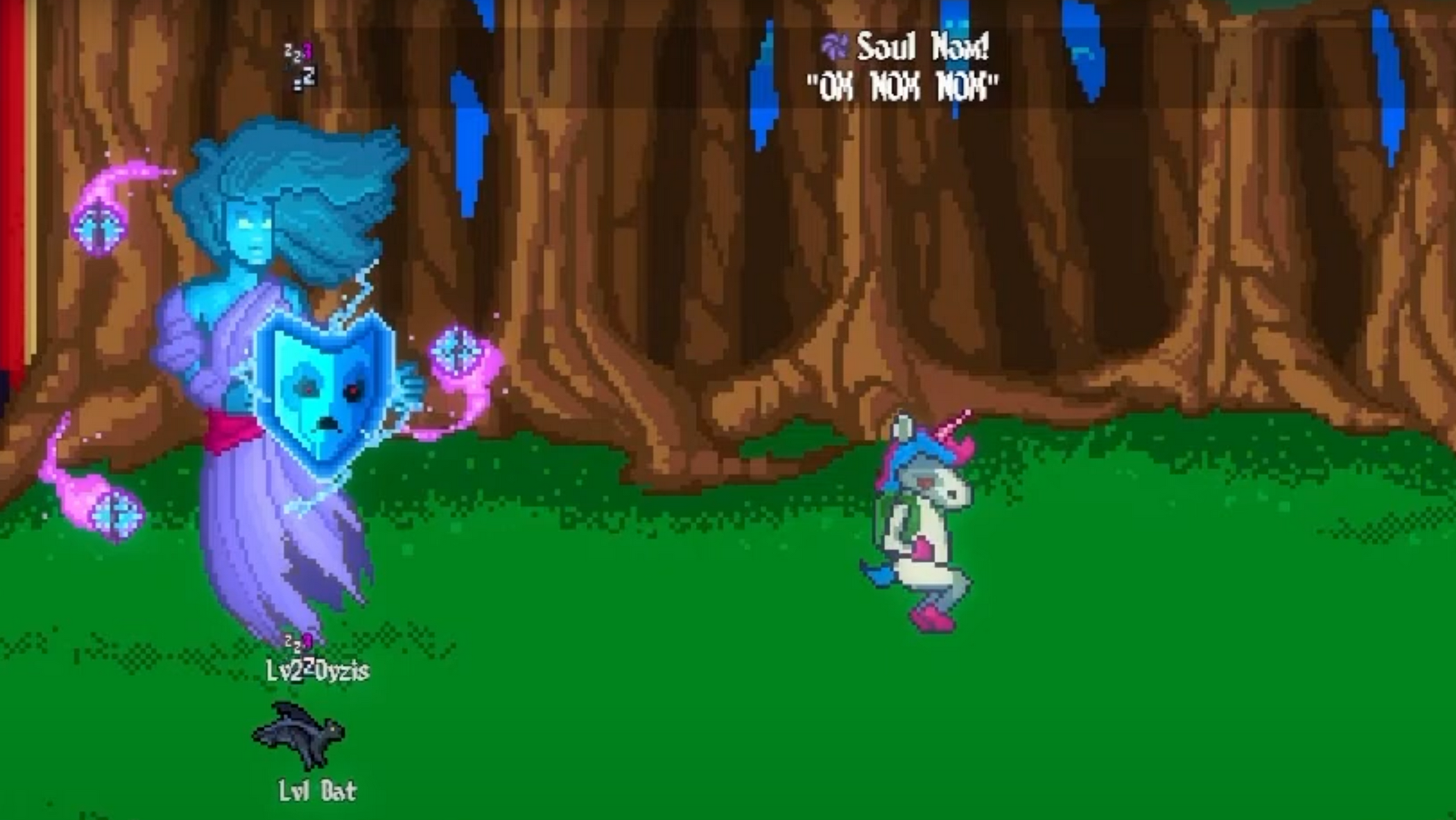
The Fall update on October 7th showed the finished Sparklepony battle sprite in action and also showed her Soul Eating power. Another system I incorporated into the game- she could essentially eat a portion of an enemy's soul (draining their MP while she was at it), and depending on the 'soul' type the enemy had, Sparklepony would create different types of poop and she could throw it at enemies. Bat Guano, for example, had a chance to silence your enemy while they gagged. Draining the Oyzis hurt your health, but it gave you Hot Topic Poop, which was dark and edgy and hurt the soul, so it would directly attack their MP instead of their health.
At this point, we also had a difficulty with the Shimmering City: we wanted to avoid extreme repetition in the building types. Some customization of the tileset went a long way towards that, but it also became apparent that the tileset had limitations. Our engine could only have so many tileset sheets loaded at any one point and no more than that. To achieve a truly unique look for our buildings, we needed to shift gears and expand into parallax mapping.
Having a parallax layer between the ground and the player for the buildings meant that I could create unique-looking pixel art that would be loaded as an image, anchored to relative coordinates so it could scroll appropriately with the camera. That process would take a bit, because the engine didn't handle the scrolling with pinpoint accuracy, and there was some drift, but it was the only viable option to have the varied look that we wanted. It would take a little while to fully implement, though.


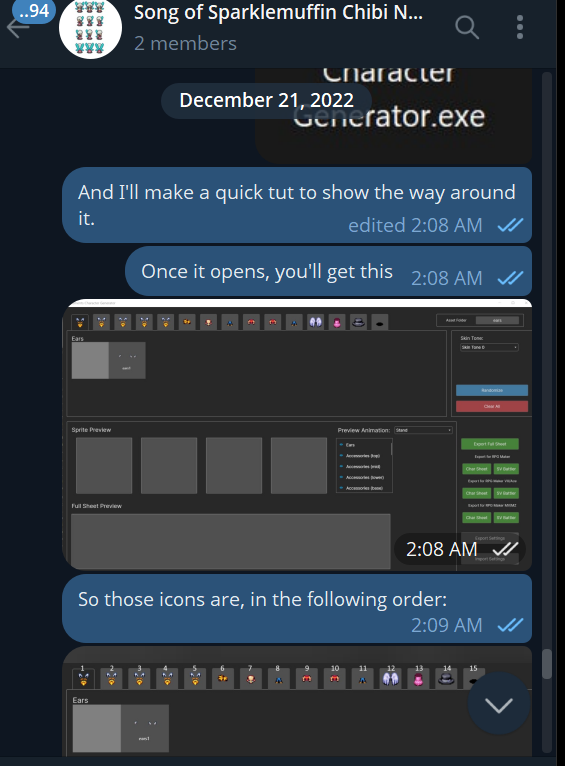
At this point, I also started working on a solution for Song so she could have an easier time of making the NPCs. Song reached out regularly with questions about pixel art style and things such as dithering, but I could see where she had difficulties, so I decided to work on something that would make NPC creation so much easier.
As a subscriber to Final Boss Blues, I already had access to his Time Elements character creator. However, the base sprites that came with that particular set had a completely different look from the ones we were using- the scale was also wrong and would have looked too small in comparison with the rest of the buildings.
But it gave me an idea.
I went into the code of the character generator and started changing things around. Pretty soon, I was able to get it to do what I wanted- but that was still just a minor part of it all.
You see... I needed the parts.
In order to have a working generator, I would need to create a template of body parts: two human head bases, two feline head bases, two canine head bases, a bovine head base for starters, four body types, in varying skin tones and fur colors, tail variants.
Then I had to create several items of clothing- each with its own color variation. Then, a layer for capes, wings, and other features, all following the standard walking spritesheet format.
It was a massive undertaking, but it had the potential of simplifying character creation by a LOT.
It'd be able to give Song a good enough start so she wouldn't have to worry about some of the fundamentals. Pixel art is its own beast, and I didn't really become as proficient with it as I am until I took a Udemy course in it during the Pandemic, which I got for $11 instead of their hundred-plus cost while they were running a special sale. The rest of my practice came from being an early Patreon backer of the Pixel Art Academy by Matej Jan, long before Song of Sparklemuffin was a project.
So, the task began. It was, as I said, a long and tedious process and the final version of the program wouldn't be ready until December.
So, the task began. It was, as I said, a long and tedious process and
the final version of the program wouldn't be ready until December.I
ended up making something along the lines of 301 different assets for
the creator. It isn't usual in game development for the development of
new tools to take longer than anticipated, but nevertheless in the long
term they facilitate things so much that they end up saving a lot of
time in the long-term.
You have to remember that I was the only artist. Animator. Engine implementer. Programmer... you get the gist. I
was doing four different but related jobs, and progress in one front
was still only one front.
I'd made a lot of headway
system-implementation wise, especially with the bespoke systems for
which we didn't really have any plugins that would suffice, and I'd
almost finished the combat sprites all of the playable characters that
were intended for the combat demo, as well as done a lot of the music
and sound design and environments.
However, If we were going to
get the backer NPCs into a production pipeline, we needed to give our
volunteer the tools necessary to expedite much of the tedious ground
work and allow her to move directly into customizing the sprites
At this point, Liana and I also started talking about the combat demo. We'd had a few meetings on the subject but no script had been started out for it. We were basically throwing ideas around.At this point she still hadn't finished fleshing out the 4Tress puzzles, and her idea was shifting towards making the combat demo have its own individual story that was separate from the vertical slice demo.
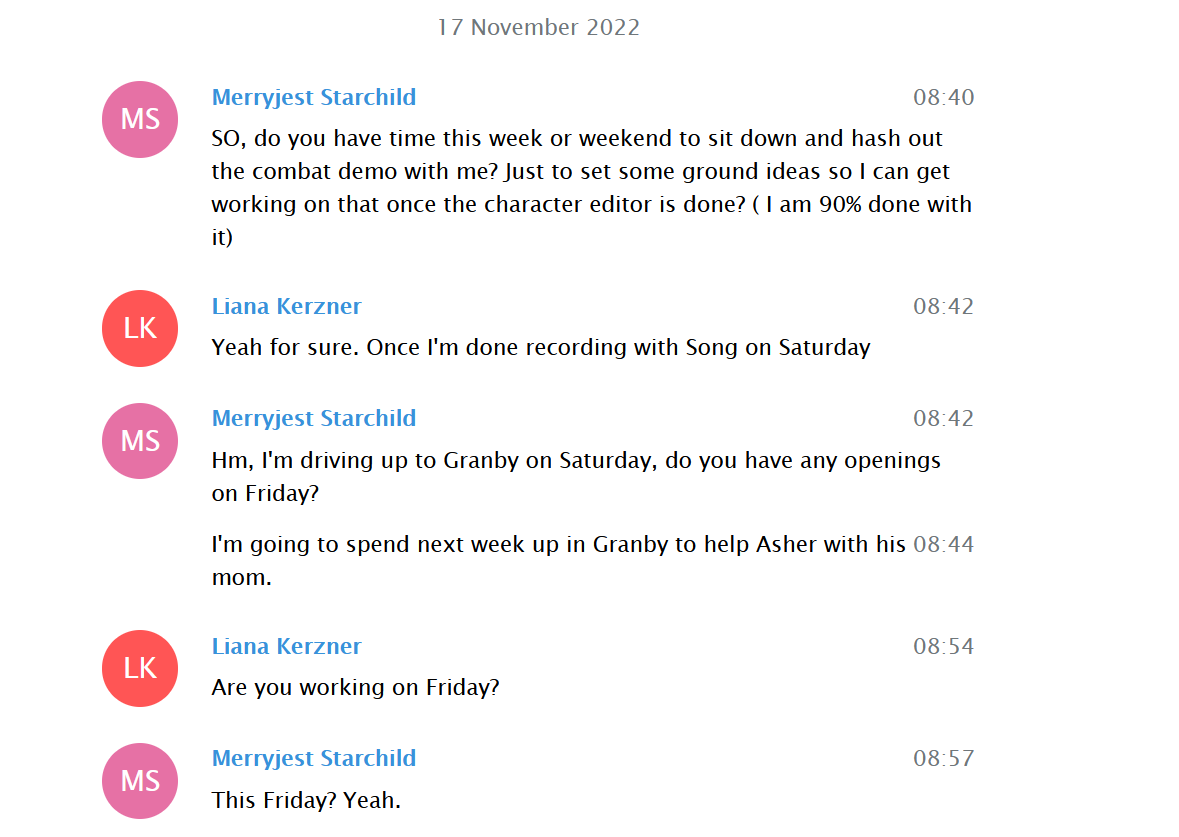
Just when it looked like I was going to be able to get generator finished and delivered to Song at the beginning of December, I got-
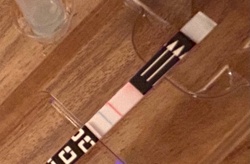
COVID/ I think I must have
spent ten of those fifteen days coughing my guts out, and my singing
voice took a hit, I wouldn't be able to sing for several MONTHS after
recovery.
By February, when we traveled to Arkansas for my friend
Captain Coloratura's wedding (which Liana attended, as well), my voice
was still extremely unsteady. I was also completely wiped out energy
wise.
I had to cancel several singing contracts, including all
holiday performances- if you're a classical musician, the winter
holidays are one of the big three times of the year where you get a
significant amount of cash flow. I wasn't able to get back to work and
finish the creator until right before the holidays, but I got it into
Song's hands and gave her a thorough walkthrough of how to use it, which
was pretty easy.
The holidays got into full swing, so we reconvened in January to post the next update and give backers an update with what had been done.
YEAR TWO